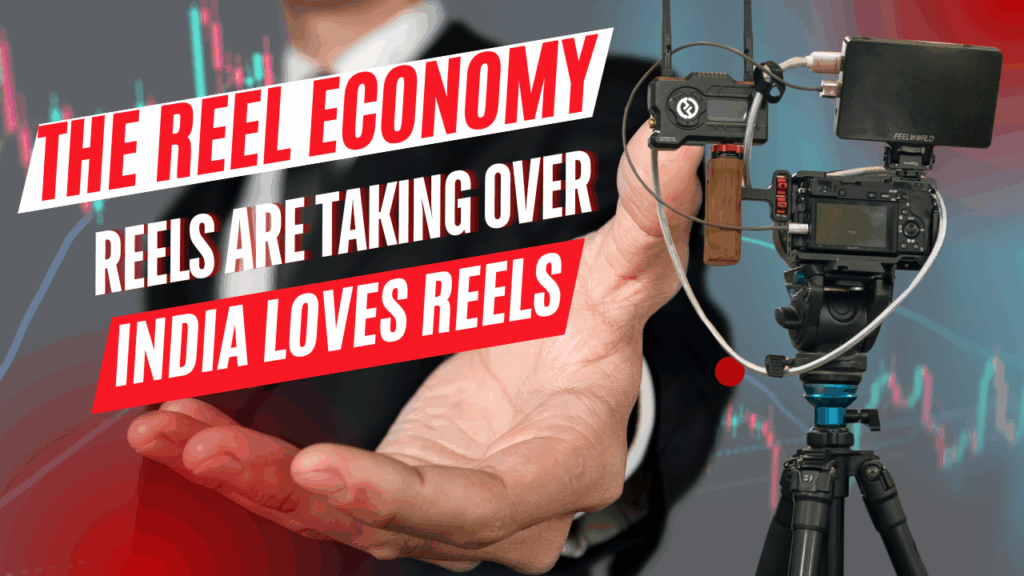
India is not stepping into the future of media slowly. It is scrolling into it, fifteen seconds at a time. The explosive rise of Instagram Reels and YouTube Shorts is not just a platform trend but a sign of a deeper transformation taking place across the country. This transformation is known as the Reel Economy, a system where short-form videos drive attention, trust, influence, and real economic outcomes. In India, the Reel Economy is not a temporary phase. It is becoming the backbone of how people discover brands, choose services, and form opinions.
The Reel Economy refers to an ecosystem where reels and short videos are no longer just content formats but economic drivers. These videos generate attention, convert emotion into trust, and influence decisions related to buying, booking, voting, and believing. In this economy, attention itself becomes a form of currency. Whoever earns attention consistently gains influence, and whoever gains influence gains power in the market.
Unlike traditional advertising, which interrupts people with forced messaging, the Reel Economy works through voluntary engagement. People choose to watch reels, save them, share them, and return to them. This choice creates a stronger psychological bond than any advertisement ever could. That is why reels feel personal, authentic, and trustworthy, especially in the Indian context.
Traditional media relied heavily on scale, budgets, and repetition. Television ads, newspaper promotions, and hoardings were designed for one-way communication. The Reel Economy flips this model entirely. It is creator-led instead of agency-led, emotional instead of informational, and conversational instead of declarative. Instead of telling people what to buy, reels allow people to feel why something matters. This shift has fundamentally changed persuasion in India.
India is uniquely positioned to dominate the Reel Economy because it has always been a storytelling civilisation. From folk tales and epics to songs and rituals, Indian culture has long relied on short, emotionally charged narratives. Reels are not foreign to Indian behaviour; they are simply a digital evolution of an ancient habit. A wedding reel today performs the same function as oral storytelling once did: preserving emotion, memory, and identity.
The rapid spread of mobile internet has further accelerated this shift. India largely skipped desktops and entered the internet age directly through smartphones. Affordable devices, low-cost data, and widespread connectivity have created a population that prefers watching over reading. In such an environment, short-form video becomes the most natural medium of communication. Reels align perfectly with how Indians consume information on a daily basis.
Language diversity also plays a crucial role in the success of reels in India. With dozens of major languages and countless dialects, text-based content struggles to scale. Reels overcome this barrier by communicating through emotion rather than words. A smile, a tear, a pause, or a moment of silence transcends language. This is why reels perform exceptionally well across regions, cultures, and communities.
Trust is a defining factor in Indian consumer behaviour. People often place more value on familiarity and emotional comfort than on price or specifications. Reels create a sense of personal connection between the creator and the viewer. Over time, this connection turns into trust. This trust reduces negotiation, speeds up decision-making, and increases loyalty. In industries like weddings, a single powerful reel can influence a booking decision worth lakhs of rupees.
From a business perspective, the Reel Economy has redefined the marketing and sales funnel. Earlier, potential clients moved from websites to service pages to contact forms. Today, reels act as the first and most influential touchpoint. By the time a conversation begins, much of the convincing has already been done emotionally. This makes services easier to sell and significantly reduces friction in the buying process.

The Reel Economy has also disrupted the dominance of large advertising agencies. Brands increasingly prefer working with individual creators and small studios who understand platform culture and speak in a human voice. This shift has opened massive opportunities for regional creators and niche studios across India. Influence is no longer determined by budget size but by relevance, consistency, and emotional intelligence.
Beyond immediate business impact, reels are becoming long-term intellectual property. A strong reel presence can lead to blogs, courses, books, consulting opportunities, and speaking engagements. Creators who document their thinking and build narrative depth turn short-form content into lasting assets. In the Reel Economy, those who think long-term will always outperform those chasing momentary virality.
Traditional advertising is losing relevance because it depends on interruption. Reels succeed because they are chosen. People skip ads, but they save reels. This behavioural difference defines the future of marketing in India. Nowhere is this more visible than in the wedding industry, where couples increasingly discover studios through reels, connect emotionally, and make decisions instinctively rather than analytically.
The influence of the Reel Economy extends beyond weddings into local businesses, politics, social movements, education, and culture. Reels shape what people believe, who they trust, and what narratives gain momentum. In a country as large and diverse as India, this influence is amplified at an unprecedented scale.
However, the Reel Economy also comes with challenges such as attention fatigue, creator burnout, and repetitive content. The creators and businesses that will survive are those who prioritise depth over frequency and authenticity over trends. Sustainable success in this economy requires patience, clarity of thought, and consistency of voice.
By 2030, reels will no longer be seen as just another content format. They will function as essential communication infrastructure, similar to mobile phones and internet access. Businesses that ignore this shift may continue to exist, but those who understand and master it will lead their industries. The Reel Economy will rule India not because of technology alone, but because it aligns perfectly with how India feels, trusts, and tells stories.
The Reel Economy is ultimately not about social media platforms. It is about a fundamental shift in human behaviour. It reflects how modern India sees the world, processes emotion, and makes decisions. Those who learn this language are not chasing trends. They are learning how the future speaks.