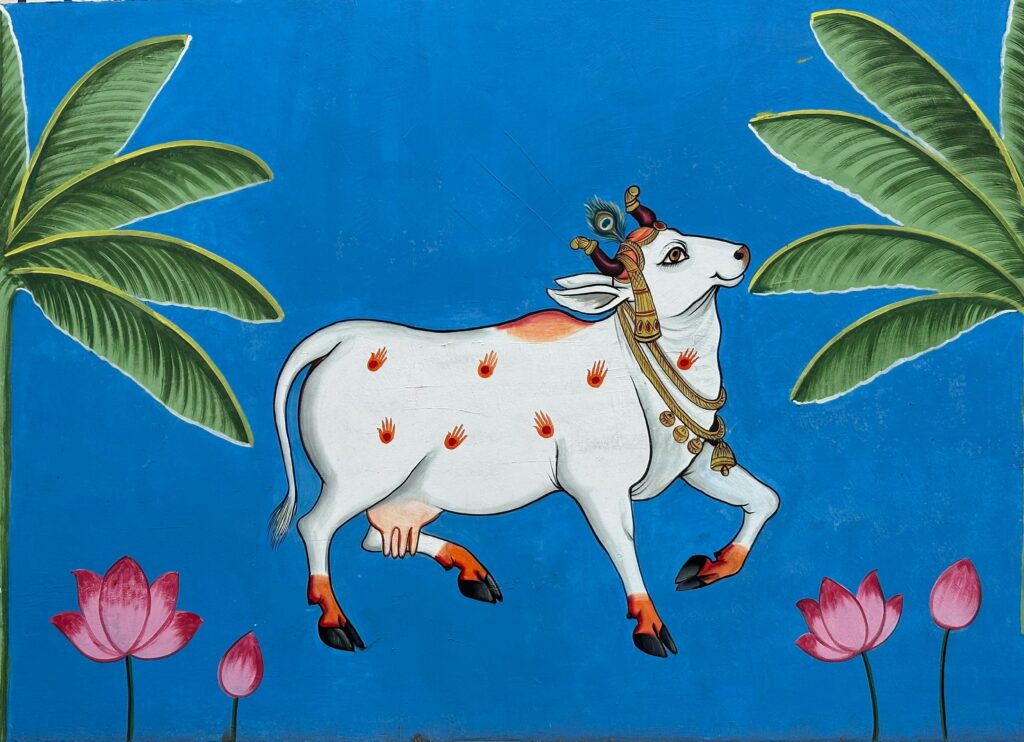
In most parts of the world, art is something you visit—museums, galleries, exhibitions. In Mithila, art is something you live inside.
The walls of homes are not plain surfaces; they are canvases. The floors are not just walked upon; they are decorated with intricate patterns. Even the smallest rituals are infused with visual expression.
What makes this unique is that the creators are not trained artists in the modern sense. They are ordinary people—especially women—who have inherited artistic knowledge through generations. There is no formal education, no design school, no professional training. Yet, the level of sophistication is astonishing.
This is because aesthetics in Mithila is not taught as a skill. It is absorbed as a culture.
From childhood, girls observe their mothers and grandmothers creating patterns, painting walls, and preparing ritual spaces. Over time, they begin to replicate these forms, adding their own variations. This continuous process ensures that art never becomes stagnant. It evolves, but it never loses its roots.
The Philosophy of “No Empty Space”
One of the most striking features of Mithila aesthetics is its complete rejection of emptiness.
Every inch of a surface is filled—lines, patterns, motifs, symbols. There is no blank space left behind. At first glance, it may feel overwhelming, but the deeper you observe, the more you realize that this fullness is intentional.
It reflects a worldview.
In Mithila’s cultural philosophy, emptiness is not desirable. Life is seen as interconnected, abundant, and continuous. Every element has meaning, and nothing exists in isolation.
This is why Mithila art often appears dense and intricate. The filled spaces symbolize a universe where everything is connected—nature, humans, animals, and the divine.
In contrast to modern minimalism, which celebrates emptiness and simplicity, Mithila celebrates complexity and richness. It tells you that life is not meant to be reduced—it is meant to be experienced in its entirety.
Rituals That Turn Life Into Art
In Mithila, aesthetics is deeply tied to rituals. Every major life event becomes an opportunity for artistic expression.
Weddings as Visual Narratives
Marriage in Mithila is not just a ceremony; it is an artistic production. The “kohbar ghar” (nuptial chamber) is decorated with elaborate paintings that symbolize fertility, prosperity, and union.
These paintings are not random decorations. Each element has meaning:
- Lotus represents fertility
- Fish symbolize prosperity
- Bamboo signifies growth and continuity
The walls become storytellers, narrating the journey of the couple and the blessings they carry.
Festivals as Aesthetic Celebrations
Festivals are another major contributor to Mithila’s aesthetic richness. Whether it is Diwali, Chhath, or local celebrations, every occasion involves visual preparation.
The floors are adorned with intricate designs made using rice paste. The entrances of homes are decorated to welcome positive energy. Even the arrangement of objects follows a certain aesthetic logic.
These practices transform ordinary spaces into sacred environments.
The Role of Women as Custodians of Aesthetics
One of the most powerful reasons behind Mithila’s aesthetic depth is the role of women.
Unlike many cultures where art becomes institutionalized and male-dominated, Mithila’s artistic tradition has been preserved primarily by women.
They are not just participants—they are creators, innovators, and preservers.
This has several implications:
- Art remains connected to daily life
- It evolves naturally with changing times
- It retains emotional and cultural authenticity
Women in Mithila do not create art for commercial purposes alone. They create it for rituals, for family, for tradition. This keeps the art deeply rooted and meaningful.
Even today, when Mithila art has gained global recognition, many artists continue to draw inspiration from their cultural practices rather than external trends.
Nature as the Core Aesthetic Influence
Mithila’s aesthetics are deeply influenced by nature. The region’s environment—rivers, fields, trees, animals—plays a central role in shaping its visual language.
You will often find recurring motifs:
- Fish, representing abundance
- Birds, symbolizing freedom and connection
- Trees, representing life and continuity
- Sun and moon, symbolizing cosmic balance
Unlike modern design, which often abstracts or simplifies nature, Mithila embraces it in its full complexity.
This connection to nature also reflects a deeper understanding of ecological balance. The art is not just inspired by nature—it respects and celebrates it.
Symbolism: A Language Beyond Words
Mithila’s aesthetics are not just visually appealing; they are intellectually rich.
Every pattern, every motif, every composition carries meaning. It is a visual language that communicates ideas, beliefs, and values.
For example:
- Repetition of patterns symbolizes continuity
- Symmetry represents balance and harmony
- Specific colors are associated with particular emotions or rituals
This makes Mithila art not just decorative but communicative. It tells stories, conveys messages, and preserves cultural knowledge.
In a way, it functions like a visual script—one that does not rely on written language but is equally expressive.
Continuity in the Face of Change
One of the biggest reasons why Mithila remains aesthetically rich is its ability to adapt without losing its identity.
Over time, Mithila art has moved from walls to paper, from homes to global markets. Artists now create works that are sold internationally, displayed in exhibitions, and appreciated by collectors.
However, the core essence remains unchanged.
The themes, symbols, and techniques continue to reflect the cultural roots of Mithila. This balance between tradition and modernity ensures that the aesthetics remain relevant while staying authentic.
The Emotional Depth of Mithila Aesthetics
Unlike modern design, which often prioritizes visual appeal, Mithila aesthetics carry emotional depth.
Each piece of art is connected to a moment—a wedding, a festival, a prayer. It is not created in isolation but as part of an experience.
This gives it a certain warmth and authenticity that is hard to replicate.
When you look at Mithila art, you are not just seeing patterns. You are witnessing emotions, beliefs, and traditions that have been preserved over centuries.
A Contrast to Modern Aesthetic Trends
Today’s aesthetic trends are often driven by:
- Social media
- Consumer culture
- Global influences
They change rapidly, with new styles emerging and fading within months.
Mithila, on the other hand, represents a slow aesthetic.
It does not chase trends. It does not seek validation. It evolves at its own pace, guided by cultural continuity rather than external influence.
This is what makes it timeless.
Why Mithila Feels So Visually Powerful
When you step into a Mithila-influenced space, you feel something different. It is not just about beauty—it is about presence.
The patterns draw your attention. The colors engage your senses. The details invite you to observe closely.
This immersive quality is what makes Mithila aesthetics so powerful. It does not just decorate a space—it transforms it.
Lessons the Modern World Can Learn
Mithila offers several lessons for the modern world:
- Integrate Art Into Life :- Art should not be separate from daily living. It should be part of it.
- Value Cultural Roots:- True aesthetics come from identity, not imitation.
- Embrace Complexity:- Life is not minimal. It is layered and rich.
- Preserve Through Practice:-Traditions survive not by documentation but by practice.
Conclusion: A Living Aesthetic Civilization
It shows us that beauty does not need to be curated—it can be lived.
In a world that is constantly searching for new trends, Mithila quietly reminds us of something profound: the most powerful aesthetics are not created—they are inherited, nurtured, and lived every single day.
And perhaps that is why Mithila does not just look beautiful.
It feels meaningful.