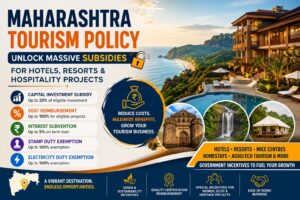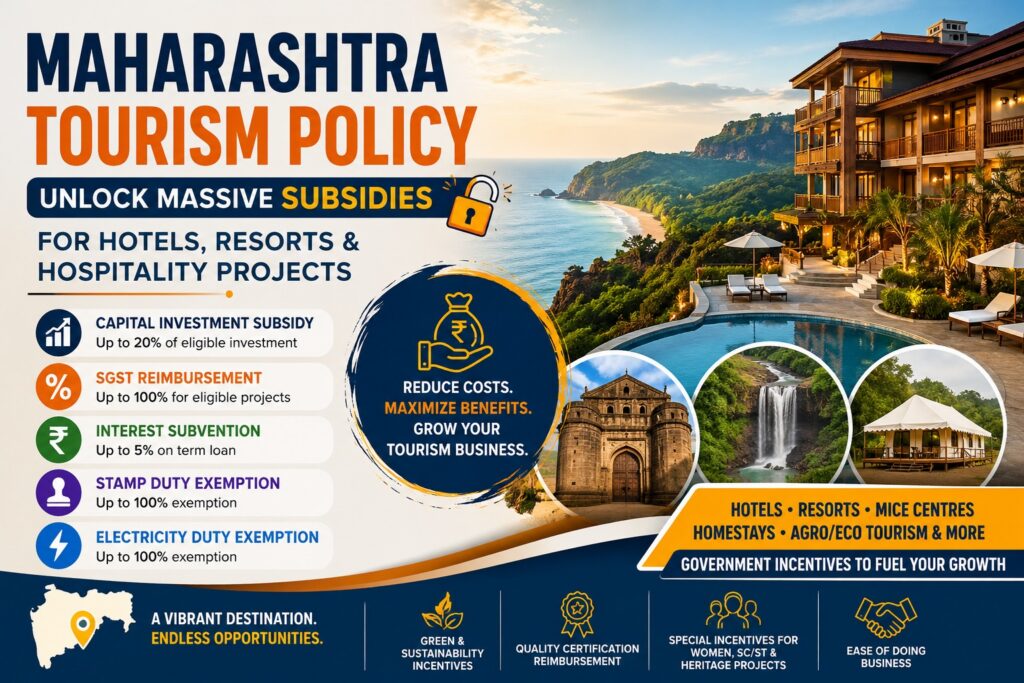
The Maharashtra Tourism Policy 2024 presents a landmark opportunity for investors, developers, hospitality entrepreneurs, landowners, and tourism businesses looking to establish or expand projects across Maharashtra. With a strong focus on infrastructure creation, sustainable tourism, employment generation, and private sector participation, the policy offers one of the most comprehensive incentive structures in the tourism sector. The Government of Maharashtra has introduced a wide range of fiscal incentives including capital investment subsidies, SGST reimbursement, interest subvention on term loans, electricity duty exemption, electricity tariff reimbursement, stamp duty exemption, sustainability incentives, quality certification reimbursement, viability gap funding, and special incentives for women entrepreneurs, SC/ST entrepreneurs, and differently-abled entrepreneurs. These benefits can substantially improve project viability and reduce the overall cost of investment for hotels, resorts, serviced apartments, agro tourism projects, eco-tourism ventures, wellness retreats, MICE centres, homestays, amusement parks, caravan parks, and other tourism infrastructure developments.
One of the biggest highlights of the Maharashtra Tourism Policy 2024 is the attractive package of fiscal incentives available for eligible tourism projects. Hotels, motels, youth hostels, resorts, log huts, and cottages are eligible for capital investment incentives of up to 20% of eligible project cost subject to a maximum prescribed limit. Other tourism projects including serviced apartments, tourist villas, agro tourism units, eco-tourism projects, homestays, bed & breakfast units, tented accommodations, cruise boats, houseboats, MICE centres, wellness centres, amusement parks, ropeways, caravan parks, tourism villages, exhibition centres, cultural centres, and tourism training institutes are eligible for capital investment incentives of up to 15% of eligible capital investment. Ultra Mega tourism projects can also avail additional support under the policy framework.
The policy further provides SGST reimbursement benefits for eligible tourism units for a defined eligibility period depending upon project category and geographical zone classification. Depending on the category and location of the project, eligible units may receive reimbursement ranging from 50% to 100% of SGST paid. This significantly reduces operational tax burden during the initial years of business operations and improves cash flow management for tourism enterprises.
Another important incentive under the policy is interest subvention on term loans. Eligible tourism projects can avail interest subsidy of up to 5% on sanctioned term loans, subject to prescribed ceilings and conditions. This benefit substantially reduces financing costs for hospitality projects and supports easier access to institutional funding. Large, Mega, and Ultra Mega projects can particularly benefit from this provision while planning long-term infrastructure investments.
The policy also grants substantial exemption from electricity duty and reimbursement of the differential between commercial and industrial electricity tariff rates. Since hotels, resorts, convention centres, amusement parks, and tourism infrastructure projects are energy-intensive businesses, these incentives can significantly reduce recurring operational expenses over the project lifecycle.
Stamp duty and registration charge exemption is another major fiscal benefit available under the policy. Eligible tourism projects may receive exemption ranging from 50% to 100% on stamp duty and registration charges related to purchase or lease of land, execution of lease deeds, mortgage documents, and other project-related transactions. This helps in lowering upfront project establishment costs for developers and hospitality businesses.
To promote environmentally responsible tourism development, the Maharashtra Tourism Policy 2024 also introduces sustainability incentives for projects implementing eco-friendly infrastructure and green practices. Eligible projects implementing rainwater harvesting systems, solar energy systems, wastewater treatment plants, renewable energy infrastructure, organic waste converters, pollution control devices, electric vehicle infrastructure, smart water management systems, and zero liquid discharge systems may receive reimbursement support up to prescribed limits. These sustainability incentives encourage long-term environmentally sustainable tourism development across Maharashtra.
The policy also promotes quality enhancement and global competitiveness of tourism infrastructure through reimbursement for quality certifications and sustainability certifications. Eligible tourism units can receive reimbursement for obtaining national and international certifications including registration fees, certification charges, and consultancy expenses. This initiative aims to improve service standards and align Maharashtra’s hospitality sector with global tourism benchmarks.
An important feature of the policy is the provision for viability gap funding (VGF) for strategically important tourism infrastructure projects which may not be financially viable on a standalone basis but are essential for regional tourism development. Such projects may receive financial assistance in the form of capital grant and/or operational grant support subject to prescribed conditions and approvals.
Special incentives have also been introduced for women entrepreneurs, SC/ST entrepreneurs, and differently-abled entrepreneurs. Tourism units with at least 51% ownership by eligible entrepreneurs may receive additional capital investment incentives under the policy. This provision is intended to encourage inclusive growth and entrepreneurship in the tourism sector.
The Maharashtra Tourism Policy 2024 also emphasizes the development of rural tourism, agro tourism, eco-tourism, heritage tourism, cruise tourism, wellness tourism, adventure tourism, and destination-based experiential tourism. The Government proposes dedicated tourism zones equipped with improved infrastructure, digital connectivity, tourist safety systems, Wi-Fi coverage, public amenities, and sustainable tourism standards to enhance visitor experience and improve destination competitiveness.
In such a dynamic and incentive-driven environment, proper planning, project structuring, documentation, and regulatory compliance become extremely important for successfully availing benefits under the policy. CA Deepak G. Thakarar & Associates can play a crucial role in assisting investors, developers, and hospitality businesses in navigating the policy framework and maximizing the available incentives. The firm can provide end-to-end professional support in tourism and hospitality projects, beginning from project conceptualization and structuring to implementation and post-approval compliance.
Their advisory services may include eligibility assessment under the Maharashtra Tourism Policy 2024, preparation of detailed project reports (DPRs), feasibility studies, financial projections, subsidy mapping, project structuring, SGST reimbursement advisory, capital subsidy planning, assistance in obtaining registrations and approvals, term loan advisory, banking coordination, compliance documentation, and preparation of incentive claim applications. The firm can also assist in GST advisory, taxation planning, accounting systems, audit support, financial due diligence, sustainability compliance, and operational compliance for hospitality businesses.
The Maharashtra Tourism Policy 2024 is not merely a subsidy scheme but a comprehensive tourism investment and development framework designed to transform Maharashtra into a globally competitive tourism destination. Investors and hospitality entrepreneurs who proactively evaluate the policy incentives and structure their projects efficiently may unlock substantial financial advantages and long-term growth opportunities in the years ahead.