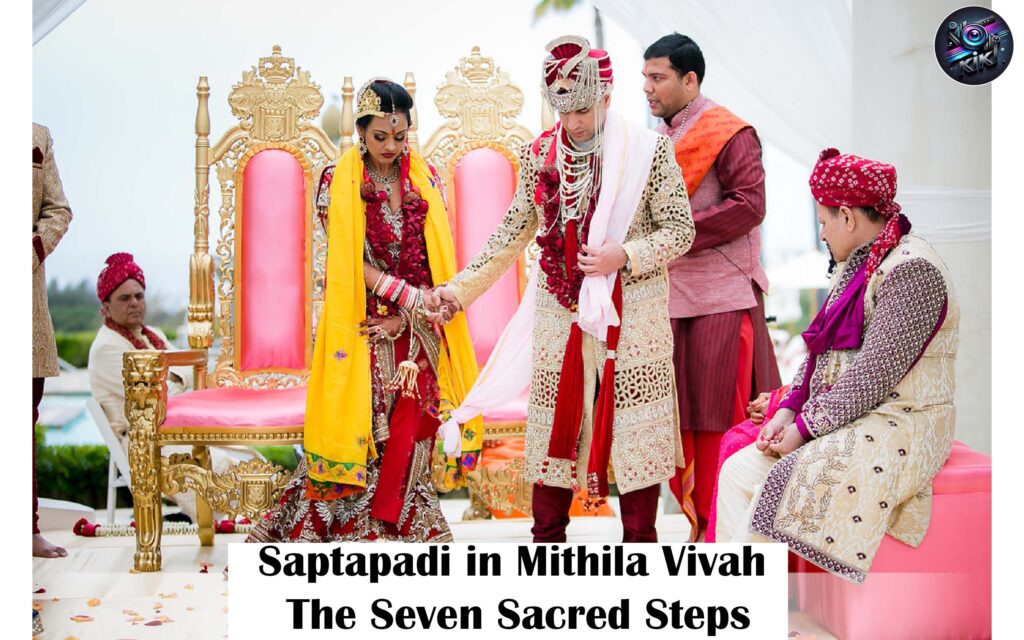
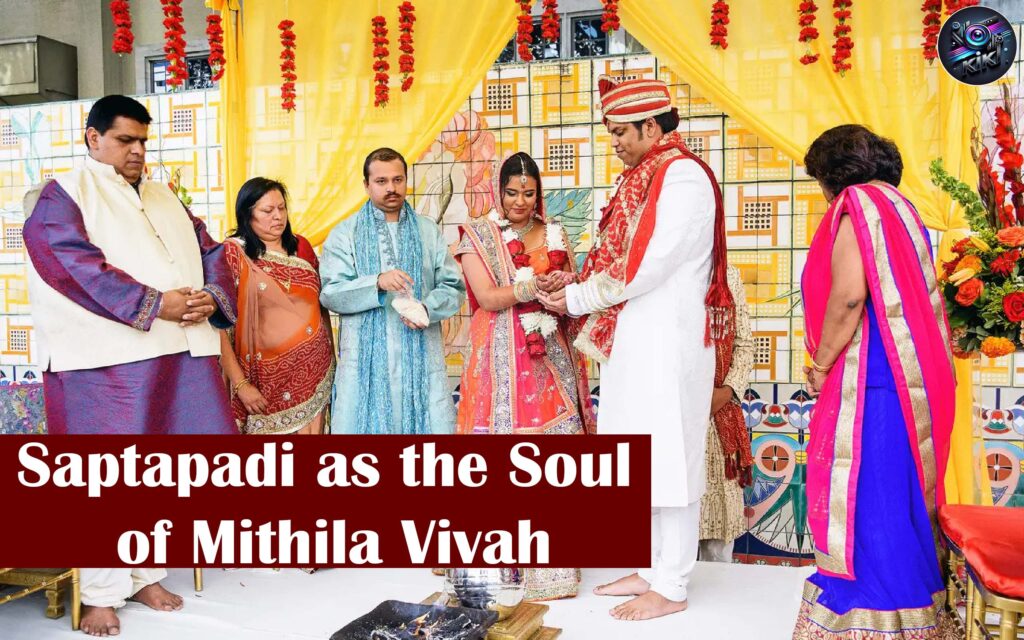
In the sacred sequence of Mithila Vivah, it is the Saptapadi—the seven steps taken together around the holy fire—that finally and irrevocably establishes a couple as husband and wife. While rituals like Kanyadaan and Panigrahan prepare the ground, Saptapadi completes the marriage. Until these seven vows are spoken and enacted, the union remains incomplete in the eyes of Dharma.
In Vedic understanding, a marriage is not sealed by emotion, but by promise.
Why Saptapadi Holds Supreme Importance

Dharmaśāstra clearly states that the marital bond becomes valid only after the completion of Saptapadi. This is why Pandits in Mithila emphasize:
सप्तपदी तु विवाहस्य मुख्यं कर्म विधीयते।
Meaning:
The act of seven steps is the principal rite of marriage.
Saptapadi follows Panigrahan, ensuring that physical acceptance is immediately strengthened by ethical and spiritual commitment. Together, these rituals convert two individuals into Gṛhasthas—partners in household, society, and spiritual life.
The Fire as Witness: The Spiritual Framework

All seven steps are taken in the presence of Agni, the sacred fire, regarded as the eternal witness (Sākṣī) of truth and vows. Fire represents:
- Moral clarity
- Continuity of life
- Accountability beyond human society
- In Mithila tradition, elders remind the couple that Agni remembers what humans may forget—making Saptapadi not symbolic, but binding.
Understanding the Seven Vows: A Household Blueprint
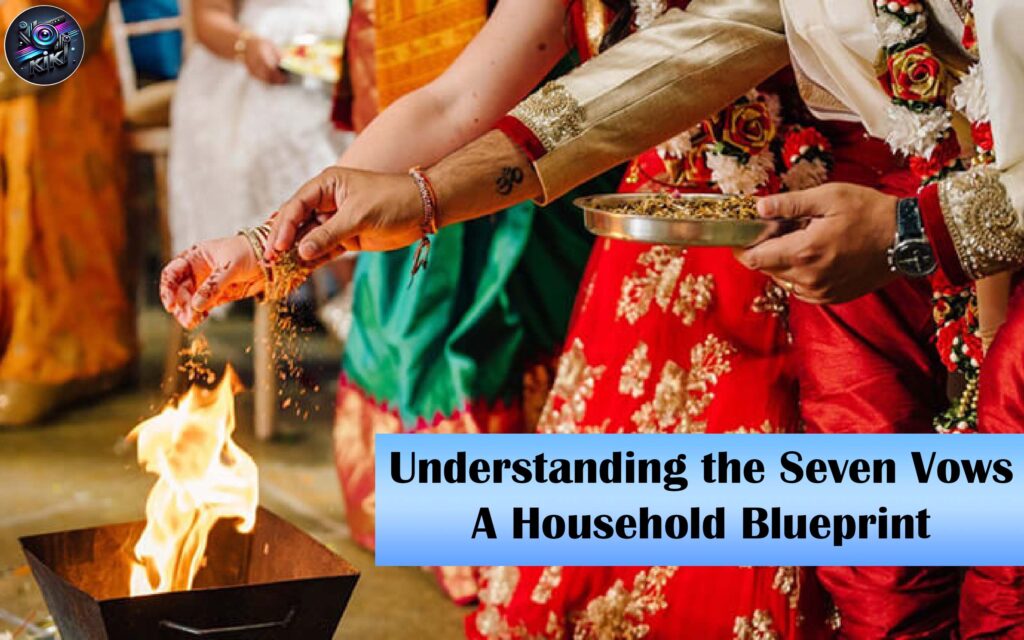
Each step of Saptapadi is concise yet comprehensive, addressing a core dimension of married life. Pandits often describe it as a complete household planning guide, delivered in seven sentences.
- Step 1 – Sustenance (Āhāra)
प्रथमं पदं अन्नाय।
Explanation:
The couple vows to ensure food, nourishment, and basic security. This step establishes that material stability is a shared responsibility, not a burden carried alone. - Step 2 – Strength (Bala)
द्वितीयं पदं बलाय।
Explanation:
This vow commits both partners to support each other physically, mentally, and emotionally. In Mithila, elders explain that strength includes care during illness, old age, and hardship. - Step 3 – Prosperity (Dhana)
तृतीयं पदं धनाय।
Explanation:
The couple promises to earn and use wealth righteously. Prosperity here is not excess, but ethical abundance—free from exploitation or greed. - Step 4 – Happiness (Sukha–Duḥkha)
चतुर्थं पदं सुखाय।
Explanation:
This step binds the couple to share joy and sorrow equally. Mithila Pandits emphasize that marriage is emotional partnership, not individual survival. - Step 5 – Progeny and Lineage (Praja)
पञ्चमं पदं प्रजायै।
Explanation:
The vow seeks virtuous children and continuity of lineage. Importantly, it also includes the moral education of future generations, not just birth. - Step 6 – Companionship (Maitrī)
षष्ठं पदं ऋतुभ्यः।
Explanation:
This step signifies lifelong friendship. Beyond duty and ritual, the couple commits to companionship, trust, and emotional presence through all seasons of life. - Step 7 – Devotion and Unity (Sakhyam)
सप्तमं पदं सख्याय।
Explanation:
The final vow establishes eternal friendship and spiritual unity. At this moment, the groom traditionally declares
सखा सप्तपदी भव।
“With these seven steps, you are now my lifelong companion.”
From this point onward, the couple is recognized as one moral unit in society.
Saptapadi and Maithil Family Values
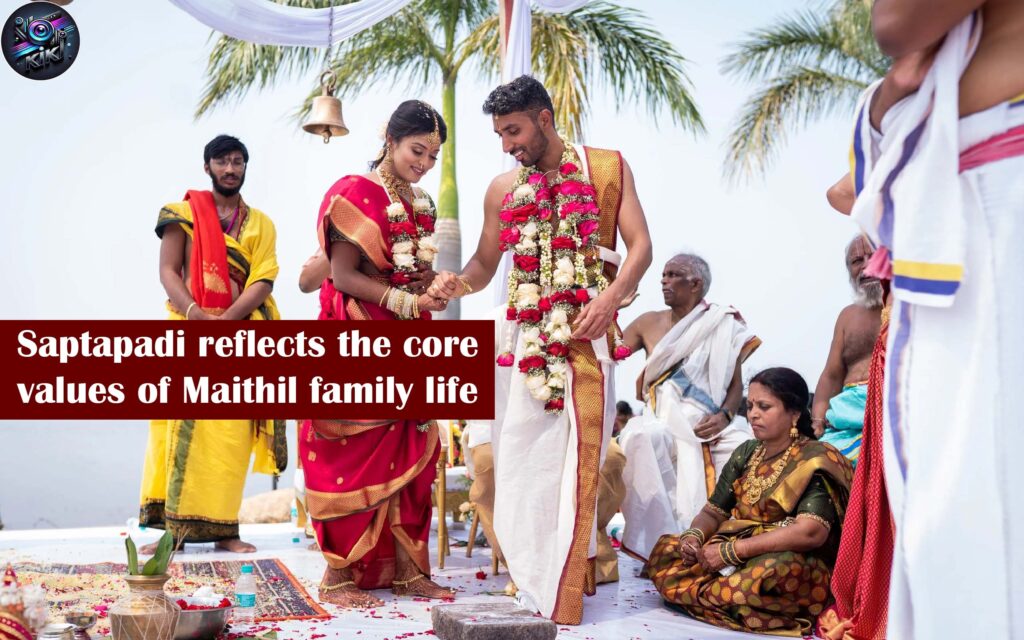
Saptapadi reflects the core values of Maithil family life:
- Mutual respect, not hierarchy
- Responsibility shared, not imposed
- Guidance from elders, not isolation
The entire family bears witness, turning the ritual into a collective blessing rather than a private contract. This shared witnessing lays the groundwork for healthy communication after marriage.
Modern Relevance: Ancient Vows, Timeless Wisdom
Even in modern life, the seven vows remain strikingly relevant. They offer guidance on:
- Financial planning and shared goals
- Emotional compatibility and mental health
- Respectful handling of in-law relationships
- Spiritual grounding amidst change
Pandits often explain that Saptapadi is not restrictive—it is protective, offering a moral framework for navigating modern complexity
Saptapadi as the Soul of Mithila Vivah
A marriage completed through Saptapadi is not merely blessed—it is prepared.