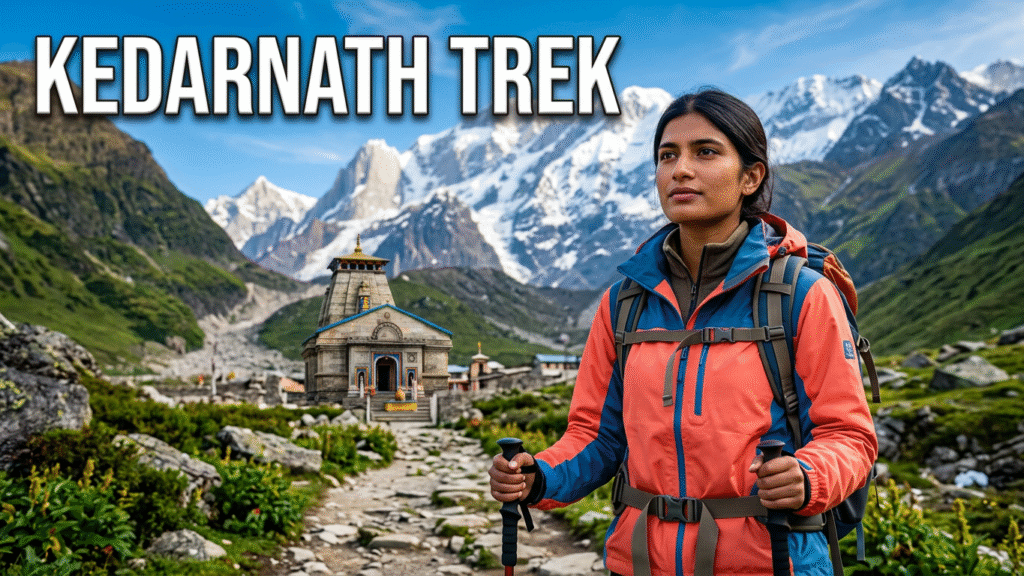
Walking from Gaurikund to Kedarnath is much more than a mountain trek. For pilgrims, it is a journey of faith, endurance and patience. The route covers more than 16 kilometres, climbing from the lower Himalayan valley toward Kedarnath at roughly 3,500 metres (11,500+ feet) above sea level.
For a first-time pilgrim, however, the reality can be very different from what photographs suggest. The weather can change suddenly, the trail can become steep and slippery, the air gets thinner as you climb, and carrying unnecessary luggage can turn an already demanding journey into an exhausting one.
The key lesson is simple: you don’t need to rush the Kedarnath trek—you need to prepare for it.
The Journey Begins at Gaurikund
Gaurikund is where the road journey effectively ends and the trek toward Kedarnath begins.
The atmosphere here can be energetic and crowded, with pilgrims preparing for the long walk ahead. It is tempting to start quickly, especially when the excitement of finally beginning the Kedarnath Yatra takes over.
But this is one of the first mistakes first-time trekkers should avoid.
The opening section can make you feel stronger than you actually are. Your body is still fresh, the excitement is high, and the climb may initially seem manageable. But the kilometres ahead can test your legs and breathing much more than the first few kilometres suggest.
Start slowly.
A comfortable, sustainable pace is far more important than trying to reach the next stop quickly.
What Makes the Kedarnath Trek Difficult?
The challenge isn’t simply the distance.
You are dealing with several things simultaneously:
- Long hours of walking
- Continuous elevation gain
- Steep sections
- Uneven and rocky terrain
- Rain and wet pathways
- Cold temperatures
- Reduced oxygen at higher elevations
- Crowded sections of the trail
- Pony and mule traffic
- Physical fatigue
The elevation also changes dramatically during the journey. Gaurikund is around 2,000 metres, while Kedarnath is above 3,500 metres.
That elevation gain is one reason why a pace that feels comfortable at the beginning may become difficult later.
What Should You Pack for Kedarnath?
One of the biggest lessons from the trek is that packing light matters.
You don’t need to carry your entire travel bag on your back. Keep heavier luggage at your accommodation or use the available luggage/transport arrangements where appropriate.
Your trekking backpack should contain only things you are likely to need during the journey.
1. Dress in Layers
Instead of wearing one extremely heavy jacket, carry multiple lightweight layers.
A practical combination can include:
- Moisture-wicking inner layer
- T-shirt or light mid-layer
- Warm fleece
- Waterproof outer layer
The advantage of layering is that you can add or remove clothing as your body temperature changes.
You may feel warm while climbing and suddenly cold when you stop.
2. Don’t Underestimate Rain
Mountain weather can change quickly.
A good-quality rain poncho or waterproof jacket can become one of the most useful things in your backpack.
An umbrella may seem convenient, but on exposed and windy sections of the trail it isn’t always practical.
Most importantly, protect your backpack and spare clothes from getting wet.
3. Your Shoes Can Make or Break the Trek
This is not the place to experiment with brand-new footwear.
Use comfortable trekking shoes with:
- Good grip
- Adequate cushioning
- Reasonable ankle support
- A sole suitable for wet and rocky terrain
And carry extra socks.
A wet pair of socks after hours of walking can make the journey considerably more uncomfortable.
What Should You Eat and Drink?
Cold weather can make you less aware of thirst.
That’s why one common mistake is simply forgetting to drink enough water.
Don’t wait until you’re extremely thirsty.
Take regular small sips and keep some quick-energy food accessible.
Useful options include:
- Dry fruits
- Energy bars
- Bananas
- Glucose/electrolyte drinks
- ORS, if appropriate for you
- Light snacks
Avoid turning the trek into a heavy feast at every stop. Your body has to digest the food while simultaneously dealing with altitude and physical exertion.
Don't Forget a Trekking Stick
A simple trekking pole or walking stick can be surprisingly useful.
On uphill sections it provides additional support, while during descents it can reduce some of the load placed on your knees.
For older pilgrims or people who aren’t accustomed to mountain walking, this can be particularly helpful.
Gaurikund to Jungle Chatti: Don’t Waste Your Energy
The beginning of the trek is where you should establish your rhythm.
Don’t compete with other pilgrims.
Someone walking faster than you isn’t necessarily going to have an easier journey later.
Walk at a pace at which you can breathe comfortably and maintain a conversation.
Take short breaks rather than waiting until you’re completely exhausted.
The objective isn’t:
"How quickly can I reach Kedarnath?"
The objective is:
“How comfortably can I keep moving toward Kedarnath?”
Bheembali to Lincholi: The Trek Gets More Serious
As the journey continues, the physical demands become more noticeable.
Steeper sections, uneven surfaces and crowded portions can make walking slower.
Another challenge is the movement of ponies and mules along the route.
Always remain aware of your surroundings and give animals sufficient space to pass. Don’t stop suddenly in the middle of a narrow section simply to take a photograph.
This is also a good time to understand why pacing yourself early matters.
The energy you save during the first few hours can become extremely valuable later.
Lincholi to Kedarnath: When Fatigue Sets In
For many pilgrims, the final section feels mentally as well as physically demanding.
You have already walked for several hours.
Your legs are tired.
The temperature may have dropped.
And the thinner air at higher elevation can make even a relatively short climb feel surprisingly difficult.
This is where patience becomes important.
Take breaks.
Breathe normally.
Drink water.
Eat something light.
And continue at your own pace.
The sight of Kedarnath ahead can provide an enormous psychological boost—but don’t allow excitement to make you suddenly increase your pace.
The Biggest Packing Mistake: Carrying Too Much
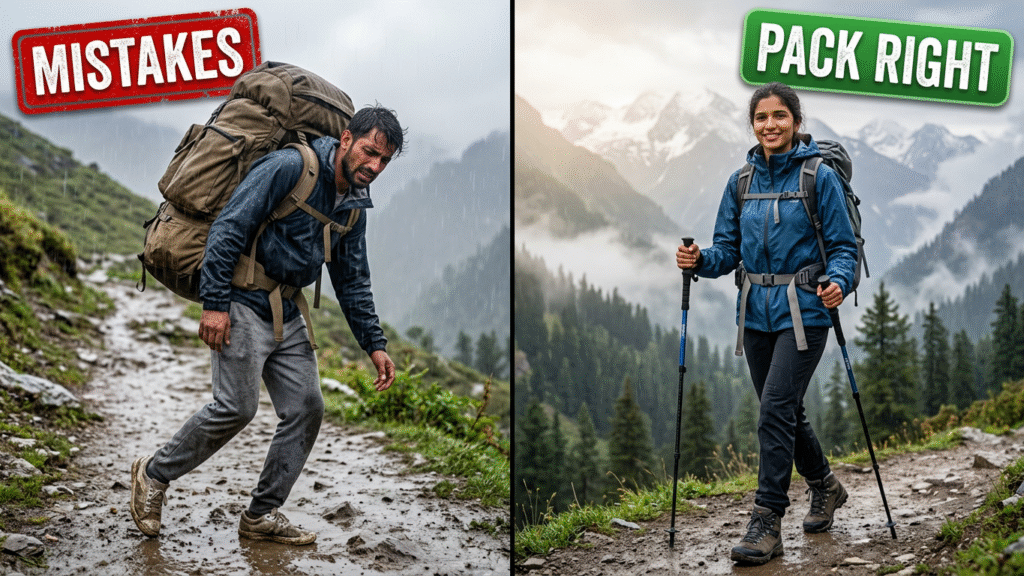
One of the easiest ways to make the trek harder is to carry unnecessary luggage.
Remember that you’re going to walk for hours through a mountainous environment.
Ask yourself before putting something into your backpack:
“Do I really need to carry this for the entire trek?”
Extra clothes, unnecessary toiletries, large camera accessories and heavy bags can add considerable strain.
Keep your trekking backpack as light as possible while carrying the essentials.
Mistake No. 2: Starting Too Late
A late start can create several problems.
You may end up walking during:
- Afternoon weather changes
- Reduced visibility
- Colder evening temperatures
- Darker trail conditions
The exact conditions vary by season and official route restrictions, so pilgrims should always check current local guidance before starting.
But as a general principle, starting early gives you more daylight and more flexibility if the journey takes longer than expected.
Mistake No. 3: Ignoring Hydration
The cold can trick you into thinking that you don’t need much water.
You do.
Long-distance walking combined with elevation gain can leave you dehydrated even when you aren’t sweating heavily.
Keep your bottle accessible rather than buried deep inside your backpack.
Small, regular sips are easier than waiting until you are exhausted and then drinking a large amount at once.
What About Altitude?
Altitude deserves respect.
Not everyone reacts to high altitude in the same way.
Symptoms such as headache, dizziness, unusual weakness, nausea or breathing difficulty shouldn’t simply be dismissed as “normal trekking tiredness.”
If you feel seriously unwell, stop and seek assistance rather than trying to prove that you can push through.
And if you have an underlying medical condition or are taking regular medication, discuss high-altitude travel with your doctor before the journey.
Reaching Kedarnath
Then comes the moment you’ve been walking toward for hours.
The landscape changes.
The mountains surround the valley, the temperature drops, and eventually the Kedarnath Temple comes into view.
After a long climb from Gaurikund, that first sight can feel incredibly emotional.
For many pilgrims, the exhaustion of the journey becomes part of the spiritual experience itself.
The trek isn’t merely the distance between two points.
It is the patience required to keep walking when your legs are tired, the discipline to slow down when necessary, and the feeling of finally arriving after hours of effort.
Night Stay in Kedarnath
Don’t assume that reaching Kedarnath means the difficult part is completely over.
At night, temperatures can become extremely cold, particularly during colder periods of the season.
Accommodation options can include hotels, guesthouses, camps and other pilgrim facilities, depending on the season and availability.
Carry adequate warm clothing and confirm your accommodation arrangements beforehand when possible.
After such a long trek, your body will need rest.
Darshan and Aarti
After completing the trek, many pilgrims naturally want to head straight for darshan.
But don’t forget that you’ve just completed a physically demanding journey.
If you are exhausted, give yourself time to recover.
For those planning darshan or attending the evening aarti, check the current temple timings, registration requirements and local arrangements before travelling, as these can change.
The atmosphere around Kedarnath Temple in the evening can be particularly serene, with the surrounding mountains and the spiritual energy of the shrine creating a memorable experience.
The Kedarnath Trek Is Not a Race
Perhaps the most important lesson for a first-time pilgrim is this:
Don’t compare your speed with anyone else’s.
A young trekker may pass you.
An experienced pilgrim may walk faster.
Someone else may arrive hours before you.
It doesn’t matter.
The Kedarnath Yatra is your journey.
Walk slowly if you need to.
Take a break.
Drink water.
Enjoy the Mandakini River.
Look at the mountains.
Listen to the bells.
Take a moment to breathe.
And then continue.
Because when you finally stand before Kedarnath Temple, you may realise that the most memorable part wasn’t only reaching the destination.
It was every step that brought you there.
Final Checklist Before Starting
Carry:
- Comfortable, broken-in trekking shoes
- Extra socks
- Lightweight warm layers
- Waterproof rain protection
- Water bottle
- ORS/electrolytes as appropriate
- Energy snacks/dry fruits
- Basic first-aid supplies
- Trekking pole/stick
- Personal medicines
- Phone and power bank
- Minimal luggage
Remember:
- Start early
- Walk at your own pace
- Stay hydrated
- Don’t overpack
- Be careful around pony/mule traffic
- Protect yourself from rain
- Take altitude symptoms seriously
- Check current route, weather and official pilgrimage instructions before starting
Kedarnath is not a journey that you conquer. It is a journey that you experience—one step, one breath and one prayer at a time.
Here is a detailed packing checklist broken down by category, along with visual shot ideas (B-roll and A-roll framing) designed to keep your video engaging and easy to follow.
Part 1: The Essential Packing Checklist
1. Clothing & Layering
- Base Layer: Moisture-wicking thermal top & bottom (keeps sweat away, avoids chills).
- Mid Layer: Lightweight fleece jacket or lightweight down jacket.
- Outer Layer: Windproof & waterproof shell jacket.
- Pants: 2 pairs of quick-dry trekking pants/track pants (avoid heavy denim).
- Footwear: Broken-in trekking shoes with deep tread/grip + 3–4 pairs of thick woolen/trekking socks.
- Warm Accessories: Beanie/woolen cap (covering ears), neck gaiter/buff, and fleece/waterproof gloves.
2. Rain & Weather Protection
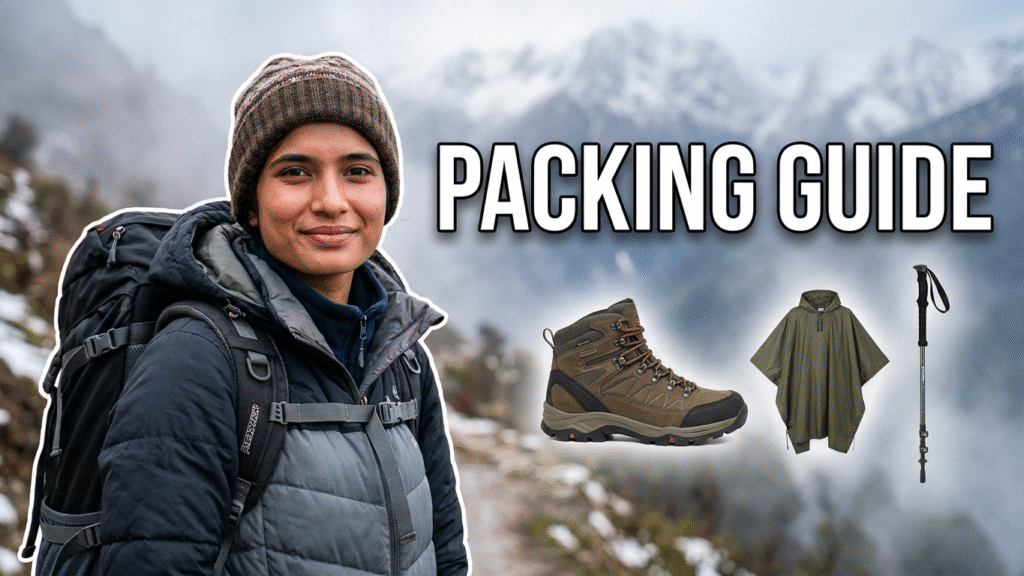
- Heavy-duty Poncho / Raincoat: Full-body coverage (far more practical than an umbrella in high mountain winds).
- Waterproof Backpack Cover: Keeps your gear dry inside the bag.
- Ziploc / Dry Bags: For keeping electronics, socks, and documents safe from water seepage.
3. Health, First Aid & Hygiene
- Medications: Pain relief spray/balm, band-aids/blister tape, altitude sickness medication (consult doctor), antacids, and motion sickness tablets.
- Hydration & Energy: Reusable insulated water bottle (thermos), ORS/electrolyte sachets, dates, nuts, glucose candies.
- Sun Protection: High SPF sunscreen, UV sunglasses, lip balm with SPF.
- Hygiene: Wet wipes, hand sanitizer, quick-dry travel towel.
4. Gear & Electronics
- Trekking Pole: Crucial for stability and knee support on steep descents.
- Power Bank: 10,000–20,000 mAh (phone batteries drain quickly in freezing temperatures).
- Headlamp / Small Torch: Essential for early morning or late evening walks.
- Cash: Sufficient paper currency (ATMs and UPI networks are often unreliable at high altitudes).
- Valid ID & Yatra Registration Pass: Physical printouts kept in a waterproof pouch.
Part 2: Visual Shot List (A-Roll & B-Roll Ideas)
Scene / SegmentShot TypeVisual Content / ActionPurpose
Intro / Hook Close-up & Wide Montage Quick cuts: Tying trekking boots, raindrops hitting a poncho, temple emerging through fog. Grabs immediate attention; sets the adventurous tone.
The “Flat Lay” Packing Overview Overhead Top-Down Shot All items neatly arranged on a bed or floor with subtle text pop-ups for each category. Gives viewers a clean, scannable visual of the entire gear loadout.
Layering Demo Medium Shot You putting on thermal -> fleece -> outer shell -> beanie/gloves in quick succession. Demonstrates the practical “layering system” rather than just talking about it.
The Footwear Comparison Low-Angle Side-by-Side Showing trekking shoes next to casual sneakers, flexing the soles to show grip/stiffness. Visually highlights why casual shoes slip on wet stones.
Backpack Weight Test Medium to Wide Shot Placing the fully packed bag on a weighing scale, showing it stays under 5–7 kg. Shows realism and emphasizes the danger of overpacking.
Trail Conditions (B-Roll) Point-of-View (POV) & Low Angle Walking shots focusing on muddy patches, wet stone stairs, and mules passing. Prepares first-timers for the real terrain.
Breather / Real-Time Check-In Handheld Close-Up (Selfie Angle) Short clip catching your breath on a bench or resting point along the path. Adds emotional authenticity and relatability to the journey.
Arrival at Kedarnath Slow Pan / Wide Reveal Slow reveal of the temple plaza and snow-capped peaks in the background. Delivers the rewarding payoff after the hard trek.
How to Sequence This in the Edit:
Hook: 10 seconds of high-energy trek B-roll + audio of mountain wind/chants.
Pre-Trek Prep: The flat-lay packing layout and quick gear demonstrations.
The Journey: Intercut your checklist tips with real trail footage showing why each item was necessary.
Would you like to draft a punchy intro script or fine-tune specific tips for staying at the top?
Absolutely. Based on this packing checklist and your realistic, first-timer-focused Kedarnath video, I’d make the opening more dramatic and practical rather than starting like a conventional travel guide.
Punchy YouTube Intro — Hindi/Hinglish
Kedarnath Trek Punchy Intro
Kedarnath jaana hai?
Toh sirf bhakti aur excitement lekar mat nikaliyega.
Gaurikund se Kedarnath ka ye 16 kilometer se zyada ka safar hai… aur raste mein sirf pahad nahi milte.
Milti hai chadhai… baarish… thand… slippery raaste… bheed… aur sabse badi baat—thakaan.
Aur agar packing mein ek chhoti si galti kar di, toh jo cheez aapko chhoti lag rahi thi… wahi poore trek mein sabse badi problem ban sakti hai.
- Kaunse shoes pehne?
- Kitne kapde lekar chalein?
- Poncho zaroori hai ya umbrella?
- Bag kitna heavy hona chahiye?
- Kya khana aur paani saath rakhein?
- Aur altitude par aisi kaunsi galti hai jo first-time pilgrims ko avoid karni chahiye?
Main aapko Kedarnath ka sirf beautiful side nahi dikhane wala.
Is video mein dekhenge Gaurikund se Kedarnath tak ka real trek… real challenges… aur woh practical lessons jo aapki yatra ko thoda safer, comfortable aur manageable bana sakte hain.
Toh agar aap pehli baar Kedarnath ja rahe hain…
Video ko end tak zaroor dekhiye.
Kyuki Kedarnath mein manzil ek hi hai…
Lekin wahan tak pahunchne ke liye har kadam taiyaari ke saath uthana padta hai.
First 10 Seconds — Visual Edit
0:00–0:02 — Trekking shoe lace tight karte hue extreme close-up
0:02–0:04 — Wet rocky trail par feet walking shot
0:04–0:06 — Poncho par girti baarish ki close-up
0:06–0:08 — Steep uphill trail + pilgrims
0:08–0:10 — Fog ke beech Kedarnath Temple ka quick reveal
Then hard cut to you with the backpack:
“Kedarnath jaana hai? Toh sirf bhakti aur excitement lekar mat nikaliyega.”
That line should come after the visual montage, because it immediately creates curiosity.
One important improvement to your packing section
I would not state “bag under 5–7 kg” as a universal rule. That’s a useful filming demonstration, but individual requirements vary considerably. Instead, say:
“Aapka daypack jitna halka rahe, utna better. Sirf wahi cheezein rakhiye jo trek ke dauran genuinely zaroori hain.”
Also, for altitude-sickness medication, keep the wording as “doctor ki salah se” rather than recommending a particular medicine. This keeps the video practical without making it sound like medical advice.
Strong transition into the packing section
“Sabse pehle baat karte hain us cheez ki jo aapke poore trek ka experience badal sakti hai—Aapke backpack ki.”
Then immediately cut to the overhead flat-lay shot and begin pulling out each item one by one.