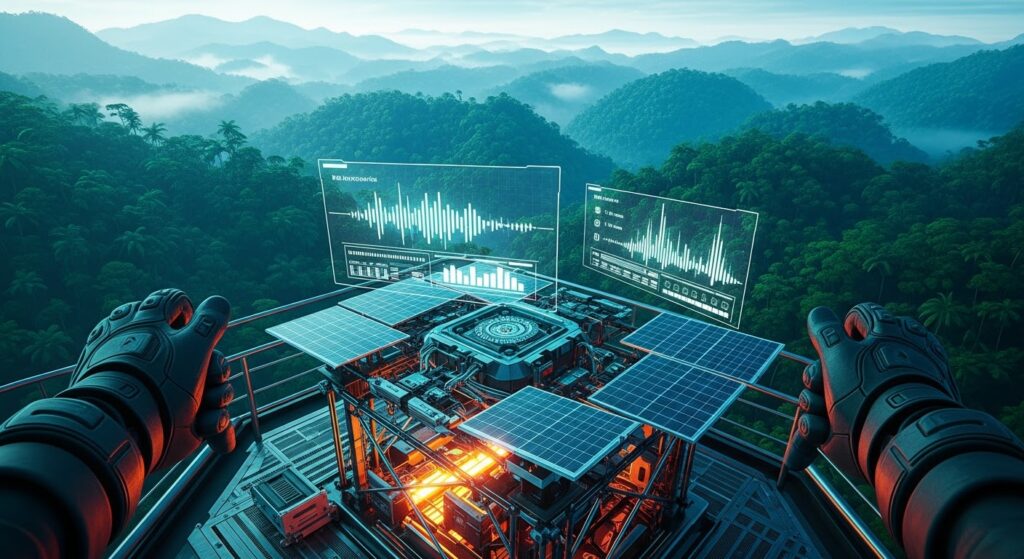
“We are dangling thousands of dollars of sensitive audio gear over a hundred feet in the air to see if solar power can survive the world’s most hostile environment. Can these lithium batteries withstand the crushing humidity and dense canopy shadows? We’re about to find out if the forest wins or if we capture its pulse.”
Deep within a tropical rainforest, where sunlight struggles to reach the forest floor and moisture hangs permanently in the air, a unique experiment is unfolding. The mission sounds deceptively simple: power a professional-grade audio recording system entirely with solar energy while suspended high above the jungle floor.
In reality, the challenge is an engineering battle against nature itself.
Rainforests represent one of the most demanding environments for electronics on Earth. Humidity routinely exceeds 95 percent, temperatures fluctuate dramatically throughout the day, insects infiltrate even the smallest openings, and heavy rains can arrive without warning. Yet these same environments contain some of the richest acoustic ecosystems on the planet—living orchestras of insects, birds, mammals, and atmospheric phenomena that scientists are only beginning to understand.
Our goal was ambitious: deploy a fully autonomous solar-powered bio-acoustic recording system deep within the rainforest canopy and determine whether modern renewable energy technology could finally meet the demands of long-term wilderness monitoring.
The results revealed both the incredible potential and the harsh limitations of off-grid environmental technology.
The High-Altitude Engineering Challenge

The first obstacle was survival.
Traditional recording equipment is rarely designed for permanent deployment in tropical rainforest conditions. Moisture can corrode circuitry, degrade batteries, and compromise microphones within days. To address these challenges, every component required extensive modification.
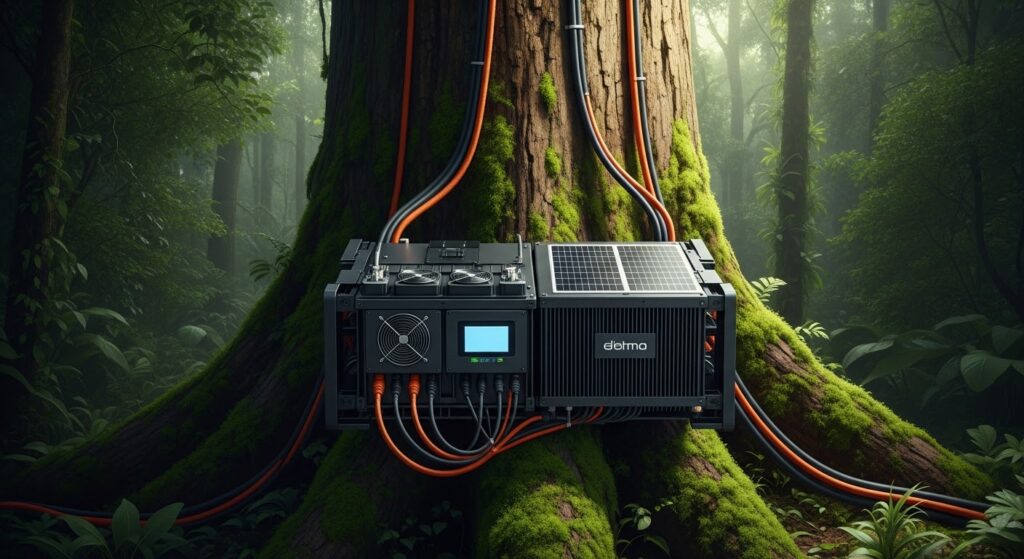
The centerpiece of the system was a custom-built waterproof housing engineered specifically for tropical deployment. Multiple layers of environmental sealing protected the sensitive electronics while carefully designed pressure-equalization vents prevented condensation buildup.
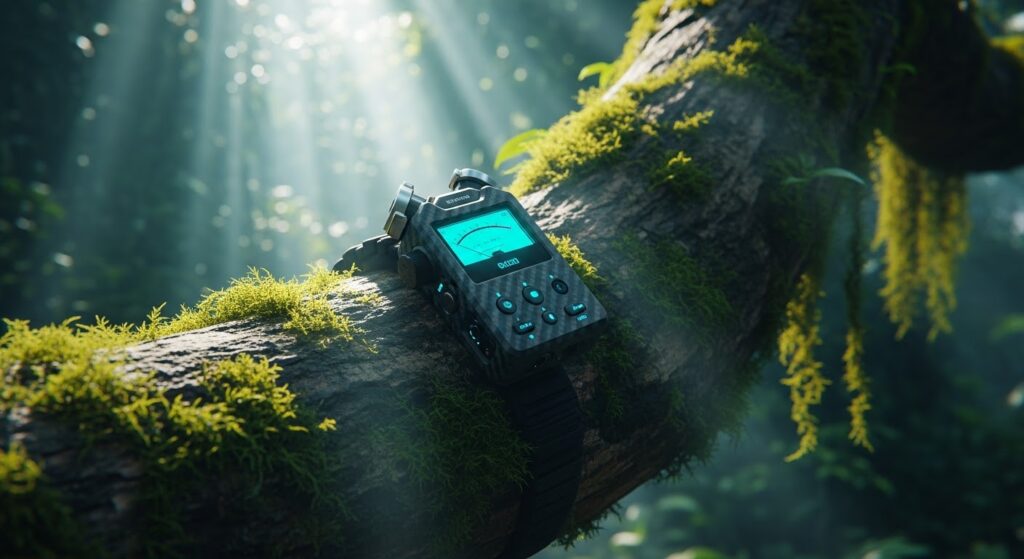
Inside the enclosure sat a high-resolution audio recorder paired with high-gain condenser microphones capable of capturing subtle biological sounds from significant distances. Each microphone assembly included specialized moisture barriers designed to maintain acoustic transparency while preventing water intrusion.
The battery system presented another challenge entirely.
Lithium-ion batteries perform best under stable environmental conditions. In a rainforest, however, constant humidity exposure, intermittent charging cycles, and fluctuating temperatures create ideal conditions for long-term degradation.
Engineers often discuss theoretical operating limits for lithium-ion chemistry, but few environments test those limits more aggressively than a tropical canopy where direct sunlight is scarce and moisture is omnipresent.
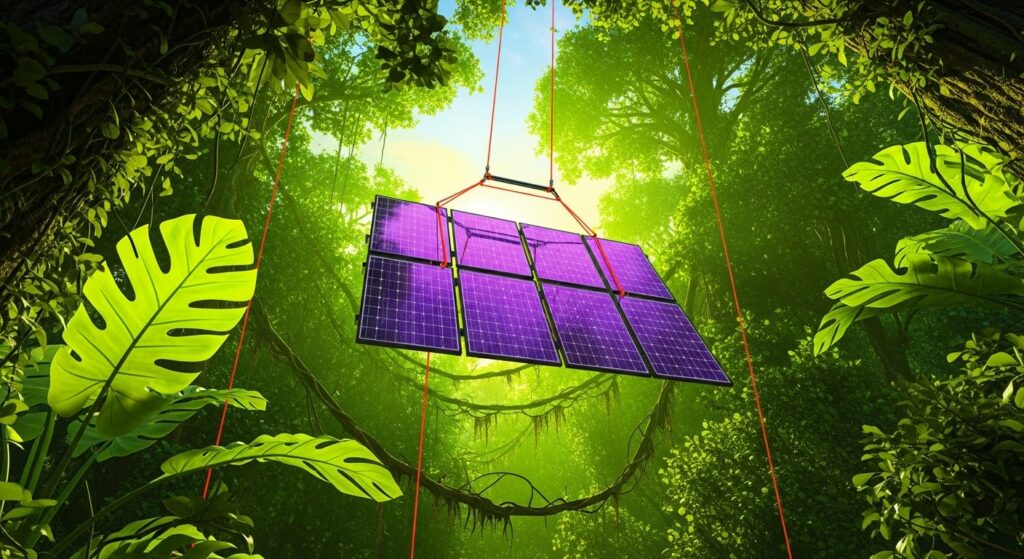
To maximize charging efficiency, solar panels needed to be positioned above the densest foliage. Reaching that location required a dangerous ascent using professional arborist rope systems.
Climbers carefully navigated more than eighty feet above the forest floor, securing flexible solar arrays at strategic locations where occasional sunlight penetrated the canopy. Every panel placement represented a compromise between maximum energy collection and structural safety.
The resulting system resembled a technological organism growing alongside the forest itself—a network of solar collectors, cables, sensors, microphones, batteries, and data storage devices suspended among the branches.
Now came the real test.
The Invisible Soundscape Paradox

Most visitors experience rainforests from the ground.
What they hear is only part of the story.
At ground level, the forest often feels surprisingly quiet. Sound becomes absorbed by dense vegetation, creating an illusion of calmness beneath the towering trees.
Everything changes when you ascend into the canopy.
As microphones began transmitting live monitoring data, an astonishing transformation emerged. The apparent silence gave way to an overwhelming acoustic landscape composed of thousands of overlapping biological signals.
Bird calls echoed across multiple canopy layers.
Insects generated continuous frequency bands spanning wide portions of the audible spectrum.
Wind interactions with leaves produced rhythmic textures that shifted minute by minute.
The forest was not silent at all.
It was deafeningly complex.
To visualize this hidden ecosystem, the team employed real-time spectral analysis software capable of converting sound into dynamic visual representations. Rather than simply listening to recordings, researchers could watch the rainforest pulse across frequencies and time.
One of the most fascinating observations occurred during changing sunlight conditions.
As solar panels received direct sunlight, system voltage increased, allowing recording equipment to operate at peak performance. Simultaneously, biological activity within the canopy often intensified as temperature and light conditions shifted.
- The resulting spectral maps appeared almost alive.
- Bands of insect activity expanded and contracted.
- Bird communication patterns surged during specific sunlight windows.
- Environmental sounds evolved continuously throughout the day.
The forest revealed itself not as a static environment but as a constantly changing acoustic network.
Yet recording these sounds introduced another paradox.
The higher the microphones climbed, the more vulnerable they became to environmental interference.
Wind noise increased significantly.
Mechanical vibrations from support structures occasionally contaminated recordings.
Solar panel movement introduced subtle acoustic artifacts.
Capturing pristine biophony eighty feet above ground required constant balancing between exposure and protection.
The rainforest was communicating, but extracting its message demanded extraordinary precision.
Testing Resilience Under the Canopy
No rainforest deployment remains peaceful for long.
Several days into operation, weather conditions shifted dramatically.
Towering tropical storm clouds rolled across the horizon, transforming the experiment into a real-world stress test.
Solar production began falling almost immediately.
Incoming UV radiation dropped by nearly 90 percent as dense cloud cover obscured the sun. The charge controller’s remote monitoring dashboard reflected the impact in real time.
Battery reserves started carrying the system.
The critical question became whether stored energy could maintain uninterrupted recording quality.
This is where intelligent power management proved invaluable.
Rather than treating all functions equally, the recording system utilized a smart-buffering architecture that prioritized audio capture over wireless communication.
When voltage levels began declining, non-essential transmissions automatically reduced.
- Remote data synchronization slowed.
- Status updates became less frequent.
- Recording quality remained unchanged.
The system effectively sacrificed convenience to preserve scientific integrity.
Meanwhile, another challenge emerged.
Moisture.
Rainforests trap heat exceptionally well, and prolonged wet conditions created microclimates inside and around equipment housings. Even with extensive waterproofing measures, signs of environmental stress began appearing.
External fasteners showed early corrosion.
- Protective coatings softened under continuous exposure.
- Cable insulation exhibited minor wear.
- Then came the insects.
- Aggressive local species investigated every exposed surface.
- Tiny insects accumulated around warm electronics.
- Certain components became gathering points for biological activity.
- Nature was actively testing every engineering assumption.
- The rainforest was not merely an environment.
- It was an adversary.
Data Extraction and System Analysis
Eventually, the deployment reached its conclusion.
The moment of truth arrived when technicians retrieved local storage drives and began verifying data integrity.
- Power fluctuations had occurred.
- Weather disruptions had been significant.
- Environmental exposure had exceeded expectations.
- Would the recordings survive?
- The answer was encouraging.
The 24-bit audio files remained intact and uncorrupted despite intermittent charging conditions and repeated voltage fluctuations. Recording continuity exceeded projections, demonstrating that modern storage technology can tolerate conditions once considered unacceptable for sensitive field deployments.
The next phase focused on energy analysis.
Researchers compared expected solar generation against actual power consumption.
The findings revealed several important insights.
Overhead solar panel placement dramatically improved charging efficiency compared with hypothetical ground-level installations. Even modest exposure above canopy shadows generated significantly more usable energy than equivalent systems placed beneath dense foliage.
However, energy demand from professional-grade recording equipment proved higher than anticipated.
High-resolution audio capture, storage management, environmental monitoring, and communications collectively consumed more power than laboratory simulations predicted.
- The forest imposed hidden energy costs.
- Temperature variations altered battery performance.
- Humidity affected component efficiency.
Wireless communication required additional power due to signal obstruction from vegetation.
Despite these challenges, the system maintained operational viability throughout the deployment.
Perhaps the most compelling evidence came from audio quality comparisons.
Researchers analyzed recordings captured from the canopy alongside lower-fidelity recordings gathered near ground level.
The difference was extraordinary.
Canopy recordings revealed significantly greater biodiversity, richer frequency content, and substantially improved signal clarity.
Entire layers of ecological information simply did not exist in ground-level recordings.
The risk had produced results impossible to achieve from safer locations.
The Future of Off-Grid Bio-Acoustics
What did the experiment ultimately prove?
First, portable solar technology has reached a level of maturity that makes long-term rainforest monitoring increasingly practical.
- The system survived.
- The batteries endured.
- The recordings remained intact.
- The data justified the effort.
Yet several improvements remain necessary before permanent deployment becomes feasible.
Future versions should incorporate enhanced corrosion-resistant materials, improved insect barriers, larger energy reserves, and more sophisticated moisture management systems.
Additional redundancy would further increase reliability during prolonged periods of cloud cover.
Artificial intelligence could also play a role by dynamically adjusting recording schedules based on environmental conditions and battery availability.
Most importantly, the experiment highlighted the growing importance of acoustic conservation.
Rainforests are changing.
Climate shifts, habitat fragmentation, and environmental pressures are altering ecological systems faster than many monitoring programs can track.
Every recording collected today becomes a digital shadow of an ecosystem that may sound very different tomorrow.
The songs of birds, the rhythms of insects, and the subtle interactions of countless species create acoustic fingerprints unique to a specific moment in time.
Preserving those fingerprints matters.
They provide scientists with baseline data, conservationists with evidence, and future generations with an auditory record of ecosystems that might otherwise disappear unnoticed.
Final Verdict: Has Solar Technology Finally Caught Up?
“Listen to that. That is the raw, rhythmic heartbeat of the rainforest, recorded with 100% off-grid solar energy captured above the emerald foliage. We’ve engineered a custom weatherproof rig to withstand relentless moisture just to bring you these high-fidelity sounds. This is the future of remote wilderness recording, powered by the sun.”
The rainforest fought back at every stage.
- Humidity attacked electronics.
- Clouds starved solar panels.
- Insects invaded hardware.
- Wind challenged recording quality.
- Nature tested every component.
- And yet the system survived.
The experiment demonstrated that modern solar technology, intelligent power management, advanced waterproofing, and resilient audio systems can now operate in environments once considered impossible for long-term autonomous deployment.
Portable solar power has not completely conquered the rainforest.
But it has finally become capable of standing its ground.
The digital forest is no longer a concept.
It is a reality—one powered by sunlight, listening to the heartbeat of the wild, and preserving sounds that might otherwise be lost forever.