Imagine opening your laptop at sunrise.
Instead of a crowded Mumbai café or a glass office tower, you look outside and see Himalayan slopes rising into the clouds. Somewhere nearby, temple bells begin to ring. The air is cold, the roads are quiet, and your next video call is with a client hundreds or thousands of kilometres away.
This is the promise of **digital nomad life in Guptkashi**.
But there is a catch.
Can modern remote work really function reliably in a Himalayan town where monsoon rain, landslides, power interruptions and difficult terrain are part of everyday reality?
That is where the romance of working from the mountains meets the reality of infrastructure.
Beyond the Pilgrimage Path
Guptkashi is best known as an important stop on the route toward Kedarnath.
For pilgrims, it is a place of accommodation, transport, food and preparation.
But look beyond the pilgrimage economy and another identity begins to emerge.
The town offers something increasingly valuable in an overcrowded digital world:
**space.**
There are fewer urban distractions, slower mornings and spectacular mountain surroundings.
During the busy pilgrimage season, however, Guptkashi can become considerably more crowded. Traffic, hotels, restaurants and transportation activity increase dramatically.
The challenge for a remote worker is therefore to find the quieter side of the town.
The reward can be substantial.
Instead of spending an hour commuting through traffic, your “commute” can be a short walk to a balcony overlooking the mountains.
Can You Really Work From the Himalayas?
The first question isn’t philosophical.
It is technical.
**Can you stay connected?**
Remote work depends on a surprisingly long chain of infrastructure.
- Your laptop requires electricity.
- Your router requires electricity.
- Your internet provider needs functioning network equipment.
- Mobile towers require power and backhaul connectivity.
And the entire system depends on infrastructure outside your control.
This is why anyone planning an extended work stay in Guptkashi should not assume that a hotel advertising “Wi-Fi available” automatically means reliable professional-grade internet.
For ordinary browsing and messaging, modest connectivity may be sufficient.
For Zoom meetings, cloud-based work, large file uploads, livestreaming or professional video production, reliability matters much more than headline download speed.
Fiber, Mobile Data and the Reality of Connectivity
Guptkashi and surrounding areas have benefited from expanding telecommunications infrastructure, but connectivity can vary significantly by location, provider and weather conditions.
A digital nomad should therefore think in terms of **redundancy rather than a single connection**.
Ideally, your setup might include:
- Primary connection: reliable fixed broadband or fiber where available.
- Secondary connection: mobile data from a different network.
- Emergency backup: another SIM, hotspot or dedicated 4G/5G router.
This approach follows one of the oldest principles of professional IT operations:
**Never allow one point of failure to bring the entire system down.**
In the mountains, that principle becomes particularly important.
Don't Believe Every "Gigabit" Claim
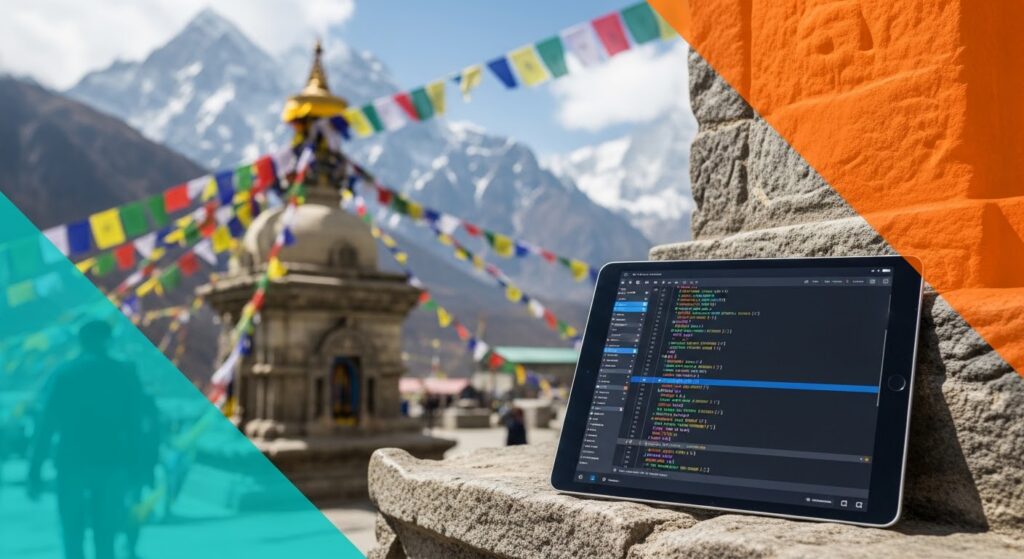
A beautiful mountain hotel advertising high-speed internet sounds perfect.
But a speed-test screenshot doesn’t tell the whole story.
A connection may deliver excellent download speeds at 10 a.m. and become unstable during evening congestion.
It may be fast but have poor upload performance.
It may work perfectly under normal weather conditions but become unreliable during heavy rain.
For a digital nomad, the important measurements are:
- Download speed
- Upload speed
- Latency
- Packet loss
- Stability over several hours
- Performance during peak periods
Someone watching YouTube needs a different connection from someone uploading a 20 GB video file to a cloud server.
The Monsoon Problem
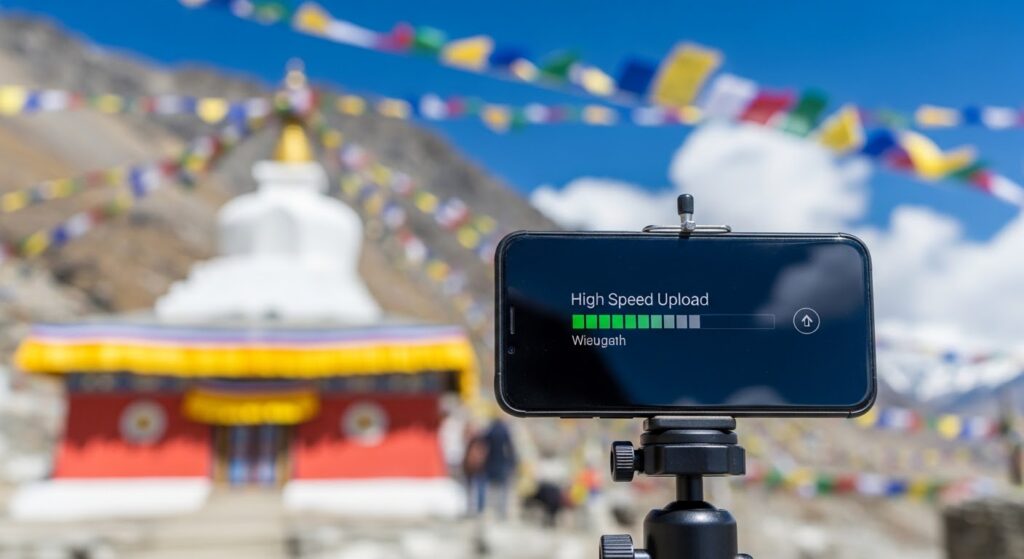
This is where Himalayan remote work becomes very different from working in a city.
The monsoon is not merely a matter of carrying an umbrella.
Heavy rainfall can affect roads, electricity, mobile infrastructure and physical access to the area.
- A short-term tourist may simply postpone a journey.
- A remote worker may have a client meeting in two hours.
- This makes preparation essential.
- Keep important documents offline.
- Download files before you need them.
- Maintain a power bank.
- Have a backup internet connection.
- Keep your laptop charged.
And if you have an important presentation or client meeting, don’t depend entirely on a single hotel Wi-Fi network.
The mountains reward redundancy.
The Power Backup Question
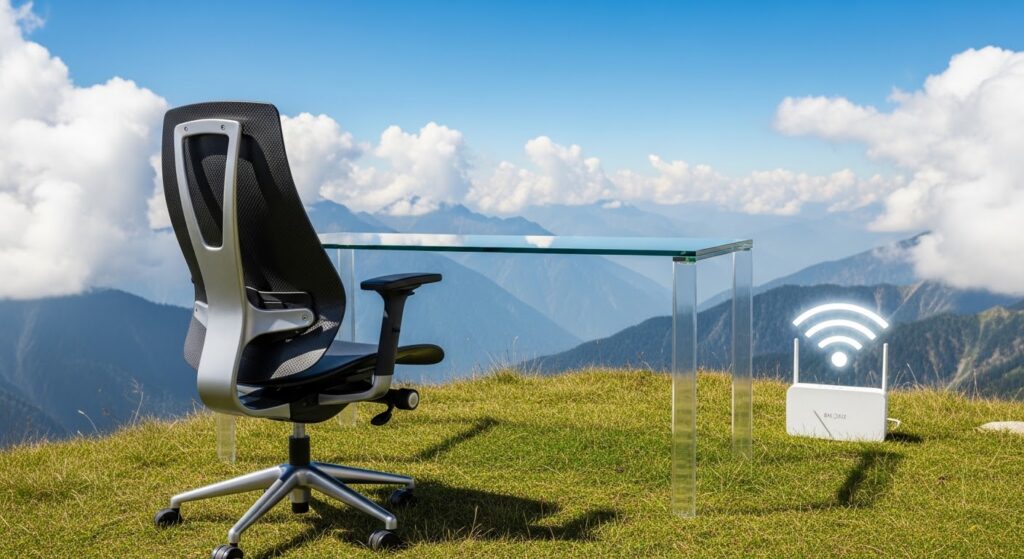
Internet without electricity is useless.
A laptop battery may keep you working temporarily, but routers, network equipment and charging systems still require power.
A serious remote setup should therefore consider:
- UPS or backup battery
- High-capacity power bank
- Laptop power bank compatible with your device
- Portable inverter
- Solar charging options for longer stays
Solar power can be particularly interesting for mountain-based work, although practical output depends on weather, roof orientation, available space and battery capacity.
A small solar panel is not a magic replacement for grid electricity.
But combined with a battery system, it can provide another layer of resilience.
Your Office Could Be a Balcony
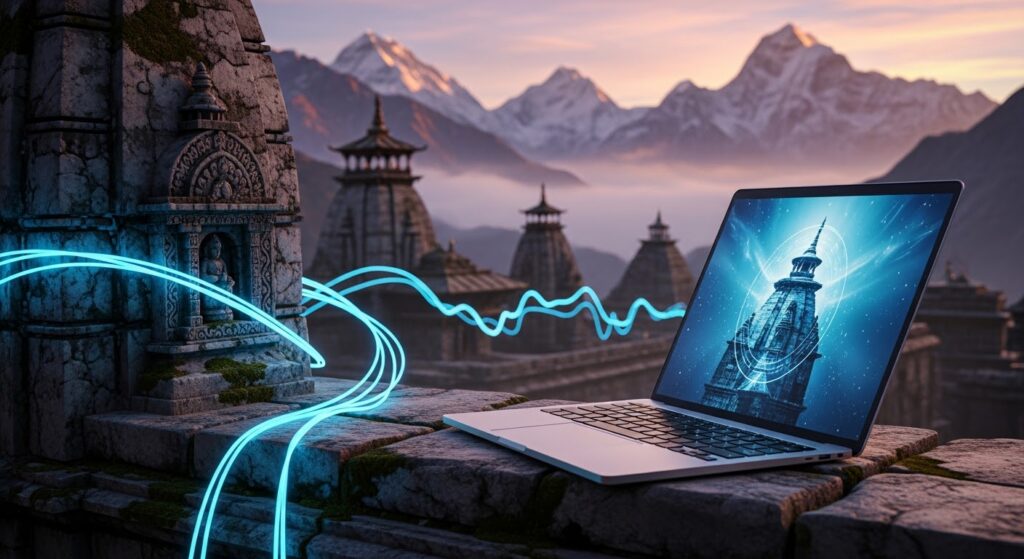
Now comes the part that makes Guptkashi irresistible.
Imagine replacing fluorescent office lighting with Himalayan daylight.
- Your desk faces mountains.
- Your lunch break becomes a short walk.
- Instead of traffic horns, you hear wind, birds and distant temple bells.
- This isn’t just an aesthetic upgrade.
- The environment in which we work influences how we behave.
Cities produce constant interruptions: traffic, notifications, meetings, advertisements, crowds and background noise.
- A quieter environment can make focused work easier for some people.
- This is where the concept of **deep work** becomes interesting.
- Guptkashi naturally removes many of the distractions associated with urban life.
- But that doesn’t mean productivity automatically improves.
- The mountains can introduce their own distractions.
A spectacular view outside your window can be just as effective at destroying concentration as an office notification.
Spiritual Stillness Meets Digital Labor
Guptkashi’s appeal goes beyond scenery.
The region has a deep religious and cultural identity.
Ancient temples, pilgrimage routes and daily spiritual practices exist alongside mobile networks, laptops and cloud computing.
That contrast creates an unusual working environment.
You might spend the morning editing a business presentation.
A few minutes later, you hear temple bells.
You may attend a video conference with colleagues in Bengaluru, Delhi or London.
Then you step outside and see the Himalayan landscape.
It is a strange combination:
**global work operating inside a deeply local environment.**
The Psychology of a Mountain Office
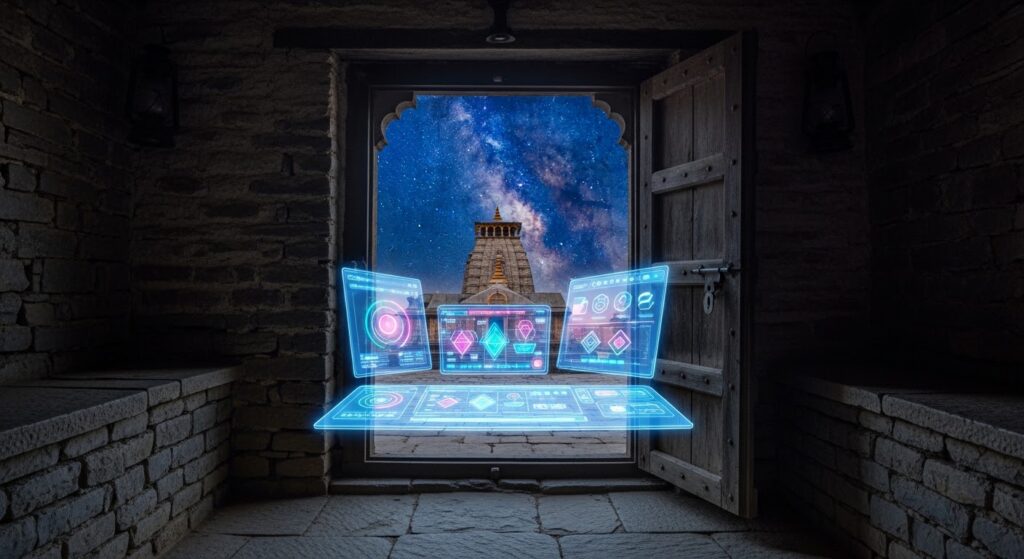
There is an important psychological shift that happens when your surroundings change dramatically.
In a city, work and personal life can blur together.
- The office is always nearby.
- The traffic is always present.
- Notifications never stop.
- In Guptkashi, physical distance creates a natural separation.
- You can close your laptop and immediately leave the workspace.
- A walk becomes a genuine walk rather than a commute.
- The mountains create a slower rhythm.
- For some professionals, this can improve mental clarity.
- For others, isolation can become difficult.
- Digital nomad life isn’t automatically peaceful.
- The same quietness that enables concentration can also produce loneliness.
That is why a good remote-work destination needs both **connectivity and community**.
What About the Cost?
Compared with major Indian metros, a longer stay in a Himalayan town can potentially be economical, particularly for someone willing to rent a room or homestay rather than stay permanently in a hotel.
But prices in pilgrimage destinations are highly seasonal.
During the Kedarnath pilgrimage season, accommodation demand can rise substantially.
A long-term remote worker should therefore negotiate monthly accommodation rather than evaluate the destination solely through daily hotel rates.
The biggest savings may not come from food or accommodation.
- They may come from lifestyle.
- There is no expensive urban commute.
- No daily café spending is necessary.
- Entertainment can be remarkably inexpensive.
- And your biggest luxury—the view—is free.
A Digital Nomad's Ideal Setup
A practical mountain workstation doesn’t need to be extravagant.
A compact setup might include:
- Laptop + external monitor
- Noise-cancelling headphones
- Primary broadband
- Backup mobile hotspot
- UPS or battery backup
- Power bank
- Portable charging equipment
- Cloud storage with offline copies
- Weather-resistant backpack
And perhaps the most important item: patience.
Mountain infrastructure does not always operate on metropolitan timelines.
The Creator's Opportunity
For content creators, Guptkashi presents an additional opportunity.
The destination itself becomes content.
A single stay can generate material around:
- Kedarnath travel logistics
- Himalayan tourism
- Spiritual tourism
- Remote work
- Mountain infrastructure
- Homestays
- Local food
- Temple heritage
- Climate resilience
- Road connectivity
- Digital transformation
- Sustainable tourism
The key is not to produce another generic “beautiful mountains” video.
The stronger story is the contrast.
- Ancient temple bells + modern internet.
- Mountain villages + digital entrepreneurship.
- Pilgrimage economy + remote work.
- Traditional lifestyles + global employment.
That contrast gives Guptkashi a much more compelling narrative.
The Future of Himalayan Remote Work
The digital nomad movement is usually associated with Bali, Thailand, Lisbon or Dubai.
But India’s Himalayan towns offer a completely different proposition.
They combine relatively affordable living with dramatic landscapes, spiritual heritage and growing digital connectivity.
The next stage will depend on infrastructure.
- Reliable broadband.
- Stable electricity.
- Better healthcare access.
- Waste management.
- Responsible tourism.
- Good accommodation.
And, critically, disaster-resilient infrastructure.
Without these systems, digital nomadism remains a temporary novelty.
With them, mountain towns could develop into genuine remote-work ecosystems.
The Blueprint for Digital Stillness
Guptkashi isn’t a perfect digital office.
And that is precisely why it is interesting.
The mountains force you to think differently about connectivity.
- You learn to maintain backups.
- You stop assuming that electricity will always be available.
- You plan around weather.
- You separate essential work from non-essential work.
And you discover that productivity isn’t necessarily about having the fastest internet connection.
Sometimes it is about having fewer reasons to look away from the screen.
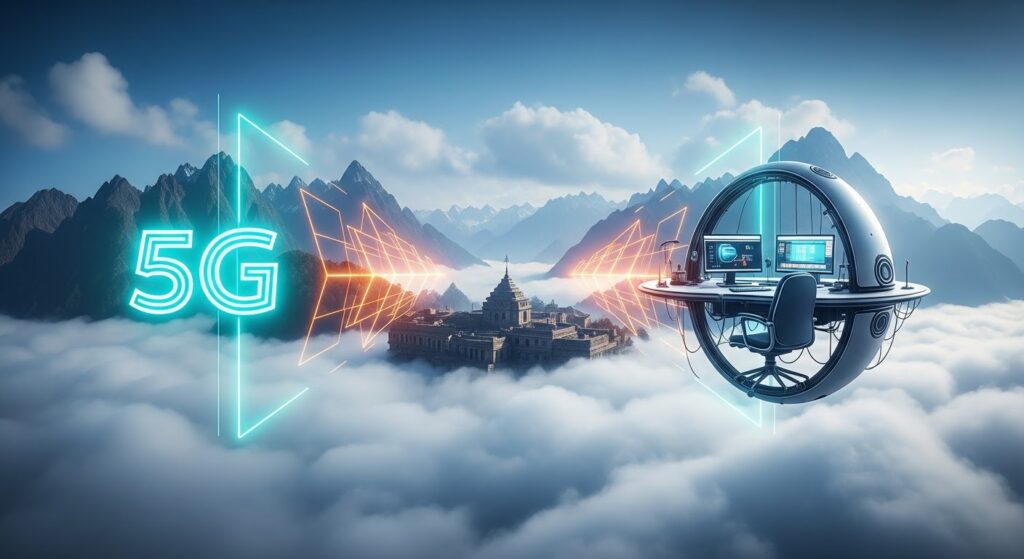
The ultimate appeal of Guptkashi is therefore not simply **5G versus mountains**.
It is the possibility of combining two worlds that traditionally seemed incompatible.
Ancient spirituality and modern employment.
Slow living and high-speed communication.
Mountain silence and global business.
The New Himalayan Workday
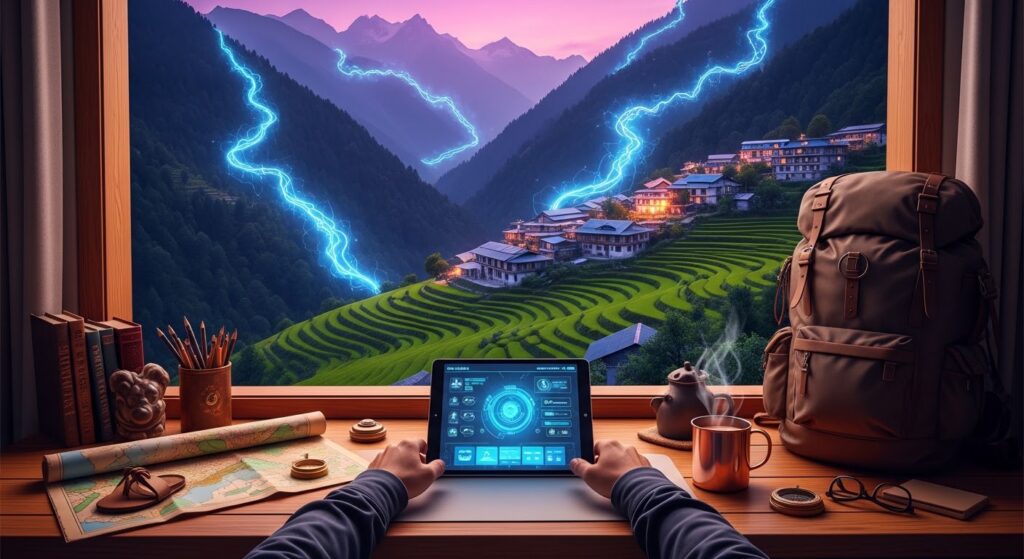
- Picture the routine.
- Wake up early.
- Watch the first light reach the mountains.
- Hear temple bells in the distance.
- Have breakfast.
- Open your laptop.
Join a meeting with a client in another city—or another country.
- Work for several hours.
- Close the laptop.
- Walk outside.
The Himalayas are still there.
- No traffic.
- No office elevator.
- No crowded train journey home.
- Just the mountain air.
That may ultimately be the real promise of digital nomad life in Guptkashi.
Not escaping work.
**But changing the environment in which work happens.**
And perhaps, in an increasingly connected world, the ultimate luxury isn’t faster technology.
It is having the freedom to use that technology from somewhere that makes you slow down.