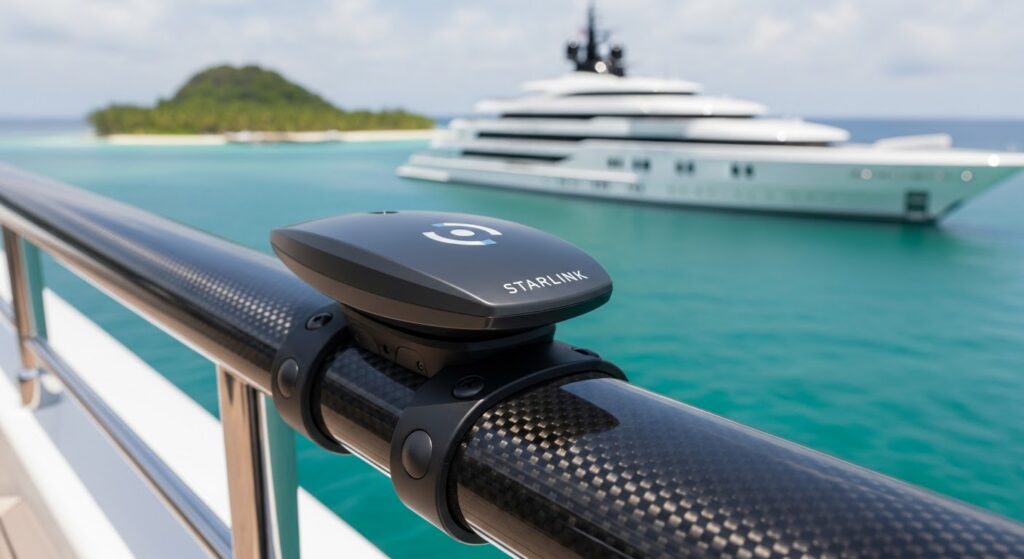
Introduction: The New Standard of Luxury at Sea
There was a time when luxury yacht owners accepted poor internet connectivity as an unavoidable compromise. Sailing away from the coastline meant leaving behind the conveniences of modern digital life. Video calls would freeze, emails would take several minutes to send, cloud applications became unreliable, and streaming a simple movie often tested the patience of guests who were otherwise enjoying a vessel worth millions of dollars. For decades, this trade-off was considered the price of experiencing complete freedom on the open ocean.
In 2026, that assumption no longer holds true. High-end travelers, corporate executives, family offices, charter operators, and superyacht owners increasingly expect the same digital experience at sea that they enjoy in a luxury penthouse or private office on land. Business leaders conduct board meetings while cruising through the Mediterranean, investors monitor financial markets during Atlantic crossings, and families expect uninterrupted 4K entertainment throughout extended voyages. The modern luxury yacht is no longer merely a floating resort—it has evolved into a floating home, office, entertainment center, and command hub.
This transformation has been made possible largely through Starlink Maritime, SpaceX’s Low Earth Orbit (LEO) satellite internet system. Unlike traditional Very Small Aperture Terminal (VSAT) technology that depended on geostationary satellites positioned nearly 36,000 kilometers above Earth, Starlink utilizes thousands of satellites orbiting approximately 550 kilometers above the planet. This seemingly simple change in orbital distance has fundamentally altered the economics and performance of maritime connectivity.
The shift is not merely technological; it is financial. Yacht owners who once spent tens of thousands of dollars on hardware and substantial monthly fees for relatively poor internet performance are now discovering that Starlink can deliver significantly higher speeds, dramatically lower latency, and lower total ownership costs. The question is no longer whether Starlink works—it clearly does for many maritime users. The more important question for luxury yacht owners is whether the investment generates measurable financial and operational value over the long term.
This article explores that question in depth by examining installation costs, monthly operating expenses, performance comparisons, return on investment, charter value, crew welfare, hybrid networking strategies, and the future of connected luxury travel.
Why Digital Connectivity Has Become Essential for Luxury Yachting
Luxury has always been associated with convenience, exclusivity, and seamless experiences. In today’s digital economy, uninterrupted internet access has become an integral part of that definition. High-net-worth individuals rarely disconnect completely during vacations. Instead, they blend work and leisure, managing businesses while spending time with family aboard private yachts. It is increasingly common to see CEOs conducting international meetings from the deck of a yacht anchored near the Amalfi Coast or investors executing time-sensitive trades while cruising through the Caribbean.
The growing popularity of remote work has accelerated this trend. Executives are no longer tied to physical offices, making luxury yachts attractive alternatives for extended stays. Reliable internet enables access to cloud-based productivity platforms, virtual private networks, secure file transfers, artificial intelligence tools, and enterprise communication systems. These capabilities transform a yacht into a fully functional floating office without compromising comfort or privacy.
Entertainment expectations have evolved as well. Guests now arrive expecting uninterrupted access to Netflix, YouTube, Disney+, Spotify, gaming platforms, and social media. Families share high-resolution travel content in real time, influencers livestream from remote islands, and charter guests expect instant connectivity throughout their journey. What was once considered an optional luxury feature has become a baseline expectation for premium travel experiences.
The Limitations of Legacy VSAT Systems

For more than three decades, VSAT technology represented the gold standard of maritime communication. While it enabled vessels to stay connected far from shore, the technology suffered from inherent limitations that became increasingly obvious as digital demands grew. Signals had to travel approximately 72,000 kilometers for a complete round trip between Earth and geostationary satellites, resulting in latency often ranging from 600 to 800 milliseconds. Although this delay may appear insignificant numerically, it created noticeable interruptions during video conferencing, cloud computing, online gaming, and voice communications.
Beyond performance issues, legacy VSAT systems required substantial capital investment. Hardware installations often exceeded $25,000 and could easily surpass $100,000 for larger superyachts. Monthly subscription costs frequently ranged between $3,000 and $20,000 depending on bandwidth requirements and cruising regions. Long-term contractual commitments, expensive maintenance, and mechanical tracking systems added further financial burdens throughout the equipment’s lifecycle.
Maintenance represented another hidden expense. Traditional VSAT antennas contained moving mechanical components designed to track satellites continuously as vessels changed direction. These systems required regular servicing, calibration, lubrication, and occasional replacement of mechanical parts. Every maintenance visit translated into additional operational costs and potential downtime.
For many yacht owners, these expenses were tolerated because no practical alternative existed. However, the arrival of Starlink Maritime has fundamentally challenged this decades-old business model.
Starlink Maritime: A New Era of Ocean Connectivity
Starlink Maritime introduces an entirely different technological architecture by utilizing thousands of interconnected Low Earth Orbit satellites. Because these satellites orbit significantly closer to Earth, communication signals travel dramatically shorter distances, reducing latency to approximately 20 to 40 milliseconds under typical conditions. The improvement is immediately noticeable during real-time communication, cloud computing, financial transactions, and streaming applications.
Marine-grade Starlink Flat High Performance (FHP) hardware has been engineered specifically for harsh ocean environments. Unlike residential equipment, maritime antennas are built to withstand continuous exposure to saltwater, ultraviolet radiation, heavy rainfall, strong winds, and constant vessel movement. Their phased-array technology contains fewer moving mechanical parts than traditional VSAT systems, contributing to lower maintenance requirements and improved reliability over time.
Hardware investments generally range between $2,500 and $10,000 depending on vessel requirements, while professional installation costs typically vary from approximately $4,000 for smaller yachts to more than $25,000 for large superyachts requiring complex deck integration and enterprise networking infrastructure. Monthly subscription costs generally range between $250 and $5,000 depending on the selected service tier, priority bandwidth requirements, and expected oceanic roaming patterns.
Although these figures represent a meaningful investment, they remain significantly lower than comparable VSAT deployments while delivering substantially better network performance.
Understanding the Financial Return on Investment
When evaluating technology investments for luxury yachts, focusing solely on upfront purchase costs provides an incomplete picture. A more meaningful assessment considers the total cost of ownership over several years, incorporating hardware expenses, installation costs, subscription fees, maintenance requirements, operational efficiencies, and potential revenue enhancements.
Consider a superyacht currently operating with a legacy VSAT installation costing approximately $60,000, combined with monthly service fees of $6,000. Over a five-year period, subscription costs alone would total approximately $360,000, bringing total ownership costs close to $420,000 before maintenance expenses are included.
By comparison, a Starlink Maritime deployment consisting of hardware, professional installation, and premium monthly subscriptions may total approximately $140,000 over the same five-year period. While actual costs vary depending on vessel size and usage requirements, the potential savings can exceed hundreds of thousands of dollars across the equipment lifecycle.
The financial advantages extend beyond reduced operating expenses. Faster internet connectivity supports business continuity, increases charter competitiveness, improves guest satisfaction, and enhances crew retention. Collectively, these benefits generate indirect financial returns that often exceed the direct cost savings associated with lower subscription fees.
Starlink's Impact on Luxury Charter Businesses
The luxury yacht charter industry has become increasingly competitive. Guests paying six-figure weekly charter rates expect flawless experiences across every aspect of their journey. In this environment, reliable high-speed internet has evolved into a deciding factor influencing booking decisions, customer satisfaction, online reviews, and repeat business.
Charter brokers frequently receive inquiries regarding onboard Wi-Fi capabilities before discussing accommodation layouts or entertainment facilities. Corporate groups increasingly choose yachts capable of supporting uninterrupted virtual meetings, while families seek vessels where children can stream educational content or entertainment without interruption. Social media creators expect rapid uploads of high-resolution photography and video, while business travelers require secure access to enterprise applications.
A yacht equipped with dependable Starlink connectivity can often justify premium charter pricing because guests recognize the practical value of uninterrupted digital access. Higher occupancy rates, improved customer reviews, and stronger repeat bookings collectively strengthen long-term revenue generation. In many cases, the incremental income generated by improved charter performance may offset a significant portion of the connectivity investment.
The Operational Value of Floating Offices
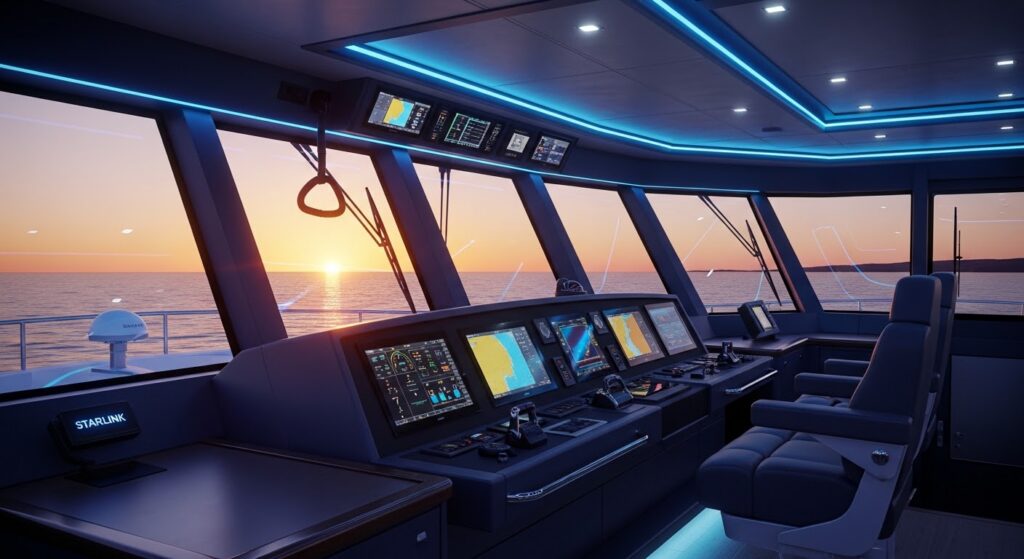
The concept of a floating office has become increasingly realistic as internet performance improves. Modern executives frequently combine leisure travel with business responsibilities, making uninterrupted connectivity essential rather than optional. Starlink enables seamless participation in international board meetings, secure access to enterprise software, cloud-based collaboration, document management systems, and artificial intelligence applications.
Financial professionals can monitor global markets continuously while traveling. Lawyers can access case files securely through encrypted VPN connections. Architects and engineers can collaborate on large design files using cloud platforms. Consultants can deliver presentations to international clients without experiencing disruptive communication delays.
These capabilities fundamentally alter the way high-net-worth individuals utilize their yachts. Instead of limiting voyages to short holidays, owners increasingly undertake extended journeys while maintaining professional productivity comparable to their land-based offices.
Crew Welfare, Recruitment, and Operational Efficiency
The advantages of high-speed connectivity extend beyond owners and guests. Professional yacht crews increasingly consider internet quality an important factor when evaluating employment opportunities. Extended periods away from family can create emotional challenges, and reliable internet enables crew members to maintain regular communication through video calls, messaging platforms, and social media.
Improved connectivity also supports online training, certification programs, banking services, telemedicine consultations, and digital administrative tasks. These benefits contribute to higher morale, stronger retention, and easier recruitment of experienced maritime professionals.
Replacing qualified crew members can be costly, involving recruitment expenses, onboarding, training, and operational disruption. By supporting crew welfare through dependable internet access, yacht owners indirectly reduce turnover-related costs while fostering a more stable and motivated workforce.
Hybrid Networks: Maximizing Performance and Reliability
Although Starlink has dramatically improved maritime connectivity, many luxury yachts continue adopting hybrid networking strategies designed to maximize uptime and optimize operating costs. Intelligent SD-WAN systems manufactured by companies such as Peplink and MDS Blender combine Starlink with 5G cellular networks, LTE services, and marina Wi-Fi into a unified communication platform.
As a yacht approaches a marina, the network automatically shifts traffic to available shore-based internet connections, preserving premium satellite bandwidth for offshore operations. Once the vessel departs coastal coverage, the system seamlessly transitions back to Starlink without requiring manual intervention.
This intelligent network management delivers approximately 99.9 percent operational uptime under well-designed configurations while minimizing unnecessary satellite data consumption. Such hybrid architectures represent the emerging standard among premium yacht operators seeking maximum reliability.
Looking Ahead: The Future of Connected Luxury Travel
Maritime connectivity continues evolving rapidly. Over the next several years, satellite constellations are expected to expand further, increasing network capacity, improving global coverage, and enhancing overall performance. Artificial intelligence will likely optimize bandwidth allocation automatically, while cybersecurity measures become increasingly sophisticated to protect sensitive business communications aboard private vessels.
Competition among satellite providers may also drive further innovation, potentially reducing costs while improving service quality. Yacht owners investing in flexible networking infrastructure today position themselves to adopt future technologies without extensive hardware replacement.
Rather than viewing connectivity as a standalone expense, forward-thinking owners increasingly recognize it as strategic infrastructure supporting productivity, operational efficiency, guest satisfaction, and long-term asset value.
Conclusion: A Smart Investment for the Modern Luxury Yacht

The economics of maritime connectivity have changed fundamentally. Traditional VSAT systems once represented the only viable solution for offshore communication, but their combination of high capital costs, expensive subscriptions, elevated latency, and ongoing maintenance requirements makes them increasingly difficult to justify for many yacht owners.
Starlink Maritime offers a compelling alternative by delivering dramatically higher speeds, lower latency, simpler hardware, reduced maintenance, and significantly lower total ownership costs. Beyond direct financial savings, reliable high-speed internet enhances charter revenue potential, strengthens guest satisfaction, supports crew welfare, enables remote business operations, and improves overall vessel competitiveness in an increasingly digital luxury market.
For private yachts, charter vessels, corporate fleets, and superyachts alike, Starlink represents far more than a technological upgrade. It is an investment in operational efficiency, business continuity, customer experience, and future readiness. As digital connectivity becomes as essential as navigation systems or luxury interiors, adopting modern satellite communications is no longer simply a matter of convenience—it has become a defining characteristic of the next generation of luxury yachting.