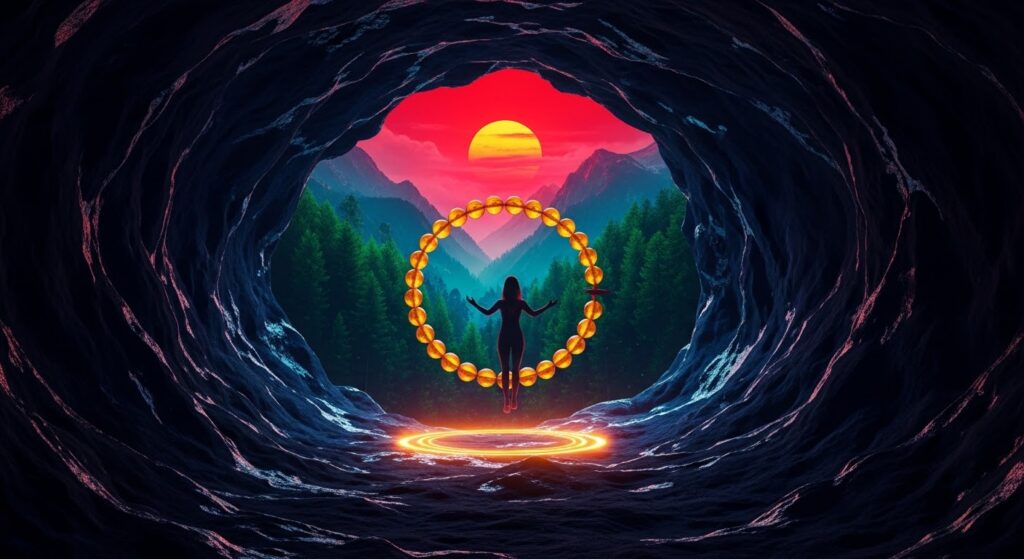
**What happens when you leave the crowded pilgrimage route and climb into a world where the sound of bells, conversations and traffic slowly disappears?**
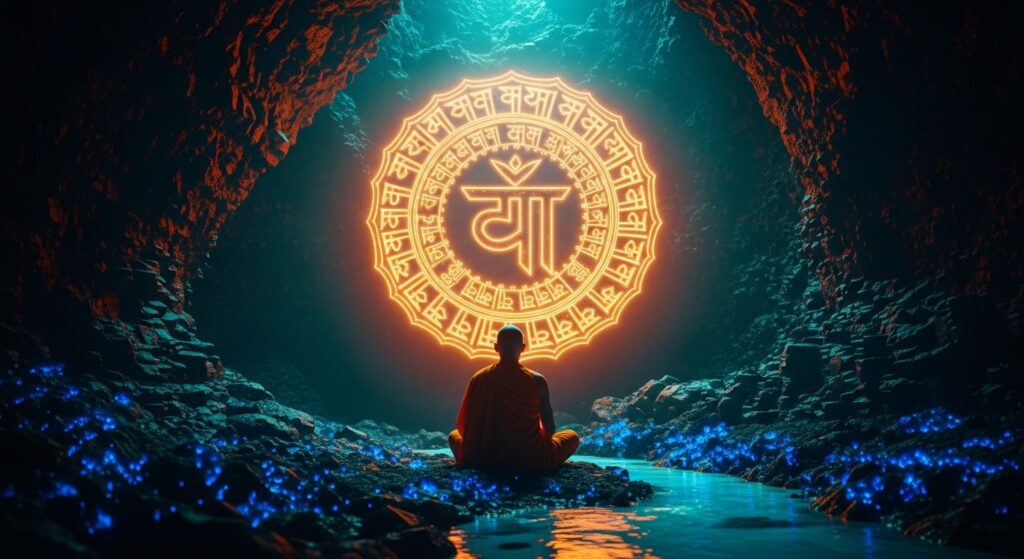
Deep in the Himalayan landscape around the Mandakini Valley, beyond the familiar pilgrimage experience of Kedarnath, lie natural caves and secluded mountain shelters associated with the age-old tradition of asceticism and meditation.
While thousands of pilgrims move through the valley toward Kedarnath, some seekers have historically chosen a completely different path—away from crowds, infrastructure and comfort.
Their destination is not a hotel.
It is not an ashram.
Sometimes, it is simply a cave in the mountains.
And that raises a fascinating question:
**Why would anyone voluntarily exchange the modern world for darkness, cold, isolation and silence?
Beyond the Kedarnath Pilgrimage Trail
For most visitors, the Kedarnath journey follows a familiar rhythm.
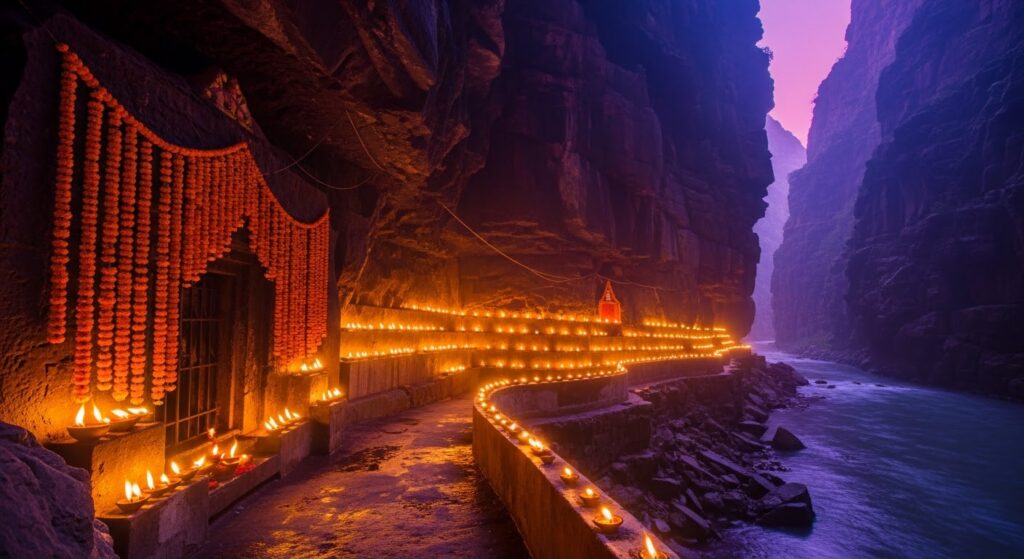
There are pilgrims, ponies, palkis, shops, shelters and the constant movement of people toward one of India’s most revered Himalayan temples.
But the Mandakini Valley has another personality.
Move away from the main pilgrimage routes and the landscape gradually becomes quieter. Human habitation becomes sparse. The soundscape changes from conversations and bells to wind, flowing water and distant mountain echoes.
The transition is almost cinematic.
One moment, you are surrounded by the energy of a pilgrimage.
The next, the mountains appear almost empty.
It is here that the idea of the Himalayan cave hermitage begins to make sense.
For centuries, the Himalayas have attracted ascetics, monks and spiritual seekers who deliberately sought places where ordinary life could be stripped down to its essentials.
The cave provided something that modern life struggles to offer:
**distance from distraction.**
Why Choose a Cave?
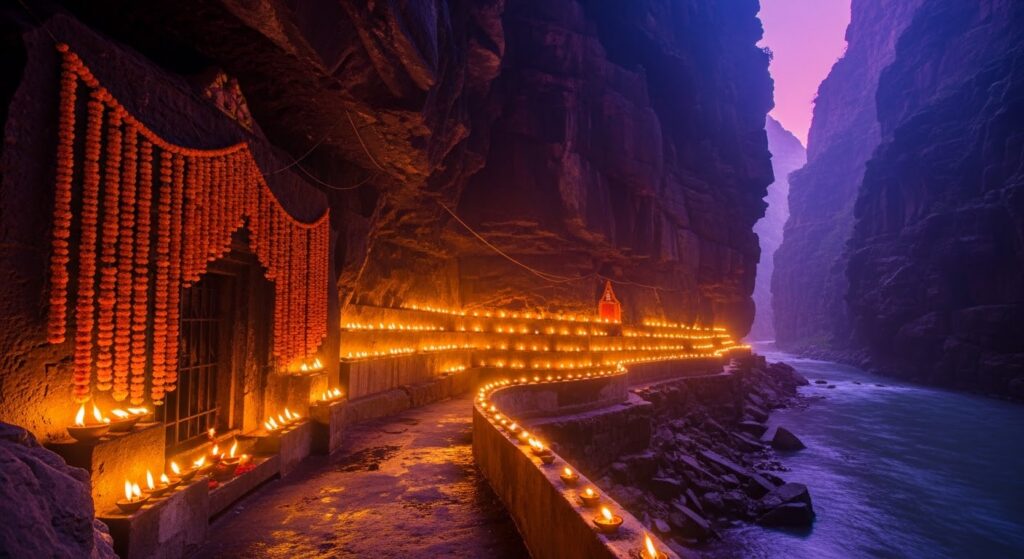
At first glance, living inside a mountain cave appears almost impossible.
There may be limited space, little natural light and difficult access to food and water. Winters can be severe, and the surrounding terrain can be dangerous.
Yet a natural cave can provide several practical advantages.
It offers shelter from wind and weather and, importantly for an ascetic, isolation.
There are fewer visitors.
Fewer possessions are required.
There is little entertainment.
There is almost nowhere to go.
That physical simplicity can become part of a spiritual discipline.
Instead of constantly changing the environment around them, the practitioner changes their relationship with the environment.
The mountain becomes the boundary.
The cave becomes the room.
And silence becomes the constant companion.
The Architecture of Isolation
A Himalayan cave isn’t a monastery built according to a carefully designed architectural plan.
Its architecture is geological.
Rock determines the walls. The mountain determines the ceiling. The entrance determines how much light enters.
Some caves may have been naturally formed through geological processes, while others may have been modified to make them more practical for human habitation.
This distinction matters.
Not every cave in the Himalayas should automatically be described as “prehistoric” or as evidence of thousands of years of continuous human occupation.
The spiritual traditions surrounding Himalayan caves can be extremely old, but the history of any individual cave requires archaeological or historical evidence before making such claims.
And perhaps that uncertainty makes them even more fascinating.
The mountain keeps part of the story hidden.
The Living Hermitage
The most fascinating aspect of these caves isn’t the rock.
It is the people who choose to live among it.
An encounter with an experienced Himalayan ascetic can challenge many assumptions about what constitutes a comfortable life.
For someone accustomed to smartphones, air conditioning, constant connectivity, restaurants and 24-hour entertainment, prolonged solitude can seem almost unimaginable.
But for an ascetic, these things may represent precisely what they are trying to escape.
Their daily routine may revolve around meditation, prayer, simple food, collecting water and maintaining the basic necessities required for survival.
There is no conventional nine-to-five schedule.
No social media feed.
No constant stream of notifications.
The day is governed largely by nature and spiritual practice.
And perhaps that is the most striking contrast of all.
**The modern world is built around stimulation. The hermitage is built around reduction.**
What Does Silence Do to the Human Mind?
This is where an ancient Himalayan practice meets a very modern scientific question.
Contemporary research has increasingly examined meditation, mindfulness, attention, stress regulation and the psychological effects of solitude.
But it is important not to turn this research into exaggerated claims.
There is no simple scientific formula saying that entering a Himalayan cave will “rewire the brain” or automatically produce extraordinary cognitive abilities.
Nor should high-altitude hypoxia be portrayed as a health treatment.
Altitude can place significant physiological stress on the human body, particularly for people who are not acclimatized.
The more interesting question is psychological:
**What happens when a person removes many of the distractions that normally compete for their attention?**
For hours or days, there may be little to look at.
Little to hear.
Little to interact with.
The mind has fewer external distractions.
And that can make meditation a radically different experience from meditation practiced in a busy city apartment.
The Sound of the Mountain

Stand outside a Himalayan cave and the environment can appear extraordinarily loud.
- Glacial streams roar through valleys.
- Wind moves across cliffs.
- Water falls over rocks.
But step inside a natural chamber and the experience can change dramatically.
The cave becomes a physical boundary between the individual and the landscape.
- Sound changes.
- Light disappears.
- The visual field becomes smaller.
- The outside world feels distant.
This sensory transition may be one reason caves have such a powerful psychological presence.
But rather than claiming that cave acoustics automatically synchronize brain waves or create specific neurological changes, it is more accurate to describe the experience itself.
**The cave doesn’t have to alter the brain to alter your perception of the world.**
Sometimes, removing sensory information is enough to make you notice what was previously ignored.
Life Above the Pilgrimage Trail
Survival at altitude is not romantic.
The Himalayan environment can be unpredictable.
Weather can change rapidly. Temperatures can fall sharply. Trails can become slippery and dangerous. Water sources may be difficult to access, and winter conditions can make isolated locations extremely challenging.
For an ascetic who has spent years in the mountains, these conditions may become part of a disciplined lifestyle.
For a visitor, however, they should never be underestimated.
A cave that looks mysterious and beautiful in a photograph can be a completely different environment after sunset, during heavy rain or in winter.
That is why documenting such places requires respect rather than adventure tourism mentality.
These are not simply “hidden Instagram locations.”
They are places where people may live, meditate and practice their spiritual traditions.
The Other Side of Kedarnath
The popular image of Kedarnath is dominated by the temple, the pilgrimage route and the spectacular Himalayan landscape.
But the region has another story.
It is the story of people who aren’t necessarily travelling toward a destination.
They are withdrawing from destinations altogether.
For pilgrims, the mountain can be a path toward the divine.
For ascetics, the mountain itself can become the place of practice.
That difference is profound.
One journey moves through the mountains.
The other attempts to disappear into them.
It is value per experience.
A ₹1 lakh Bali trip and a ₹1 lakh Dubai trip can feel completely different because they purchase different types of experiences.
Spiritual ROI vs Status ROI
Perhaps the most interesting way to compare these destinations is through an unconventional concept:
Return on Investment from a holiday.
Bali offers what we might call spiritual ROI.
You may return with better memories of nature, wellness, culture, solitude and personal reflection.
Dubai provides something closer to status ROI.
The value comes from experiencing extraordinary architecture, luxury hospitality, premium shopping, exclusive venues and the atmosphere of one of the world’s most ambitious cities.
Can Ancient Solitude Teach the Modern World Anything?
Perhaps the most interesting lesson isn’t that everyone should move into a cave.
They shouldn’t.
Modern life provides enormous benefits that an isolated Himalayan existence cannot.
The lesson may instead be about **attention**.
Most people today live surrounded by continuous information.
- Messages arrive instantly.
- Videos never end.
- News updates appear throughout the day.
- Social networks constantly compete for attention.
- Silence has become surprisingly difficult to find.
- The Himalayan cave represents the opposite extreme.
- There is almost nothing.
- And in that emptiness, the mind has nowhere to escape except into itself.
Perhaps this is - why the idea continues to fascinate modern travellers.
- We don’t necessarily want to live in a cave.
But many of us secretly wonder what it would feel like to spend even one day without the noise of modern life.
The Mystery That Remains
The Mandakini Valley doesn’t give up its secrets easily.
- Mist can cover the mountains.
- Clouds can erase entire ridgelines.
- Trails disappear into forests and rock.
And somewhere beyond the familiar pilgrimage routes, caves remain tucked into the landscape.
- Some have stories.
- Some have spiritual associations.
- Some may have been used by individuals seeking solitude.
But separating documented history from legend is essential.
The real mystery isn’t whether every cave has a story stretching back thousands of years.
The deeper mystery is much simpler:
**Why has the human desire for solitude survived for so long?**
From ancient hermitages to modern meditation retreats, the search continues.
We change our technology.
- We change our cities.
- We change our lifestyles.
But the desire to occasionally escape all of it remains remarkably constant.
The Echo of the Mandakini
Eventually, the journey leads back toward the world of people.
The bells return.
Pilgrims appear on the trail.
The familiar sounds of commerce and conversation gradually replace the silence.
Yet the experience of the cave stays behind in your mind.
Perhaps the greatest lesson of these Himalayan hermitages isn’t hidden in some extraordinary scientific phenomenon.
It is hidden in something far more ordinary—and far more difficult to achieve.
**Silence.**
In a world where almost every empty moment is filled with information, a place where nothing demands your attention can feel almost revolutionary.
The mountains may keep their secrets.
The caves may remain mysterious.
But perhaps the greatest secret isn’t hidden inside the rocks.
**It is hidden inside the people who choose to enter them—and what they discover when the outside world finally becomes quiet.**
A Note for Travellers
Caves and remote hermitages around the Mandakini Valley should not be treated as ordinary tourist attractions. Some locations may be difficult or dangerous to access, and some may be private spiritual spaces.
Do not enter occupied caves without permission, disturb meditation practices, remove objects, or attempt difficult off-trail climbs without appropriate local guidance.
In the high Himalayas, **respect for the mountain and the people who live there should come before the photograph.**