
The Traditional Real Estate Rulebook Is Being Rewritten
For decades, the global real estate industry operated on a simple assumption: people lived close to where they worked. Residential neighborhoods expanded around office districts, commercial towers dominated city skylines, and property values were largely determined by local employment opportunities. A person’s career and their property investment strategy were deeply connected to one geographic location. Companies built headquarters, employees purchased homes nearby, and governments designed taxation and urban planning around fixed populations. That system generated enormous wealth for institutional investors, developers, and homeowners, but it also created significant limitations. Individuals became financially dependent on the economic performance of a single city, while corporations invested billions into office infrastructure that often remained underutilized.
By July 2026, that model has undergone one of the most significant transformations in modern economic history. Remote work has evolved from an emergency workplace solution into a permanent structural feature of the global economy. Millions of professionals now earn salaries from companies headquartered thousands of miles away while living wherever quality of life, tax efficiency, affordability, and connectivity create the greatest financial advantage. Employment has become increasingly borderless, income has become increasingly mobile, and real estate has become increasingly global.
This transformation has given rise to what many analysts now describe as the Nomadic Equity Business Model—a framework where remote professionals no longer think of property ownership as purchasing a single home but instead view real estate as a diversified international portfolio designed to maximize income, reduce tax exposure, and generate long-term wealth. The focus is no longer merely on owning property. It is about strategically owning the right property in the right jurisdictions while maintaining complete professional mobility.
The traditional real estate market is not necessarily disappearing, but its foundations are unquestionably shifting. While many local markets experience stagnation due to changing workplace dynamics, a new generation of digital professionals is identifying opportunities across borders, using geographic arbitrage to transform overlooked assets into high-yield investments. Rather than remaining financially tied to one economy, they are building equity across multiple countries, leveraging technology, remote employment, and institutional-grade investment structures that were previously available only to multinational corporations.
The Post-Office Era and the Birth of Liquid Capital
The office tower was once the physical symbol of economic productivity. Major corporations competed to construct larger headquarters, prestigious business districts commanded premium property prices, and daily commuting shaped urban infrastructure across continents. However, as organizations increasingly embraced distributed teams, many of these assumptions began to unravel.
Across much of the developed world, hybrid and remote employment have significantly reduced demand for permanent office space. Commercial vacancy rates have increased in numerous metropolitan centers, prompting institutional investors to reconsider their long-term allocation strategies. Rather than concentrating capital exclusively in commercial skyscrapers, investment funds are increasingly exploring residential assets designed for mobile professionals who require flexibility rather than permanence.
This transition has fundamentally altered the velocity of capital. Instead of remaining trapped inside long-term office leases and geographically fixed housing markets, investment is flowing toward adaptable residential ecosystems capable of serving an internationally mobile workforce.
Liquid capital is replacing static capital.
Rather than purchasing one expensive home in a high-cost city simply because employment requires physical attendance, remote professionals can strategically distribute their investments across multiple countries while choosing to live wherever economic efficiency is greatest.
The implications extend far beyond individual lifestyle preferences. Governments, developers, financial institutions, and multinational corporations are redesigning investment models around populations that move freely across borders while maintaining stable digital incomes.
Understanding the Nomadic Equity Framework

The Nomadic Equity Business Model represents far more than remote work combined with property investment. It is a comprehensive financial ecosystem that integrates recurring income, diversified ownership, technology-driven management, and international mobility.
Instead of treating accommodation as a monthly expense, many emerging platforms allow remote professionals to convert their housing costs into equity-building opportunities. Premium subscription-based living communities increasingly combine flexible housing with fractional ownership structures, enabling members to accumulate ownership interests across multiple properties while continuing to relocate internationally.
Rather than purchasing one apartment worth $500,000, an investor might hold fractional stakes in residential developments across Portugal, Thailand, Indonesia, the UAE, Mexico, Estonia, and Vietnam simultaneously. Each property serves different market dynamics, tourism cycles, rental demand, and currency exposures.
This diversified structure reduces concentration risk while creating exposure to multiple economic growth regions.
Technology serves as the backbone of this model. Blockchain-based ownership records increase transparency, simplify transfers, and reduce administrative complexity associated with international transactions. Digital identity verification, secure online documentation, and automated compliance systems significantly lower barriers that previously prevented cross-border ownership for ordinary investors.
Instead of requiring extensive legal procedures every time an investor enters a new market, standardized digital frameworks are gradually making international property investment as accessible as purchasing shares through an online brokerage platform.
Geographic Arbitrage: Turning Mobility into Wealth
Perhaps the most powerful principle driving the Nomadic Equity Model is geographic arbitrage.
Geographic arbitrage occurs when professionals earn income in high-value currencies while living or investing in regions where purchasing power is significantly greater. A software engineer earning a North American salary, for example, may choose to live in Southeast Asia or Eastern Europe while investing savings into rapidly appreciating real estate markets.
The financial mathematics become extraordinarily compelling.
Monthly living expenses decline substantially while disposable income increases dramatically. That additional capital can then be directed toward diversified property acquisitions rather than higher consumption.
Over several years, these investments begin generating rental income, appreciation, and increasing equity.
Instead of allowing inflation to erode purchasing power in expensive metropolitan centers, remote earners strategically reposition capital into emerging markets where demographic growth, tourism expansion, digital infrastructure, and favorable government policies support long-term appreciation.
The result is not merely lower living costs but accelerated wealth accumulation.
Digital Nomad Visas Are Reshaping Global Property Markets
Governments increasingly recognize that attracting high-income remote workers generates substantial economic benefits without requiring traditional employment creation.
As a result, numerous countries have introduced digital nomad visa programs designed specifically for internationally mobile professionals.
These initiatives frequently include streamlined residency procedures, attractive tax incentives, simplified banking access, and investment-friendly regulations.
Countries such as Portugal, the United Arab Emirates, Spain, Greece, Estonia, Croatia, Thailand, Indonesia, and several Caribbean nations continue refining policies intended to attract location-independent professionals whose incomes originate outside domestic labor markets.
These professionals contribute to local economies through housing demand, hospitality spending, technology services, education, healthcare, transportation, and entrepreneurship.
Consequently, residential property markets in many of these destinations have experienced increasing investor attention.
Institutional funds are carefully monitoring migration patterns, recognizing that remote workers often create stable long-term rental demand while maintaining relatively high purchasing power.
Infrastructure Is the New Location Advantage
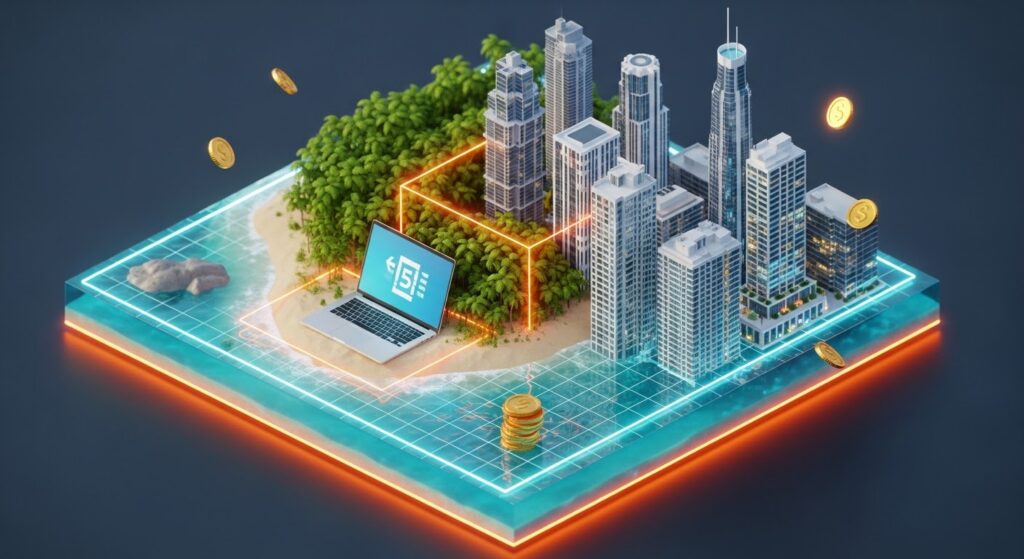
Historically, successful real estate markets depended upon proximity to factories, ports, highways, or central business districts.
The Nomadic Equity Economy measures infrastructure differently.
Reliable fiber internet, satellite connectivity, renewable energy systems, modern healthcare, international airports, digital banking, cybersecurity, and supportive immigration policies increasingly determine whether a city becomes attractive for globally mobile professionals.
Satellite internet services have dramatically expanded connectivity into previously underserved regions, allowing professionals to maintain uninterrupted productivity from coastal communities, mountain regions, islands, and rural innovation hubs.
Simultaneously, decentralized renewable energy systems improve resilience against traditional infrastructure limitations.
Cities capable of combining affordable living, advanced digital infrastructure, political stability, and attractive lifestyle offerings increasingly outperform traditional business centers in attracting high-income knowledge workers.
Real estate values naturally follow this migration.
Artificial Intelligence Is Managing Property Without Owners
One of the largest historical barriers to international property investment involved operational management.
Property owners frequently worried about maintenance, tenant screening, repairs, regulatory compliance, rent collection, insurance coordination, and legal documentation.
Artificial intelligence is transforming each of these functions.
Modern property management platforms increasingly automate maintenance scheduling, predictive equipment monitoring, tenant communications, payment collection, occupancy optimization, and financial reporting.
Machine learning systems continuously analyze rental demand, seasonal pricing trends, and local market conditions to optimize occupancy rates.
Owners receive real-time financial dashboards while operational decisions occur automatically through integrated software platforms.
As automation expands, managing international real estate portfolios becomes increasingly similar to monitoring diversified financial investments.
Distance becomes operationally insignificant.
Smart Contracts Are Simplifying Cross-Border Ownership
International real estate has traditionally involved legal complexity, extensive paperwork, multiple intermediaries, currency exchange challenges, and tax uncertainty.
Smart contracts are gradually streamlining these processes. han Ever
Blockchain-enabled agreements automatically execute contractual obligations when predetermined conditions are satisfied. Rental income distributions, ownership transfers, maintenance payments, and revenue sharing can occur with greater efficiency and transparency.
While legal frameworks continue evolving across jurisdictions, institutional interest in programmable contracts continues expanding due to their ability to reduce administrative costs and improve transaction integrity.
Automated compliance systems further simplify international tax reporting by integrating property income, deductible expenses, depreciation schedules, and jurisdiction-specific requirements into unified reporting environments.
Rather than manually coordinating multiple accounting professionals across different countries, investors increasingly benefit from integrated compliance platforms capable of generating standardized documentation.
Virtual Reality Has Eliminated Geographic Barriers
Physical property inspections once represented an unavoidable component of international investment.
Today, immersive visualization technologies are dramatically reducing this requirement.
Virtual reality tours enable investors to experience properties from anywhere in the world, while digital twin technology creates highly detailed virtual replicas containing structural, environmental, engineering, and operational data.
Potential investors can examine layouts, construction quality, surrounding infrastructure, sunlight exposure, neighborhood development, and maintenance conditions without boarding international flights.
Artificial intelligence further enhances these evaluations by estimating renovation costs, forecasting appreciation potential, identifying structural concerns, and comparing investment opportunities across thousands of properties simultaneously.
Investment decisions become increasingly data-driven rather than emotionally driven.
- Institutional Capital Is Following the Nomadic Workforce
- Large institutional investors rarely chase temporary trends.
- Instead, they monitor long-term demographic shifts.
The migration of skilled remote professionals represents precisely such a structural transformation.
Investment funds increasingly allocate capital toward flexible residential communities offering coworking facilities, hospitality services, wellness amenities, short-term leasing options, and technology-enabled living experiences.
Traditional apartment complexes are gradually evolving into integrated lifestyle ecosystems specifically designed for internationally mobile professionals.
- Developers recognize that this demographic values flexibility more than permanence.
- Consequently, real estate products themselves are changing.
- Properties become service platforms rather than simply physical buildings.
Revenue increasingly originates from subscriptions, premium experiences, shared amenities, digital memberships, concierge services, and integrated technology offerings.
Real estate evolves into a recurring revenue business.

Building Personal Wealth Through Global Equity
For individuals, the Nomadic Equity Model represents an opportunity to rethink wealth creation from first principles.
Traditional financial planning often emphasized purchasing one primary residence followed by decades of mortgage repayments.
While this strategy remains appropriate for many households, remote professionals possess additional options unavailable to previous generations.
Rather than concentrating assets within one local housing market, they can gradually assemble diversified international portfolios benefiting from multiple economic cycles.
- Rental income generated across different countries provides geographic diversification.
- Currency diversification reduces dependence upon any single economy.
- Tax planning opportunities improve after obtaining qualified professional advice.
- Lifestyle flexibility increases alongside financial resilience.
Over time, individuals transition from renters consuming housing expenses into equity stakeholders benefiting from global property appreciation.
The Future: Nomadic Equity Meets Decentralized Finance
Looking ahead, the next stage of this evolution may involve deeper integration between international real estate and decentralized finance.
Tokenized property ownership, blockchain-based lending, decentralized insurance systems, programmable mortgages, and globally accessible investment pools could significantly expand participation in international property markets.
Fractional ownership may become increasingly liquid, allowing investors to rebalance portfolios with efficiencies resembling modern stock exchanges.
Artificial intelligence will likely provide increasingly sophisticated portfolio optimization, identifying favorable jurisdictions, tax structures, rental opportunities, and currency diversification strategies.
As regulatory frameworks mature, digital identity systems may further simplify cross-border ownership verification while improving fraud prevention.
The combination of AI, blockchain, cloud computing, remote employment, and international mobility has the potential to redefine how individuals build wealth over the coming decades.
A Roadmap for Transitioning Into the Nomadic Equity Economy
The next stage involves understanding international markets rather than chasing speculative trends. Investors benefit from researching countries that offer political stability, transparent legal systems, attractive digital nomad policies, reliable infrastructure, and healthy rental demand. Comparing taxation, residency options, financing availability, and long-term economic growth allows informed decisions rather than emotional purchases.
Diversification remains the defining principle. Instead of allocating all available capital to a single property in one city, investors increasingly seek exposure across multiple markets with different economic drivers. Residential rentals, hospitality-oriented accommodations, fractional ownership platforms, and mixed-use developments each contribute different risk and return characteristics. Technology then enables these assets to be monitored, managed, and optimized from virtually anywhere in the world.
Professional advice remains indispensable. International taxation, regulatory compliance, inheritance planning, financing structures, and foreign ownership rules vary significantly between jurisdictions. Experienced legal, tax, and financial professionals help investors navigate these complexities while ensuring that global expansion remains compliant and financially efficient.
The Nomadic Equity Business Model ultimately represents far more than a real estate strategy. It reflects a broader transformation in how work, capital, technology, and mobility interact. As employment becomes increasingly borderless and digital infrastructure continues to improve, wealth creation is becoming less dependent on physical location and more dependent on strategic allocation of global opportunities. The future of corporate value and personal prosperity may no longer be defined by the city where someone works, but by the global portfolio they build while working from anywhere.