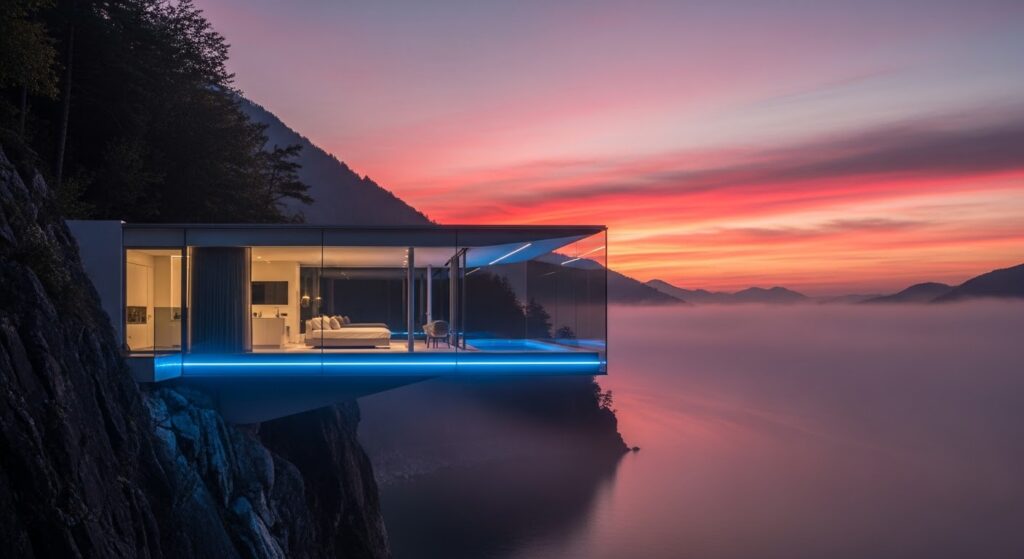
**Forget the overcrowded hills of Lonavala and Mahabaleshwar.** The next opportunity in Maharashtra’s luxury outdoor hospitality market may lie farther from the established weekend-resort circuit—on forested plateaus, mountain edges, tribal landscapes and quiet valleys where the experience is still more important than the address.
But there is a catch.
A beautiful view does not automatically make a viable glamping site.
For a serious 2027 investor, the real questions are more technical: **Can guests reach the property comfortably? Can water and power be managed? Will the land withstand monsoon conditions? Can tents or modular structures be legally and safely installed? Can wastewater be treated? And, most importantly, can the property command a premium rate for enough nights of the year?**
Our approach is therefore not simply to find the prettiest mountain.
It is to identify locations where **landscape + accessibility + tourism demand + infrastructure potential + sustainability + distinctive storytelling** can combine into a commercially viable boutique hospitality proposition.
The locations below are opportunity zones, not automatically development-ready parcels. Protected areas, Eco-Sensitive Zones, forest boundaries, land classification, CRZ where applicable, local planning rules and other permissions must be verified for the exact property before investment.
The Changing Face of Luxury Tourism in 2027
Indian luxury travel is gradually moving beyond the conventional five-star formula.
The new luxury is increasingly about **privacy, landscape and experience**.
A traveller may happily exchange a conventional hotel room for a beautifully designed tent if that tent offers:
- a private deck overlooking the mountains;
- exceptional food;
- silence;
- stargazing;
- an outdoor bathtub or thoughtfully designed bathroom;
- local cultural experiences;
- wellness;
- and a memorable sunrise.
This is particularly relevant around Mumbai and Pune.
A customer doesn’t necessarily want to travel hundreds of kilometres for a weekend escape. The opportunity is to create a property that feels **far away while remaining realistically accessible**.
That is where Maharashtra’s less-developed mountain destinations become interesting.
What Makes a Good Glamping Location?

Before revealing the five locations, let’s establish the investment filter.
A strong glamping location needs six things.
1. Landscape
The view is the product.
Mountains, valleys, forests, waterfalls, lakes, vineyards or distinctive rock formations can justify premium pricing.
2. Accessibility
Remote does not mean inaccessible.
Ideally, the property should have a practical connection to a major city and a final approach that ordinary cars can manage, or where a controlled transfer system can be provided.
3. Water
Water can become one of the biggest operating constraints.
A property should be evaluated for:
- groundwater potential;
- legal water sources;
- rainwater harvesting;
- storage capacity;
- seasonal availability;
- wastewater treatment.
4. Monsoon resilience
The Western Ghats receive intense seasonal rainfall.
The beautiful valley that looks perfect in January can become a drainage nightmare in July.
The site investigation must therefore consider:
- slope;
- drainage;
- erosion;
- runoff;
- soil conditions;
- access-road stability;
- retaining requirements;
- wind exposure.
5. Legal feasibility
Never assume that agricultural or scenic land can automatically become a resort.
The exact parcel needs professional verification of:
- title;
- land classification;
- permissible use;
- development controls;
- forest status;
- Eco-Sensitive Zone restrictions;
- local authority requirements;
- tourism-related permissions;
- fire and safety requirements;
- sanitation and wastewater arrangements.
6. Year-round revenue potential
A property that works only for eight monsoon weekends is not a strong investment.
The best projects have multiple demand seasons:
**Monsoon + winter + weekends + holidays + corporate retreats + celebrations + wellness + destination experiences.**
Technical Validation: Why the Plateau Matters
Glamping structures may look lightweight, but the site beneath them is not a cosmetic consideration.
The geology and topography influence:
**foundation strategy → drainage → erosion → accessibility → construction cost → long-term maintenance.**
Basalt is widespread across the Deccan Plateau and Western Ghats, but the presence of basalt does **not** mean every site is automatically suitable.
A competent site assessment should examine:
- rock outcrops;
- weathered rock;
- soil depth;
- slope;
- bearing conditions;
- natural drainage;
- landslide susceptibility where relevant;
- groundwater;
- flood/runoff patterns.
For semi-permanent structures, the goal should not be to “fight” the landscape.
The better philosophy is:
Design around the terrain rather than flattening the terrain.
That can mean lightweight modular systems, carefully positioned decks, minimal excavation and elevated structures where technically appropriate.
Why Monsoon Data Matters
Maharashtra’s monsoon is both an asset and a risk.
Rain creates the visual identity that sells many Western Ghats destinations.
It also tests every part of a resort.
Before developing a property, investors should examine available historical rainfall, topographic and drainage information and conduct a site inspection during or after significant rainfall where feasible.
The questions are simple:
- Where does water come from?
- Where does it go?
- Does the access road remain usable?
- Does water accumulate beneath the proposed tent platforms?
- Does the slope show erosion?
- Is the parking area stable?
A premium tent costing several lakh rupees should never be positioned simply because it has the best Instagram view.
The Five Emerging Locations
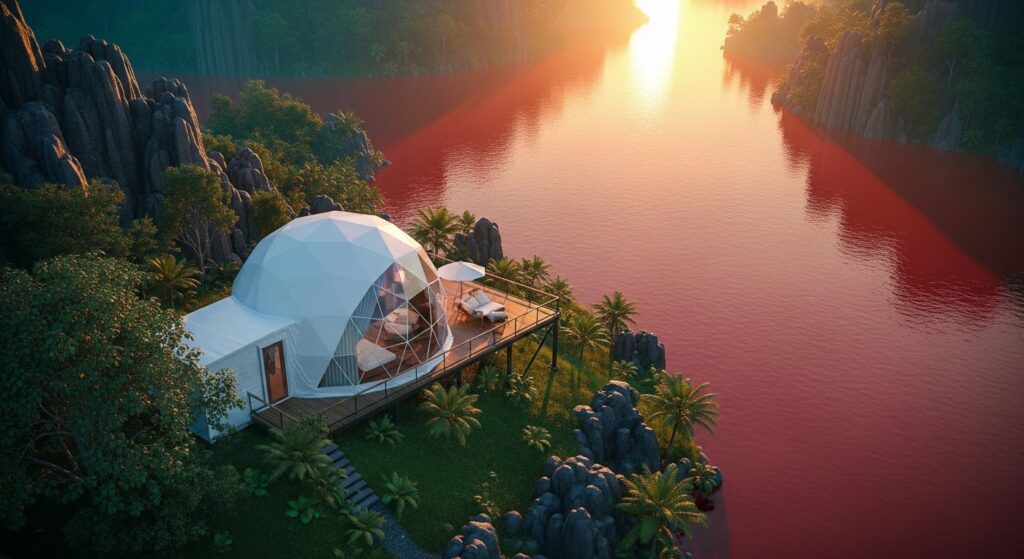
1. Jawhar–Dabhosa: The Tribal Luxury Opportunity
The concept: Warli Forest Glamping
If we were looking for a first Maharashtra location for a boutique glamping case study, Jawhar and the Dabhosa region would be near the top of the list.
Located in Palghar district, the region offers a combination that is extremely valuable to experiential tourism:
mountains + waterfalls + forests + tribal heritage + Mumbai catchment.
The region’s Warli cultural identity gives a glamping operator something that many generic resorts lack—a genuine local storytelling layer.
Instead of building another property with imported “bohemian” décor, imagine:
- contemporary luxury tents;
- Warli-inspired artwork;
- local cuisine;
- guided cultural experiences;
- waterfall excursions;
- forest walks;
- craft workshops;
- sunrise breakfasts;
- stargazing.
The result is not simply accommodation.
It becomes a **destination experience**.
Why investors should watch it
Jawhar has an important advantage: it can potentially serve the large Mumbai market without requiring the traveller to make a long-distance holiday commitment.
That makes it suitable for:
Friday evening departures → Saturday experience → Sunday return.
Best business positioning
**Premium couple’s retreat + family nature escape + small corporate retreat**
Indicative occupancy strategy
Rather than depending exclusively on monsoon tourism:
- Monsoon: waterfall and landscape packages
- October–February: couples, families and outdoor experiences
- March–May: wellness, forest and curated weekend packages
Investment score
- Accessibility: ★★★★½
- Landscape: ★★★★★
- Differentiation: ★★★★★
- Development complexity: ★★★½
- Overall opportunity: ★★★★★
2. Bhandardara Hinterland: Lake, Mountain and Stargazing
The concept: Luxury Under the Sahyadris
Bhandardara is no longer a secret.
That is precisely why the opportunity should not be approached as another conventional Bhandardara resort.
The smarter strategy is to explore the less-developed hinterland and surrounding mountain landscapes, subject to land and environmental due diligence.
The region’s combination of:
- Arthur Hill Lake;
- Sahyadri peaks;
- waterfalls;
- forests;
- trekking;
- night skies;
creates multiple experiences that can be packaged into a premium stay.
The product
Imagine six luxury tents.
Not twenty.
Each with:
- private deck;
- premium bed;
- private bathroom;
- outdoor seating;
- controlled lighting;
- mountain-facing orientation.
Then add:
stargazing + local dinner + guided trek + sunrise breakfast.
The property sells privacy rather than volume.
The astronomy advantage
The night sky can become an important differentiator.
Instead of treating darkness as a problem, the resort can turn it into an attraction.
A carefully designed low-light property can offer:
guided stargazing + astrophotography + night walks + storytelling around the sky.
Investment consideration
The biggest challenge is site selection.
Water, road access, drainage and monsoon conditions need particular attention.
Investment score
- Accessibility: ★★★★
- Landscape: ★★★★★
- Differentiation: ★★★★½
- Development complexity: ★★★½
- Overall opportunity: ★★★★★
3. Malshej Ghat Hinterland: The 48-Hour Mountain Escape
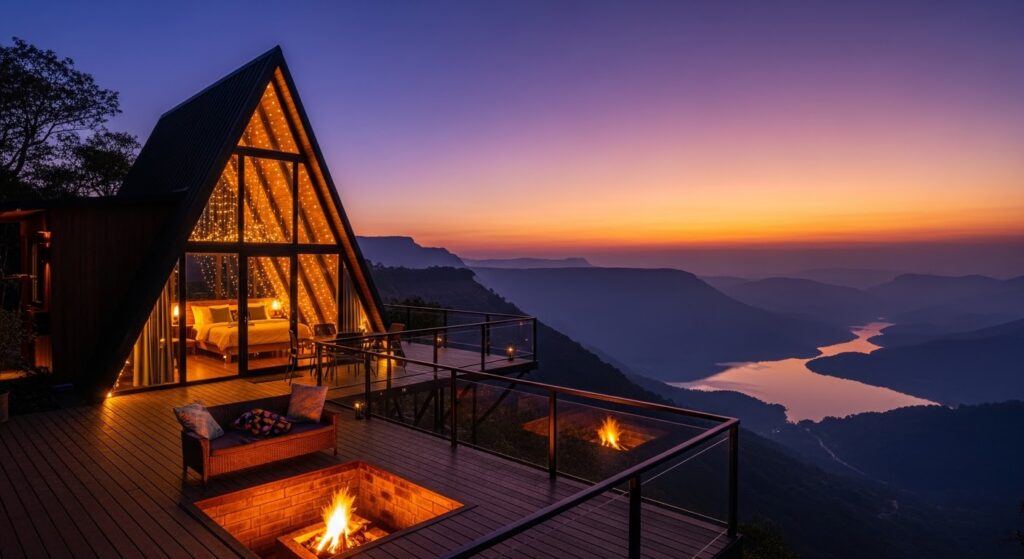
The concept: Luxury Above the Clouds
Malshej Ghat already attracts weekend travellers.
That doesn’t eliminate the opportunity.
It changes the strategy.
Instead of competing with existing hotels on room count, a boutique operator can create a small, highly differentiated experience away from the busiest tourist concentrations.
The customer proposition is simple:
Leave Mumbai or Pune on Friday evening. Wake up in the mountains on Saturday. Return Sunday evening.
This is the perfect structure for a premium weekend product.
Who is the customer?
- Mumbai professionals
- Pune professionals
- couples
- content creators
- small corporate groups
- photography enthusiasts
- wellness travellers
The design opportunity
The property could contain only:
5–8 tents
with substantial spacing.
The visual language should be minimalist:
**basalt + timber + canvas + glass + natural landscaping.**
Don’t overbuild.
The landscape should remain the hero.
Revenue strategy
The operator can create packages rather than selling rooms alone:
- Stay + breakfast
- Stay + dinner
- Couples weekend
- Photography weekend
- Corporate off-site
- Monsoon experience
- Wellness retreat
That increases the revenue generated per guest.
Investment score
- Accessibility: ★★★★★
- Landscape: ★★★★½
- Differentiation: ★★★★
- Development complexity: ★★★
- Overall opportunity: ★★★★½
4. Nashik Hinterland: Where Wine Meets Wilderness
The concept: Wine Country Glamping
This location demonstrates why glamping should not always be associated with mountains.
Nashik already has a tourism ecosystem around:
- vineyards + wine + food + countryside + weekend travel.
- The opportunity is to take that ecosystem one step further.
Instead of selling:
- A tent in the countryside.”
Sell:
- A complete wine-country weekend.”**
The guest journey
Arrival Friday evening.
↓
Sunset deck.
↓
Curated dinner.
↓
Saturday vineyard experience.
↓
Local food.
↓
Cycling or countryside exploration.
↓
Evening wine-and-food experience where legally and operationally appropriate.
↓
Sunday brunch.
↓
Return to Mumbai/Pune.
The accommodation becomes part of a larger tourism product.
Why this model is attractive
The operator isn’t entirely dependent on the room tariff.
Revenue can come from:
- accommodation;
- food;
- experiences;
- curated activities;
- private dinners;
- celebrations;
- corporate retreats.
That creates a potentially stronger revenue model.
The design
This property could be more sophisticated than traditional camping:
**canvas + wood + stone + vineyard-inspired interiors + outdoor dining.**
The décor capability within your proposed consulting team could become particularly useful for this type of project.
Investment score
- Accessibility: ★★★★½
- Landscape: ★★★★
- Differentiation: ★★★★★
- Development complexity: ★★★
- Overall opportunity: ★★★★½
5. Toranmal and the Satpuda Landscape: The High-Risk, High-Differentiation Bet

The concept: **Satpuda Wilderness Retreat**
If the objective is to find a location with substantially less mainstream glamping competition, **Toranmal** deserves investigation.
But this is not the easiest project.
And that is precisely why it could become interesting.
The Satpuda landscape offers:
- forests;
- mountains;
- viewpoints;
- cooler conditions;
- tribal culture;
- water bodies;
- a sense of remoteness.
The challenge is market access and infrastructure.
You aren’t simply developing accommodation.
You are helping create a destination proposition.
The right customer
Not the traveller looking for a quick overnight stay.
Instead:
nature enthusiasts + photographers + wellness travellers + adventure tourists + slow travellers + curated group retreats.**
The design philosophy
This location should not copy a luxury resort from Mumbai.
The property should reflect its geography.
Think:
**local materials + tribal-inspired design + low-impact structures + regional food + guided nature experiences.**
The resort itself becomes part of the landscape.
Investment score
- Accessibility: ★★½
- Landscape: ★★★★★
- Differentiation: ★★★★★
- Development complexity: ★★★★½
- Overall opportunity: ★★★★
Infrastructure Planning for Rugged Vistas
The future of glamping shouldn’t mean putting a conventional hotel on a mountain.
The better model is **lightweight, modular and reversible wherever feasible**.
Modular accommodation
Premium tents and modular pods can potentially reduce the amount of conventional construction required, subject to engineering and local regulatory requirements.
But “temporary” does not mean “permission-free.”
The structure still needs to be appropriate for:
- wind;
- rain;
- drainage;
- electrical safety;
- fire safety;
- sanitation;
- guest safety.
Solar power
Remote properties can combine grid electricity where available with:
**solar + battery storage + efficient appliances + backup systems.**
The objective isn’t simply to advertise “solar.”
It is to reduce operating vulnerability.
Water
A sustainable property should examine:
**rainwater harvesting + storage + efficient fixtures + wastewater treatment + greywater reuse where legally and technically appropriate.**
Water management should be designed before the tents arrive.
Designing the Arrival Experience
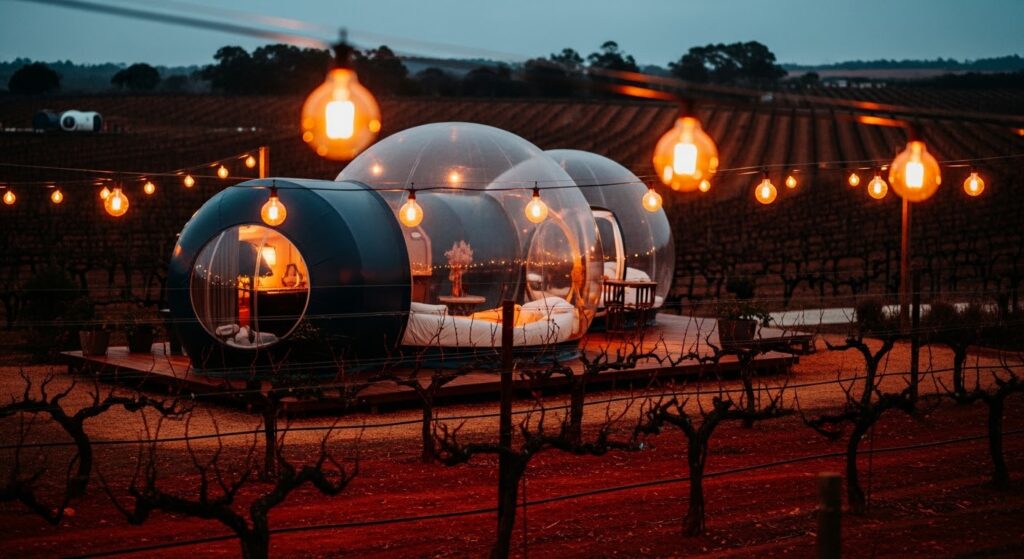
One of the biggest opportunities in glamping is turning the journey itself into part of the product.
Imagine:
- Stage 1 — Urban departure
Guest leaves Mumbai or Pune. - Stage 2 — Base village
Vehicle reaches the property’s designated arrival point. - Stage 3 — Controlled transfer
Guests move into a resort vehicle where the final approach requires it. - Stage 4 — The reveal
The landscape suddenly opens. - Stage 5 — Private tent
Guest enters a carefully designed accommodation with a mountain or forest view.
The transition from **urban congestion to wilderness** becomes part of the luxury experience.
What About Navi Mumbai Airport?
Perhaps the most fascinating thing about exploring this rImproved regional connectivity could strengthen the long-term tourism catchment of destinations across the wider Mumbai Metropolitan Region and Maharashtra.
But investors should avoid building a financial model based solely on anticipated infrastructure.
The correct approach is:
**Current access = base case**
**Future infrastructure = upside**
For every proposed site, calculate realistic travel time from:
- Mumbai;
- Navi Mumbai;
- Pune;
- nearest railway station;
- nearest airport;
- nearest major highway.
Infrastructure should improve the business—not be the only reason the business exists.egion is the contrast.
Turning Wilderness Into a Profitable Asset
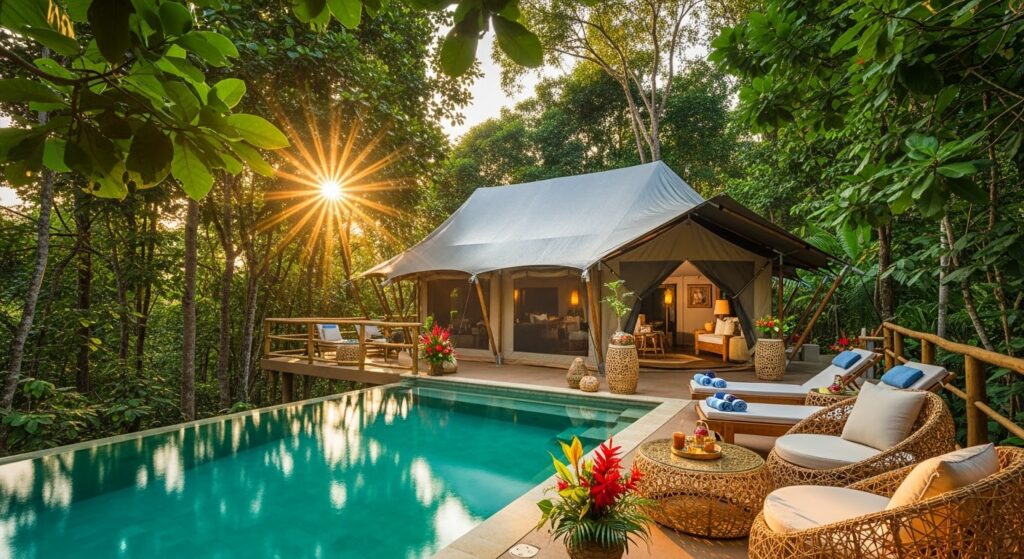
The most important question isn’t:
“How much does a tent cost?”
It is:
- “How much revenue can one acre generate without destroying the landscape?”
- Consider a hypothetical six-tent boutique property.
Suppose:
6 tents
Average annual occupancy:45%
Average room rate: ₹8,000
The accommodation revenue would be:
6 × 365 × 45% × ₹8,000= **approximately ₹78.8 lakh annually.**
Now imagine additional revenue from:
- food;
- beverages;
- activities;
- private experiences;
- celebrations;
- corporate retreats.
The total property revenue could potentially exceed accommodation revenue significantly.
But these are **illustrative assumptions, not guaranteed returns**.
A professional feasibility study should model at least three scenarios:
conservative
35% occupancy
### Base case
45–50%
### Optimistic
60%+
Then calculate:
**Revenue → operating expenses → EBITDA → debt servicing → DSCR → break-even occupancy → investor return.**
Don't Ignore the Cost of the Land
A common mistake is to calculate:
Tent cost × number of tents
and call that the project cost.
The real CAPEX may include:
- land lease/deposit;
- site preparation;
- access road;
- drainage;
- water system;
- sewage treatment;
- electrical infrastructure;
- solar;
- bathrooms;
- decks;
- kitchen;
- dining;
- reception;
- staff accommodation;
- parking;
- landscaping;
- furniture;
- safety systems;
- design fees;
- professional fees;
- marketing;
- working capital.
A ₹4 lakh tent can therefore become a **much larger hospitality investment once it becomes part of a functioning resort.**
Legal and Regulatory Reality
This is where romantic glamping concepts often collide with reality.
There is no universal “glamping permission” that makes every rural parcel automatically developable.
The requirements depend on the **state, local authority, land classification, project design and location**.
A serious investor should conduct due diligence covering, as applicable:
Land
- ownership/title;
- encumbrances;
- land classification;
- permissible use;
- access rights.
Environment
- forest boundaries;
- protected areas;
- Eco-Sensitive Zone status;
- water bodies;
- biodiversity/environmental restrictions;
- local development controls.
Construction and hospitality
- local planning/development permissions;
- building/structure permissions where applicable;
- sanitation;
- wastewater;
- fire and life safety;
- electricity;
- water supply.
Business
- business entity;
- GST where applicable;
- local registrations;
- tourism/hospitality-related registrations or approvals as applicable;
- food-related licences if food is served.
The exact approval pathway should be established **for the specific property before the land transaction or construction commitment**
The 2027 Glamping Investment Formula
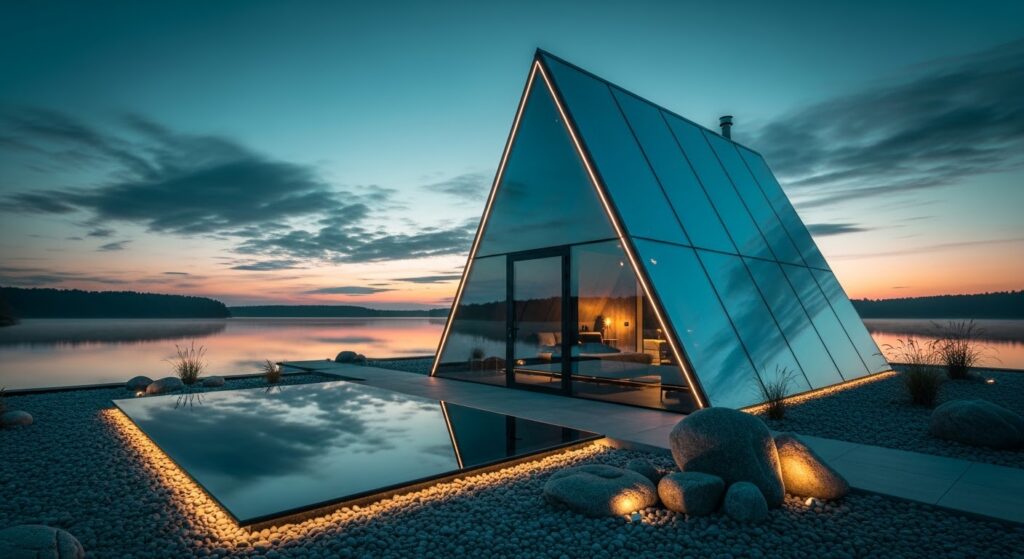
The winning formula isn’t:
**Remote land + expensive tents = luxury resort.**
It is:
- Distinctive landscape
- 2–3 hour catchment
- Low-density development
- Premium experience
- Strong digital marketing
- Professional financial planning
- Responsible land and environmental due diligence
That combination can turn a scenic property into a genuine hospitality business.
Which Location Would We Choose?
If the objective is to create a **first boutique glamping project serving the Mumbai market**, our shortlist would begin with:
- Jawhar–Dabhosa
Best combination of accessibility, landscape, culture and differentiation. - Bhandardara hinterland
Excellent for mountain, lake and stargazing positioning. - Malshej hinterland
Strong weekend market and relatively straightforward positioning. - Nashik hinterland
Best for combining accommodation with wine, food and experiences. - Toranmal
The most adventurous proposition—and potentially the most differentiated—but requiring significantly more infrastructure and market-development work.
The Bigger Opportunity: Don't Just Build a Resort
There is a much larger business opportunity behind Maharashtra’s emerging glamping market.
A tourism entrepreneur needs answers to five questions:
- Where should I invest?
- How much should I invest?
- What should I build?
- How do I finance and legally structure it?
- How do I get customers?
That is where a multidisciplinary tourism advisory model becomes powerful.
A team combining **tourism experience, banking, CA/financial expertise, legal support, hospitality design and digital travel media** can approach the project from every direction.
The objective isn’t simply to sell tents.
It is to help turn **tourism ideas into bankable hospitality businesses**.
Final Verdict: The 2027 Opportunity
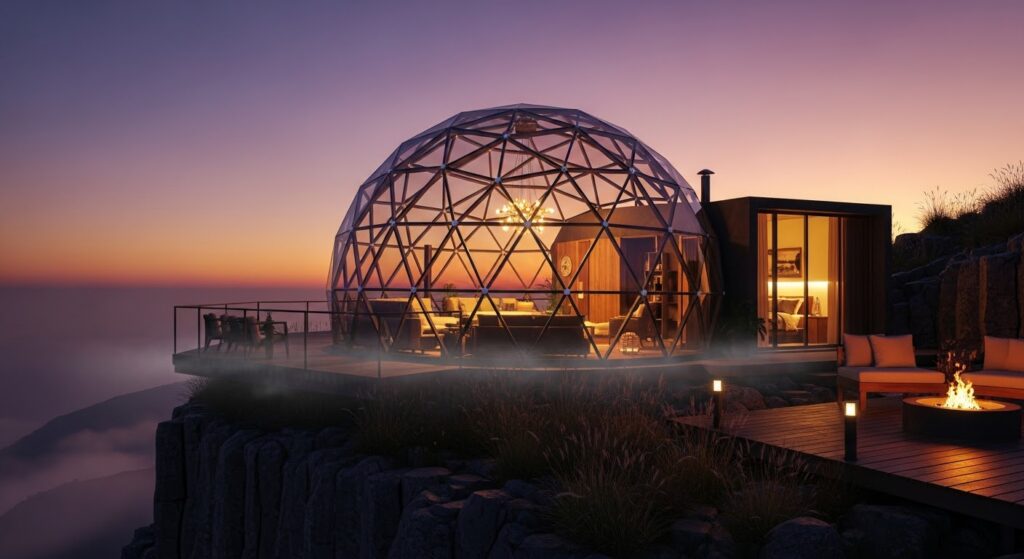
Maharashtra does not need another copy of Lonavala.
It needs **small, high-quality, landscape-sensitive hospitality projects in carefully selected destinations**.
The opportunity is not necessarily in the most famous mountain.
It may be in the next destination that travellers haven’t discovered yet.
And that is the real investment thesis for 2027:
> **Don’t chase the crowded destination. Find the landscape with the right combination of accessibility, authenticity, infrastructure potential and unmet demand—and build the smallest possible luxury project that can make the landscape itself the attraction.**
**The future of Maharashtra’s glamping industry may not belong to the biggest resorts. It may belong to the operators who understand that, in luxury nature tourism, less construction can create more value.