
For decades, India’s luxury hospitality industry was dominated by towering five-star hotels that symbolized prestige, sophistication, and architectural excellence. Brands such as Taj, Oberoi, ITC Hotels, Marriott, Hyatt, and The Leela built their reputations on lavish lobbies, expansive banquet halls, fine-dining restaurants, luxury spas, and hundreds of meticulously designed guest rooms. Investors traditionally believed that long-term wealth in hospitality could only be created through permanent real estate assets supported by prime urban locations. Building bigger hotels on expensive land was considered the safest path to sustainable profitability. However, the Indian travel landscape of 2026 is rewriting these assumptions. A new generation of travelers is demanding experiences instead of monuments, while a new generation of investors is prioritizing capital efficiency over concrete. At the center of this transformation is glamping, a hospitality model that combines luxury accommodation with nature, sustainability, and operational flexibility. What was once dismissed as premium camping has evolved into one of the most financially attractive investment opportunities in India’s tourism sector.
The shift is not simply about changing travel preferences. It is about changing economics. Modern investors are asking difficult questions that traditional hospitality has struggled to answer. Why should hundreds of crores remain locked inside concrete buildings that may take years to complete before generating a single rupee of revenue? Why should developers carry enormous debt, employ hundreds of staff members, and maintain vast physical infrastructure when travelers increasingly value privacy, wellness, and authentic experiences over marble floors and chandeliers? The answer lies in the financial structure of glamping, where lower capital expenditure, faster project completion, reduced operational complexity, and premium pricing create an entirely different investment equation. Rather than measuring success by the size of the property, investors now evaluate how efficiently each rupee invested generates recurring cash flow.
This change has given rise to one of the most disruptive business models in Indian hospitality. Luxury tents, safari lodges, geodesic domes, treehouses, and modular cabins are beginning to compete directly with traditional five-star hotels, not because they offer more facilities, but because they offer experiences that command premium prices while requiring far less capital to build and operate. The economics behind this transition are compelling enough that family offices, private equity funds, tourism entrepreneurs, and institutional investors are beginning to examine experiential hospitality with the same seriousness once reserved for luxury urban hotels.
The biggest challenge confronting traditional five-star hotels today is the enormous financial burden associated with permanent construction. Developing a luxury hotel in metropolitan cities such as Mumbai, Delhi, Bengaluru, or Hyderabad requires acquiring expensive land, securing dozens of statutory approvals, completing detailed architectural and engineering designs, and investing heavily in structural construction. Every stage introduces additional costs and extends the timeline before the property can begin earning revenue. In many cases, project development spans several years, during which interest expenses accumulate while the asset generates no operating income. Investors effectively finance an expensive waiting period before welcoming their first guest.
Construction costs have risen steadily due to inflation, labor shortages, premium materials, regulatory compliance, environmental approvals, and increasingly sophisticated building technologies. A modern five-star hotel frequently demands an investment of several crores per room after considering not only the guest accommodation but also restaurants, conference facilities, swimming pools, health clubs, parking structures, staff accommodation, landscaping, utility systems, and public areas. Even before furniture, branding, marketing, and working capital are considered, the capital requirement becomes substantial. Such investments may be appropriate for landmark properties in major cities, but they significantly increase financial risk in emerging tourism destinations.
Glamping operates under a fundamentally different philosophy. Instead of constructing massive permanent buildings, developers install prefabricated luxury accommodation that is manufactured in controlled environments and assembled rapidly at the destination. A premium safari tent equipped with insulated walls, luxury interiors, ensuite bathrooms, climate control, smart automation, and private outdoor spaces costs only a fraction of what is required to build an equivalent luxury hotel suite. While exact costs vary according to specifications, location, and infrastructure requirements, modular hospitality generally requires considerably lower capital investment per accommodation unit than conventional five-star construction.
The reduction in capital expenditure has profound implications for investment returns. Lower project costs reduce financing requirements, resulting in smaller loan amounts and lower interest obligations throughout the project’s life. Investors preserve more equity for expansion, technology upgrades, marketing, and guest experience enhancements rather than tying it up in concrete and steel. Banks also view projects with healthier debt-service coverage more favorably, improving access to financing and reducing financial stress during the early years of operation.
Perhaps the most overlooked financial advantage of glamping is construction speed. Traditional hotels frequently require three to five years before becoming operational, depending on project complexity and regulatory approvals. During this period, market conditions may change significantly. Tourism demand may fluctuate, construction costs may rise further, and competitive supply may increase. Every delay reduces project efficiency because capital remains unproductive.
Prefabricated luxury tents compress this timeline dramatically. Factory manufacturing allows accommodation units to be produced simultaneously while site preparation occurs in parallel. Once delivered, installation often requires only weeks rather than years. Investors begin generating revenue much earlier, improving cash flow and increasing Internal Rate of Return simply because positive cash inflows arrive sooner. In finance, the timing of cash flows is as important as the amount, making accelerated market entry one of the strongest competitive advantages of modular hospitality.
Another significant burden facing traditional hotels is depreciation. Every building begins losing economic value from the moment construction is completed. Flooring wears out, plumbing ages, elevators require modernization, HVAC systems deteriorate, interior finishes become outdated, and guest expectations evolve. Maintaining five-star standards demands continuous renovation cycles involving substantial capital expenditure every few years. These refurbishments frequently require temporary room closures, reducing revenue while increasing maintenance costs.
This phenomenon may be described as the “depreciation trap.” Luxury hotels must continually invest in maintaining premium standards simply to remain competitive. Even iconic brands undertake extensive renovation programs because today’s luxury traveler expects contemporary design, advanced technology, and modern amenities. The property therefore consumes additional capital long after construction has finished.
Modular glamping addresses this challenge differently. Individual accommodation units can often be upgraded independently without disrupting the entire property. Exterior fabrics, decking, interiors, furnishings, and smart technologies may be replaced selectively rather than undertaking full-scale structural renovation. Because each module functions independently, operators can modernize assets gradually while keeping the majority of the resort operational. Maintenance becomes a continuous optimization process rather than an expensive periodic overhaul.
The flexibility extends beyond refurbishment. If guest preferences change or technological improvements emerge, modular units can often be upgraded more easily than permanent buildings. New insulation materials, solar technologies, energy-efficient systems, or interior concepts may be incorporated without demolishing major structures. This adaptability reduces lifecycle costs while preserving guest satisfaction.
Regulatory efficiency also contributes to the financial appeal of glamping. Large permanent hotels often require lengthy approval processes involving environmental impact assessments, zoning permissions, construction permits, fire safety clearances, utility infrastructure, and multiple government agencies. Each stage introduces uncertainty and additional expenditure. Delays increase financing costs while postponing revenue generation.
The exact regulatory framework for glamping projects varies considerably across states and local authorities. Developers must comply with applicable land-use laws, environmental regulations, tourism policies, and construction standards. Nevertheless, modular hospitality projects often benefit from simpler construction methodologies and reduced site disturbance compared with large concrete developments, which can shorten implementation timelines where all necessary approvals are obtained.
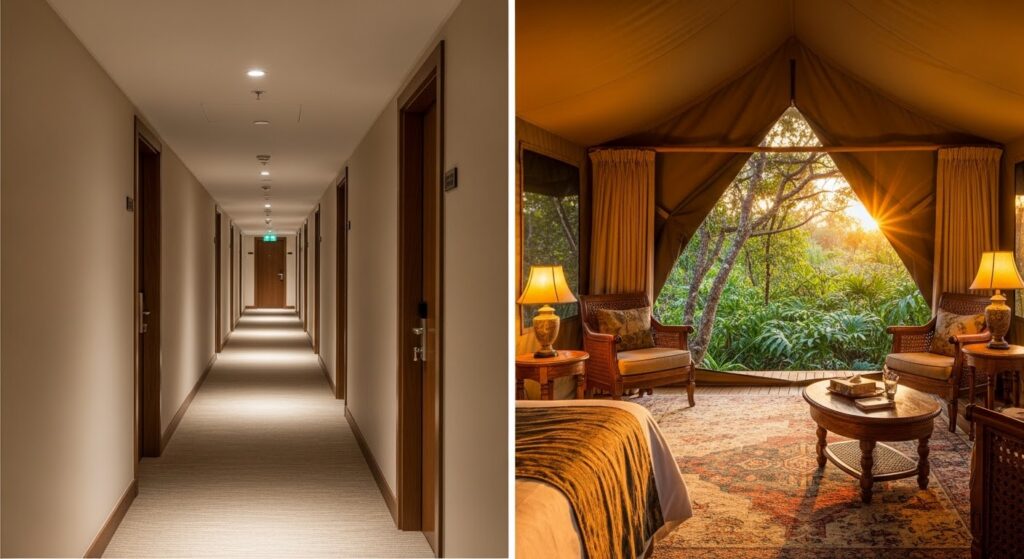
Capital efficiency is becoming the defining competitive advantage in hospitality investment. Investors increasingly compare not only total returns but also returns relative to the capital employed. A resort requiring ₹300 crore to generate annual profits may actually produce lower returns on invested capital than a glamping destination requiring only ₹25 crore while generating proportionately strong operating income. This perspective fundamentally changes investment decision-making.
Modern financial analysis emphasizes metrics such as Return on Invested Capital (ROIC), Return on Capital Employed (ROCE), Internal Rate of Return (IRR), Net Present Value (NPV), and free cash flow generation. Lower capital intensity significantly improves many of these indicators because the denominator—the initial investment—is substantially reduced while revenue potential remains attractive.
Scalability further strengthens the business model. Traditional hotels usually require complete construction before opening because guest expectations demand fully integrated facilities. Glamping developments can expand progressively. Developers may begin with ten luxury tents, validate market demand, and subsequently increase capacity to twenty, forty, or sixty units using cash generated from existing operations. Expansion therefore becomes demand-driven rather than speculation-driven.
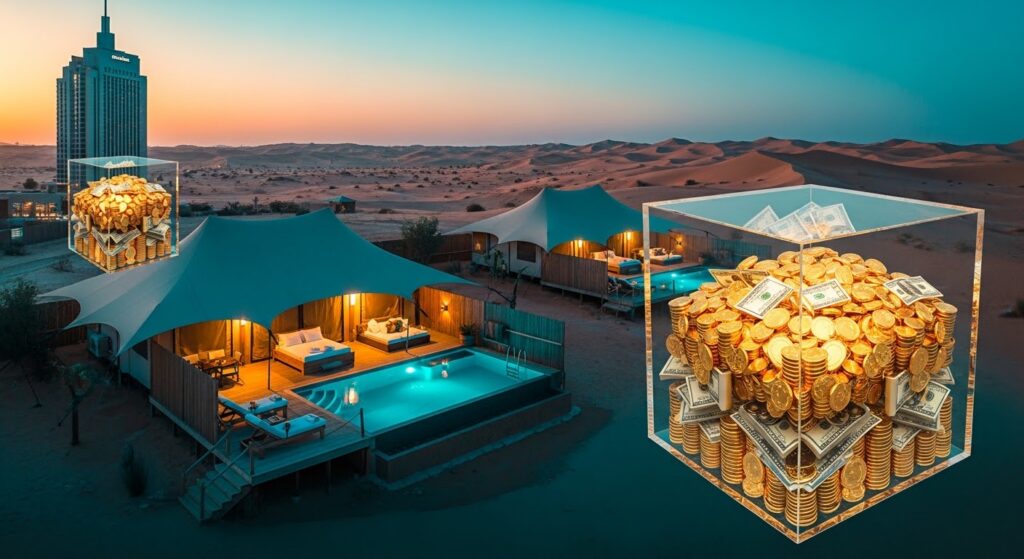
This staged growth strategy dramatically reduces financial risk. Instead of committing maximum capital upfront based on uncertain occupancy forecasts, investors allocate resources incrementally as booking patterns become established. If demand exceeds expectations, additional modules can be installed rapidly. If market conditions soften, expansion may simply be postponed without carrying the burden of underutilized permanent infrastructure.
The appeal of glamping is also closely linked to changing traveler behavior. Luxury is increasingly defined by exclusivity rather than excess. Guests no longer judge accommodation solely by the size of the lobby or the number of restaurants within the property. They increasingly value privacy, breathtaking landscapes, personalized experiences, wellness, sustainability, and digital detox opportunities. A luxury tent overlooking the Himalayas, a forest retreat in Karnataka, or a riverside eco-lodge in Rajasthan often creates memories that no urban skyscraper can replicate.
This evolution enables glamping operators to command premium nightly rates despite offering fewer conventional facilities. Travelers willingly pay for emotional experiences rather than physical infrastructure. Investors therefore benefit from a pricing model based upon uniqueness instead of construction cost.
The Indian hospitality sector is entering a period where financial discipline matters as much as architectural ambition. Lower capital expenditure, faster construction, modular flexibility, and changing consumer preferences have created an environment in which glamping is no longer an alternative niche—it is emerging as a mainstream investment strategy. Yet construction efficiency alone does not explain why glamping is outperforming traditional five-star hotels. The true financial advantage becomes even more evident once operations begin.
In the next part, we will examine the unit economics that drive profitability, comparing EBITDA margins, staffing costs, utility expenses, automation, pricing power, and the operational efficiencies that are allowing lean glamping resorts to generate impressive returns while many conventional luxury hotels continue to struggle with high fixed costs.