Your Degree Just Became Invisible to the Machines
Imagine spending four years earning a prestigious degree, graduating with honors, and polishing your resume for months—only to have it rejected within seconds by an AI system that never cared about your university in the first place.
Welcome to the AI recruitment crisis of 2026
Across industries, organizations are replacing traditional resume screening with AI-powered Applicant Tracking Systems (ATS) that evaluate candidates differently from human recruiters. Instead of focusing on university prestige or lengthy academic histories, these systems increasingly analyze technical competencies, verified projects, digital portfolios, keyword relevance, and demonstrable problem-solving abilities.
The uncomfortable reality is that a degree alone is no longer enough.
The future belongs to professionals who continuously build, adapt, and demonstrate their skills rather than merely listing qualifications earned years ago.
The New Hiring Revolution
Recruitment has undergone one of the biggest transformations in modern history.
A decade ago, hiring managers manually reviewed resumes, looked at educational qualifications, and scheduled interviews based largely on experience and academic reputation.
Today, AI performs the first screening.
Modern recruitment platforms analyze thousands of applications within minutes. Instead of simply searching for degree titles, they increasingly identify evidence of relevant skills, recent projects, certifications, software proficiency, and measurable accomplishments.
Many organizations now use AI-assisted matching to rank candidates before a human recruiter ever reviews an application. This means candidates may never reach the interview stage if their application lacks signals of current, relevant capabilities.
The hiring process is shifting from “What degree do you have?” to “What can you actually do today?”
The Invisible Filter

Most job seekers never realize they have already been rejected.
AI-powered recruitment platforms increasingly rely on semantic matching rather than exact keyword searches. Instead of merely checking whether your resume says “MBA” or “Computer Science,” they analyze the overall context of your skills, experiences, projects, and tools.
For example, a cybersecurity role might prioritize evidence of:
- Cloud security projects
- Python scripting
- SIEM tools
- Threat detection experience
- GitHub repositories
- Professional certifications
- Recent learning activities
A candidate with an elite university degree but no practical demonstrations may rank lower than someone with a modest academic background who has completed relevant projects and continuously updated their skills.
This is often called the prestige paradox.
Prestigious education remains valuable, but it is no longer sufficient by itself
Why Static Resumes Are Becoming Obsolete
Traditional PDF resumes were designed for human readers.
AI systems increasingly evaluate additional sources, such as:
- Professional portfolios
- GitHub repositories
- LinkedIn activity
- Technical blogs
Public presentations - Verified certifications
- Digital badges
- Open-source contributions
- Portfolio websites
A static resume captures a snapshot of your past.
A digital portfolio demonstrates your present capabilities.

Employers increasingly want evidence that you are actively learning, solving problems, and adapting to technological change.
The Death of the Four-Year Learning Cycle
Universities continue to provide valuable foundations in theory, research, and critical thinking. However, technology evolves much faster than traditional academic programs.
AI models, automation tools, cloud platforms, cybersecurity practices, and programming frameworks can change significantly within months.
Many professionals graduate with knowledge that must be continually updated through self-learning and practical application.
This does not make degrees worthless.
It simply means that graduation is no longer the finish line—it is the starting point.
Continuous learning has become an essential career strategy.
Knowledge Is No Longer Enough
For decades, employers valued what applicants knew.
Today, organizations increasingly value what applicants have built.
Hiring managers often ask questions like:
- Have you deployed an AI application?
- Have you automated workflows?
- Have you analyzed real business data?
- Have you developed APIs?
- Have you created dashboards?
- Have you managed cloudinfrastructure?
- Have you contributed to collaborative projects?
Modern hiring rewards evidence over claims.
The ability to demonstrate competence often outweighs the ability to describe it.
Proof Over Pedigree

The strongest resumes increasingly include measurable achievements supported by practical work.
Examples include:
- Live Projects:- Building a functioning application demonstrates far more than simply listing programming languages.
- GitHub Contributions:- Consistent coding activity reflects ongoing learning and technical engagement.
- Data Analytics Dashboards- Interactive dashboards showcase analytical thinking and business intelligence capabilities.
- API Integrations- Connecting multiple software platforms demonstrates practical engineering skills.
- AI Automation Projects- Designing AI-assisted workflows illustrates an understanding of emerging technologies.
- Technical Writing- Publishing articles or tutorials establishes subject-matter expertise and communication skills.
The modern portfolio has become the new professional identity.
The Rise of Verified Digital Credentials
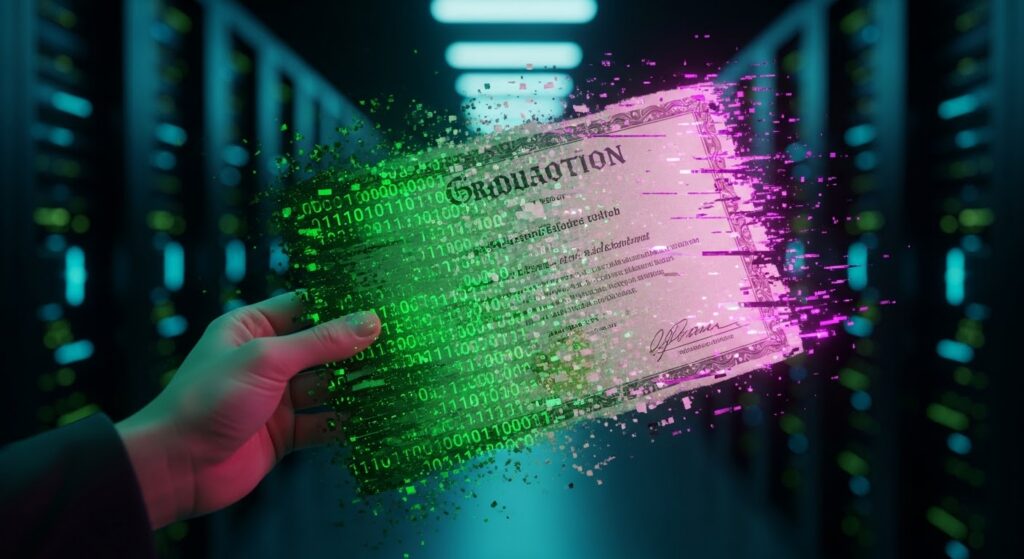
Traditional diplomas represent one significant educational achievement.
Increasingly, employers also value smaller, verifiable credentials earned throughout a career.
Examples include:
- Cloud certifications
- Cybersecurity certifications
- Data analytics certificates
- AI engineering programs
- Financial modeling certifications
- Project management credentials
- Industry-recognized micro-certificates
Some organizations are also exploring blockchain-based credential systems that allow qualifications to be securely verified. While concepts such as blockchain verification and “Skill NFTs” are emerging, they are not yet widely adopted across mainstream hiring and should be viewed as developing trends rather than current hiring standards.
The broader direction is clear: employers increasingly seek trusted, verifiable evidence of ongoing learning.
Build a Machine-Readable Career
AI systems evaluate structured information.
That means your professional presence should be organized and consistent across platforms.
Consider maintaining:
- An optimized LinkedIn profile
- A professional portfolio website
- GitHub repositories
- Verified certifications
- Personal technical blogs
- Public speaking videos
- Project case studies
- Online publications
Each element contributes to your digital professional identity.
Instead of relying on one resume, you create an ecosystem that reflects your expertise.
The Skill-Stacking Strategy

Successful professionals are increasingly adopting a quarterly learning model rather than relying solely on qualifications earned years earlier.
A practical approach might include:
- Quarter One:- Learn AI fundamentals and prompt engineering.
- Quarter Two:- Develop data analysis and visualization skills.
- Quarter Three- Build automation workflows and API integrations.
- Quarter Four:- Strengthen leadership, communication, and strategic decision-making.
Rather than waiting a decade to pursue another degree, professionals continuously expand their capabilities throughout their careers.
Human Skills Matter More Than Ever
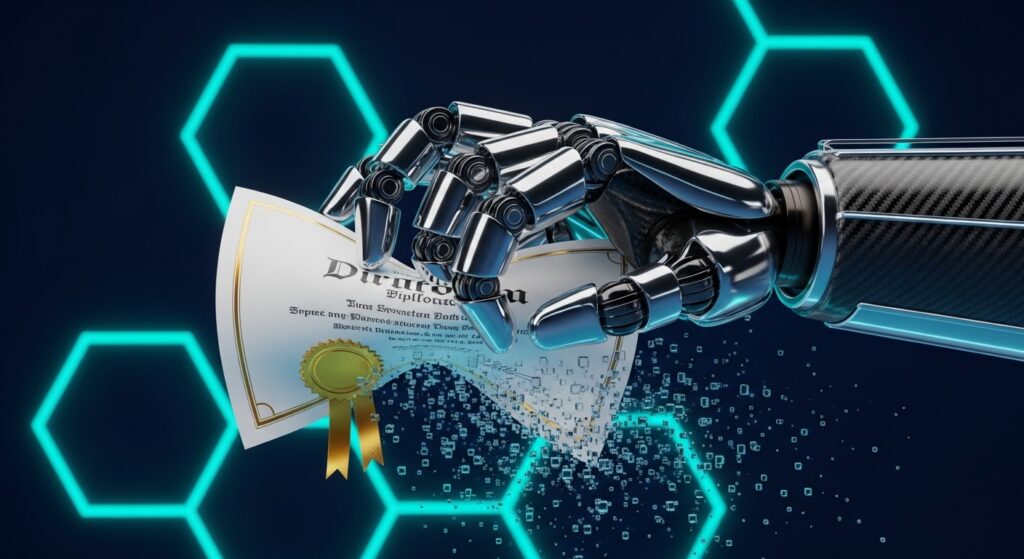
Ironically, as artificial intelligence becomes more capable, uniquely human abilities become even more valuable.
Organizations continue to need professionals who can:
- Exercise ethical judgment
- Solve ambiguous problems
- Negotiate complex situations
- Build client relationships
- Lead teams
- Think strategically
- Communicate clearly
- Evaluate AI-generated outputs
In many high-stakes industries—including finance, healthcare, law, engineering, and public administration—human oversight remains essential because AI systems can still produce inaccurate or fabricated information.
The future is likely to involve humans working alongside AI, combining automation with informed professional judgment.
Financial Literacy Is Becoming a Competitive Advantage
Technical knowledge alone is not enough.
Organizations increasingly value employees who understand business impact.
- Can you calculate return on investment?
- Can you evaluate automation costs?
- Can you interpret financial statements?
- Can you estimate operational savings from AI implementation?
Professionals who combine technical expertise with financial understanding often contribute more effectively to strategic decision-making.
This combination can strengthen both employability and long-term career growth.
Degrees Still Matter—But They Are No Longer the Whole Story

Degrees continue to provide valuable foundations.
They teach structured thinking, research methods, discipline, and domain knowledge.
However, employers increasingly evaluate additional evidence, including:
- Practical experience
- Recent learning
- Technical adaptability
- Project outcomes
- Communication skills
- Problem-solving ability
- Collaboration
- Continuous professional development
Academic achievement remains important, but it is increasingly one part of a broader professional profile.
A Roadmap to Stay Relevant
If you want to remain competitive in an AI-driven job market, consider adopting these habits:
- Learn a new technical skill every quarter.
- Build projects instead of only collecting certificates.
- Maintain an updated digital portfolio.
- Share your work publicly through blogs or GitHub.
- Develop financial and business literacy alongside technical skills.
- Improve communication, leadership, and critical thinking.
- Review and update your professional profiles regularly.
- Use AI as a productivity tool while verifying its outputs carefully.
Career resilience increasingly depends on adaptability rather than static credentials.
Final Thoughts

Artificial intelligence is not eliminating the value of education—it is redefining how competence is recognized.
The diploma that once guaranteed interviews is now only one signal among many. Employers increasingly seek professionals who combine foundational knowledge with current skills, practical experience, and a demonstrated commitment to continuous learning.
The question is no longer whether you have a degree.
The question is whether your skills, portfolio, and professional presence clearly show that you can solve today’s problems in a rapidly evolving workplace.
Those who embrace lifelong learning, build evidence of their capabilities, and adapt alongside technological change will be well positioned to thrive in the AI era. Those who rely solely on credentials earned years ago may find that the recruitment algorithms simply move on to candidates whose skills are more visible and up to date.