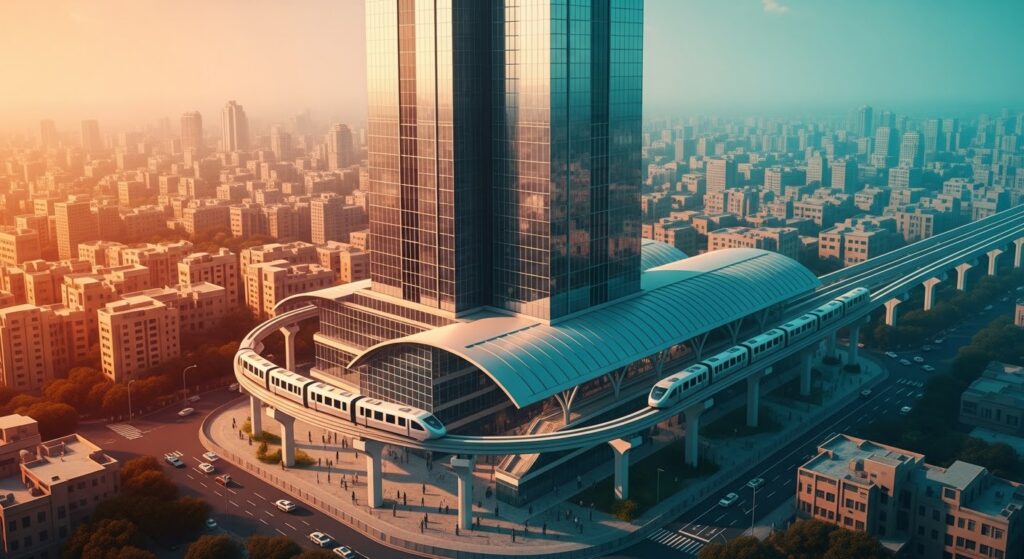
For decades, Indian real estate followed a relatively simple formula: buy land, look at the road width, calculate the permissible FSI, and estimate how much construction can happen on the plot.
That formula is changing.
In 2026, one of the most important variables entering India’s real-estate equation is no longer simply how much land you own.
It is increasingly becoming:
How close is that land to mass transit?

Across Mumbai, Bengaluru, Delhi-NCR, Pune, Hyderabad, Chennai and other rapidly expanding cities, metro and mass-transit corridors are creating a new geography of urban wealth. Properties that sit within convenient walking distance of major stations can command a premium because they offer something increasingly valuable in India’s congested cities:
time.
This is where Transit-Oriented Development, or TOD, enters the picture.
TOD is not simply about constructing apartments beside a metro station. It represents a broader transformation in urban planning—concentrating homes, offices, retail, entertainment and public amenities around high-capacity public transportation.
And there is a potentially powerful real-estate consequence.
When planning regulations allow greater development intensity around transit corridors, the economic value of land can rise dramatically.
The result is a new urban equation:
Metro + Walkability + Higher Development Potential = Transit Premium.
The Hidden Wealth Sitting Beside India’s Metro Stations
Imagine two apartments that are otherwise similar.
One is located several kilometres from the nearest metro station and requires a car, taxi or bus for daily commuting.
The other is a 7–10 minute walk from a metro station connecting directly to major employment and commercial districts.
The second apartment may cost more.
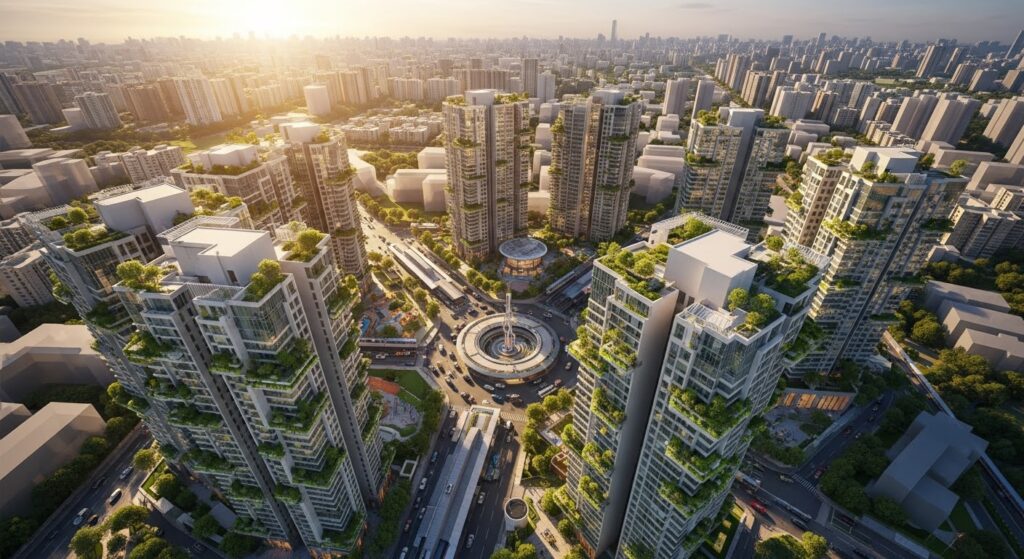
But the premium isn’t necessarily because the building is better.
It is because location has become infrastructure.
A metro station can effectively expand the number of places residents can reach without depending on private vehicles.
- For a working professional, that can mean less time in traffic.
- For a retailer, it can mean more pedestrian footfall.
- For an office developer, it can mean access to a larger labour pool.
- For a residential developer, it can mean stronger demand.
- And for an investor, it can create the possibility of a transit premium.
This is why the area immediately surrounding a major station can become significantly more valuable than a neighbourhood that looks similar on a map but lacks rapid-transit connectivity.
The Infrastructure Pivot: From Horizontal Cities to Vertical Cities
India’s traditional urban expansion model has been largely horizontal.
As populations increased, cities spread outward.
New housing colonies appeared on the outskirts. Roads were extended. Commercial centres followed. Eventually, residents faced longer journeys between home and work.
The result?
- Urban sprawl and traffic congestion.
- TOD attempts to reverse this pattern.
Instead of continuously pushing development outward, planners can concentrate greater intensity around major public-transport corridors, subject to the planning regulations of each city.
The basic concept is straightforward:
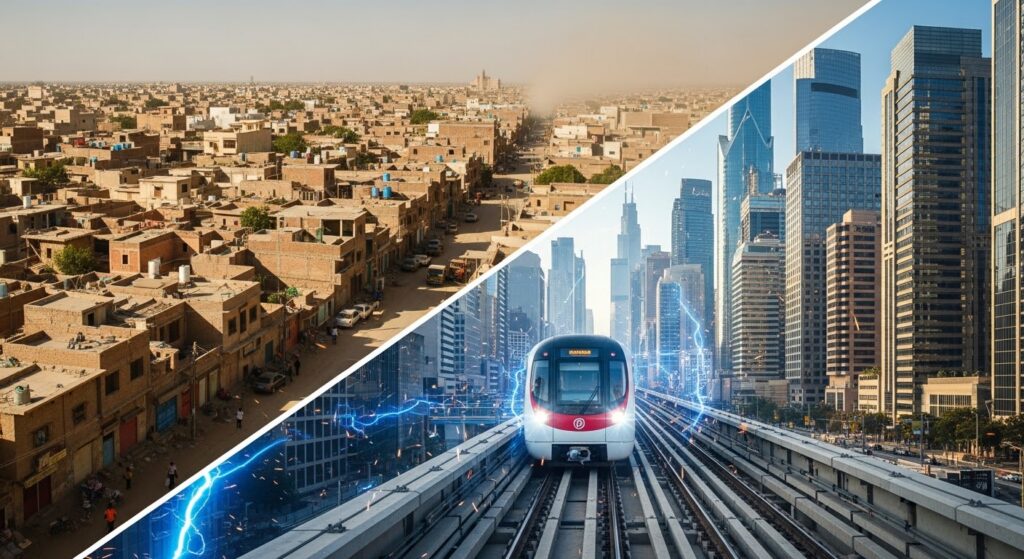
Build more people and economic activity where transportation capacity already exists.
A metro line can carry thousands of passengers along a relatively narrow corridor.
That infrastructure can therefore support a much higher concentration of homes and businesses than an ordinary suburban road.
This creates a powerful relationship between transport capacity and development intensity.
Why FSI Suddenly Matters So Much
To understand the TOD real-estate revolution, you need to understand one acronym:
FSI — Floor Space Index.
FSI broadly determines how much floor area can be constructed relative to the size of a plot, although the actual calculation and permissible components vary according to local development regulations.
For example, a simplified illustration:
If a 10,000-square-foot plot has an effective FSI of 2, the permitted floor area might be around:
20,000 square feet.
If planning regulations permit substantially higher development intensity, the potential buildable floor area can increase.
That additional development capacity has economic value.
And this is where TOD becomes particularly interesting.
Many Indian cities have introduced or expanded planning mechanisms that encourage higher-density development around mass-transit corridors, though the exact rules, premiums, setbacks, road requirements and eligibility conditions differ considerably between cities and projects.
So the old question:
“How big is the plot?”
increasingly needs to be followed by:
“What can legally be built on that plot?”
And then:
“How close is it to high-capacity transit?”
The Real Estate Value of a Metro Station
A metro station doesn’t just move passengers.
It can change the economic characteristics of an entire neighbourhood.
Consider what happens when a station opens.
Suddenly, a previously inconvenient location may become connected to:
- employment centres
- universities
- shopping districts
- airports
- railway stations
- business parks
- entertainment zones
- other metro corridors
The catchment area of the neighbourhood expands.
A resident may be willing to live farther from their workplace if the journey becomes predictable.
A company may consider an office location that previously seemed inconvenient.
Retailers may value pedestrian traffic.
Restaurants may benefit from commuter flows.
Developers may see an opportunity to consolidate smaller plots into larger projects.
The station therefore becomes an economic anchor.
The Transit Premium: India’s New Property Metric
For years, Indian buyers have focused on traditional property metrics:
- Locality.
- Builder reputation.
- Road width.
- Amenities.
- School proximity.
- Parking.
- Future infrastructure.
TOD introduces another metric:
Transit accessibility.
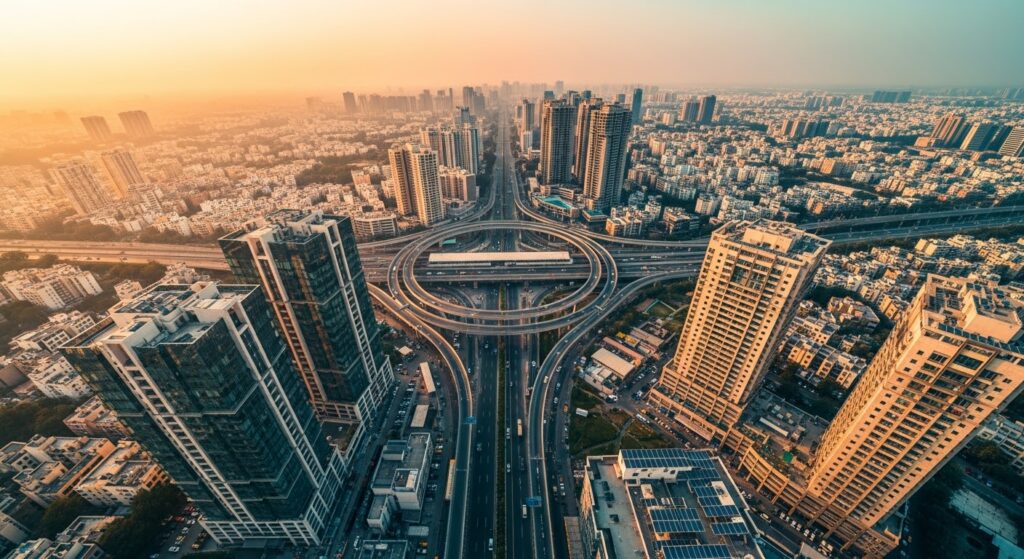
A property within comfortable walking distance of a station can potentially command a premium over otherwise comparable properties farther away.
- But there is an important distinction.
- Not every property beside a metro station automatically becomes a great investment.
- The quality of the transit connection matters.
A station that connects efficiently to employment centres is fundamentally different from one with limited network integration.
Similarly, walkability matters.
A station that is technically 800 metres away but requires crossing dangerous roads may be less valuable from a practical commuter perspective than one that is 600 metres away through a pedestrian-friendly route.
So investors should stop thinking only in terms of distance from the station.
They should think in terms of actual accessibility.
The Rise of the 15-Minute City
One of the most important ideas influencing modern urban planning is the 15-minute city.
The objective is simple:
- Essential parts of daily life should be accessible within a short journey from where people live.
- In an Indian context, this doesn’t necessarily mean every resident literally reaches everything within 15 minutes.
- Instead, the broader principle is about creating neighbourhoods where people can access:
- homes + workplaces + shops + schools + healthcare + recreation + transit
- without requiring a car for every trip.
TOD fits naturally into this model. - A high-density transit district can support shops at street level, offices above them and residential buildings nearby.
- Instead of separating every activity into different parts of the city, the neighbourhood becomes more integrated.
- And that integration can itself become a property amenity.
Why Developers Love High-Density TOD Projects
From a developer’s perspective, higher permissible development intensity can fundamentally change project economics.
Suppose a developer acquires an expensive parcel of urban land.
The land cost is already high.
If development potential is limited, recovering that land cost becomes difficult.
But if planning regulations permit greater floor area under an applicable TOD framework, the developer may be able to distribute the land cost across a much larger saleable or permissible development footprint, subject to the regulations and project economics.
This is one reason developers aggressively track:
FSI + transit corridors + redevelopment opportunities.
The equation becomes:
Expensive land + greater development potential = potentially stronger project economics.
This also explains the increasing popularity of large mixed-use developments.
The Mixed-Use City Is Coming
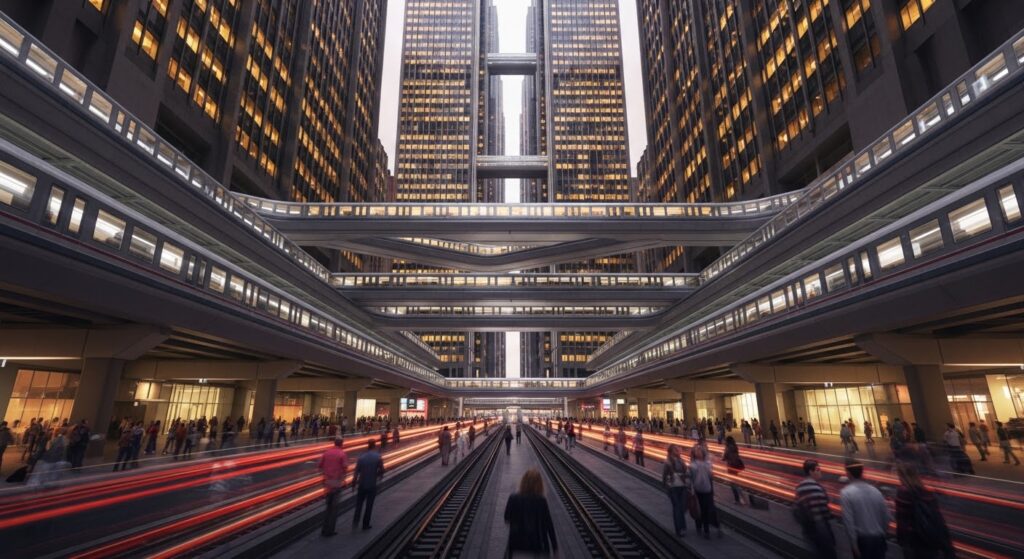
Imagine one vertical development containing:
- Retail on the lower floors.
- Restaurants and entertainment nearby.
- Offices above.
- Apartments higher up.
- Metro connectivity at ground or basement level.
This is the basic logic behind many modern TOD projects.
Instead of forcing residents to travel across the city for every activity, the development creates multiple uses within a relatively compact area.
For developers, this can increase the number of revenue-generating uses.
For residents, it can reduce travel.
For cities, it can potentially reduce pressure on road infrastructure.
And for investors, diversified mixed-use demand can make strategically located developments particularly attractive.
Parking Is Losing Its Monopoly Over Urban Space
There is another fascinating consequence.
Traditional Indian residential development often devotes enormous amounts of space to cars.
Basements become parking areas.
Ground-level areas are sacrificed for vehicle movement.
Large plots are designed around automobile access.
TOD changes the equation.
If residents can comfortably reach offices, shops and public transport on foot, the need for multiple daily car trips can decline.
That doesn’t mean cars disappear.
Instead, the city can potentially allocate more valuable urban space to:
- parks
- plazas
- pedestrian areas
- retail
- cycling
- infrastructure
- community spaces
- public amenities
This is especially important in land-scarce cities such as Mumbai.
When every square metre is expensive, deciding whether that space should accommodate people or parked vehicles becomes an economic question.
Mumbai: Where TOD Could Become a Major Real-Estate Story
Mumbai provides an especially interesting example because land is scarce, housing demand is enormous and commuting distances can be painful.
The expansion of metro connectivity, suburban rail integration and major transport corridors is creating new nodes of accessibility across the metropolitan region.
Areas once considered peripheral can become significantly more attractive when connected to fast mass transit.
The effect can be particularly powerful when several infrastructure systems intersect.
For example:
- Metro + suburban rail + road network + commercial development
- can create a powerful urban node.
- In such locations, the property value story isn’t simply about the apartment.
- It is about the network surrounding the apartment.
- Bengaluru’s Metro Expansion Is Changing Location Economics
Bengaluru has a different problem.

The city is one of India’s most important technology and employment centres, but severe traffic congestion has made commuting one of its biggest urban challenges.
Metro expansion therefore has the potential to alter residential preferences.
A neighbourhood previously dismissed because of road congestion can become more attractive if a rapid-transit connection dramatically improves accessibility.
This creates an interesting contradiction:
The worse the traffic becomes, the more valuable reliable mass transit can become.
For some buyers, a smaller apartment near a metro station may eventually be more attractive than a larger apartment requiring a long daily drive.
That is a major behavioural shift.
Millennials and Gen Z Are Changing the Property Equation
Indian property preferences are also changing.
Younger buyers are increasingly balancing traditional aspirations—such as owning a home—with other priorities:
mobility, convenience, career flexibility and lifestyle.
For these buyers, the question isn’t always:
“How large is the apartment?”
It can be:
“How much of my life will I lose travelling to and from it?”
A compact apartment near a metro, restaurants, cafés, gyms and workplaces may therefore compete strongly against a much larger suburban property.
The value of time is becoming part of the value of real estate.

But TOD Does Not Mean Every Metro Property Will Become Expensive
This is where investors need to be careful.
The TOD story can easily become a speculative narrative.
Metro proximity alone does not guarantee appreciation.
Property prices depend on numerous factors:
- local supply and demand
- development regulations
- station connectivity
- employment growth
- infrastructure quality
- project execution
- developer reputation
- redevelopment potential
- rental demand
- surrounding neighbourhood quality
- actual walkability
A property marketed as “TOD” should therefore not automatically be treated as a guaranteed wealth generator.
Investors need to examine the specific development regulations applicable to the property.
The Hidden Risk: Hyper-Density
There is another side to the vertical-city revolution.
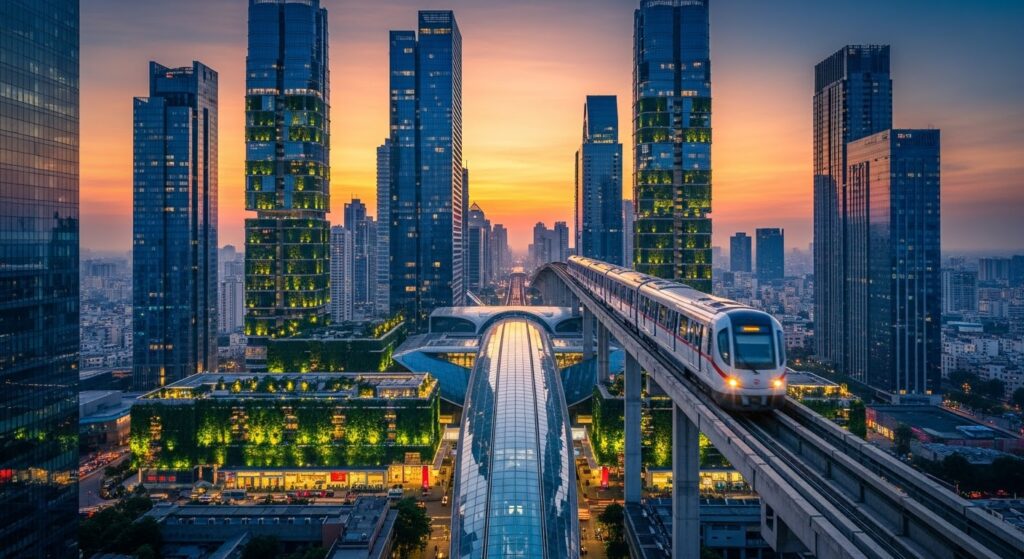
If thousands of additional residents and workers are concentrated around transit corridors, infrastructure must keep up.
More buildings mean greater pressure on:
- water supply.
- sewage networks.
- electricity.
- roads.
- schools.
- healthcare.
- parking.
- waste
- management.
A metro station can solve the transportation problem only if the surrounding urban infrastructure can handle the population density.
Otherwise, TOD can simply replace one problem with another.
- You can reduce traffic congestion while creating pressure on utilities.
- That is why successful TOD requires much more than taller buildings.
- It requires integrated infrastructure planning.
- The Technology Behind the High-Density City
The future of TOD will increasingly depend on technology. - Smart traffic management can monitor congestion.
Digital building-management systems can optimise energy consumption.
- Intelligent water systems can identify leakage.
- Automated waste-management systems can improve collection.
- Real-time public-transit data can help commuters plan journeys.
- Smart parking systems can reduce unnecessary vehicle circulation.
And integrated urban command centres can monitor multiple infrastructure systems simultaneously.
The vertical city of the future therefore isn’t simply going to be taller.
It will need to be smarter.
Will TOD Save India's Green Spaces?
Potentially—but only if implemented properly.
This is one of the most compelling arguments for concentrated development.
Instead of allowing cities to continuously consume agricultural land, forests and open spaces at their edges, planners can encourage more intensive development in already urbanised transit corridors.
The theory is simple:
- Build upward where infrastructure exists instead of endlessly building outward.
- If successful, this can help contain urban sprawl.
- But higher density does not automatically protect the environment.
- Poorly planned high-rise development can create its own environmental problems.
The objective should therefore be:
- higher density + better transit + better public spaces + efficient infrastructure.
Not simply:
- more towers.
The New Indian Real-Estate Formula
The property market of the next decade could increasingly be evaluated through a combination of variables.
Instead of looking only at:
- Location + Area + Builder
- investors may need to think about:
- Transit + Development Potential + Walkability + Employment + Infrastructure.
And perhaps the most important relationship will be:
- Transit Accessibility × Development Potential
- A parcel with modest development potential but excellent transit may be valuable.
- A parcel with enormous development potential but poor connectivity may also be valuable.
- But when both occur together, the economics can become particularly powerful.
That is the real promise of TOD.
Why Your Small Apartment Could Become More Valuable
Now we return to the original question.
Could a small apartment near a metro station eventually outperform a larger property farther away?
It is certainly possible—but not guaranteed.
The reason is that urban property value is not determined by physical space alone.
It is also determined by access to economic opportunity.
If a metro station connects your neighbourhood to major employment centres, commercial districts and other transit lines, the location becomes more useful.
And useful locations tend to attract demand.
That demand can translate into higher rents, stronger resale interest and potentially greater capital appreciation.
- The apartment may remain physically small.
- But the city around it has effectively become larger.
- The Next Decade of Indian Urban Wealth
- India is entering one of the biggest urbanisation phases in its history.
- Millions of people will continue moving toward major employment centres.
- Cities will become denser.
- Land will become more expensive.
- Road space will become increasingly scarce.
And governments will have to find ways to accommodate more people without allowing urban areas to spread indefinitely.
That makes mass transit more than a transportation project.
It makes it an urban development engine.
Metro corridors can influence where homes are built, where offices locate, where retail emerges and where land values rise.
And as TOD policies evolve, the relationship between transit access and development rights could become increasingly important.
The Bottom Line: Follow the Metro, But Follow the Rules
The biggest real-estate opportunity of India’s TOD revolution may not simply be buying an apartment next to a metro station.
It may be understanding what the metro station does to the land around it.
Does it increase accessibility?

- Does the local development plan permit greater density?
- Is there genuine employment nearby?
- Can the infrastructure support additional population?
- Is the station genuinely walkable?
- Is the area becoming mixed-use?
And most importantly:
Is the government’s urban-planning policy moving in the same direction as private investment?
Because when transportation policy, development regulations and private capital move together, neighbourhoods can transform rapidly.
The future Indian skyline may therefore not be shaped simply by who owns the most land.
It may be shaped by where transit, density and development rights intersect.
And that is why, in the emerging Indian city, the most valuable address may not necessarily be the biggest house.
It could be the apartment that lets you walk downstairs, enter a metro station and reclaim an hour of your life every day.
In the TOD era, time is property—and connectivity is becoming wealth.