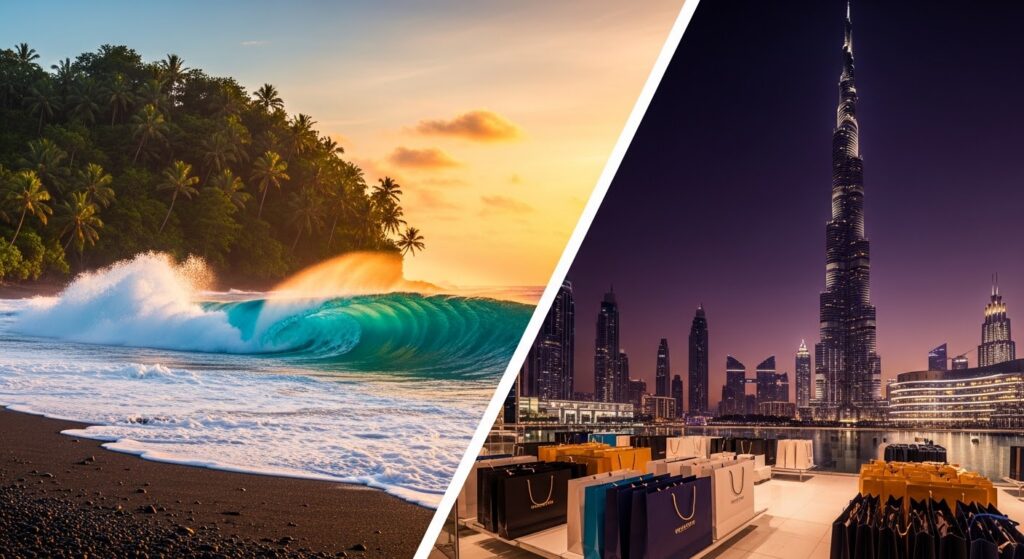
Two destinations can offer completely different definitions of luxury.
Bali gives you volcanic beaches, tropical forests, surf breaks, temples, artisan villages and slow mornings. Dubai gives you architectural spectacle, five-star hotels, futuristic malls, luxury shopping and nightlife that continues long after sunset.
In 2026, the real question is no longer simply “Which destination is better?” It is:
Do you want to escape the modern world—or experience its most spectacular version?
Bali and Dubai sit almost at opposite ends of that question.
Natural Spirit vs Engineered Luxury
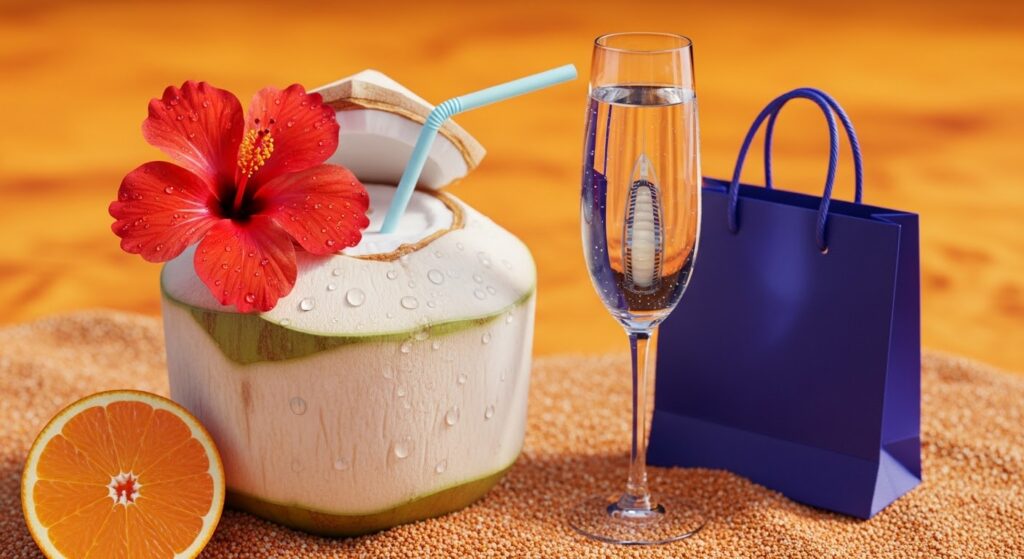
Bali’s appeal begins with something that cannot be completely manufactured: imperfection.
Its coastline is shaped by volcanic geology, powerful waves and centuries of tropical weather. Black-sand beaches, limestone cliffs, rice terraces and dense vegetation create landscapes that feel organic rather than designed.
You can wake up near the ocean, hear scooters and birds outside your hotel, walk through a village and suddenly find a centuries-old temple surrounded by tropical vegetation.
Dubai offers almost the opposite experience.
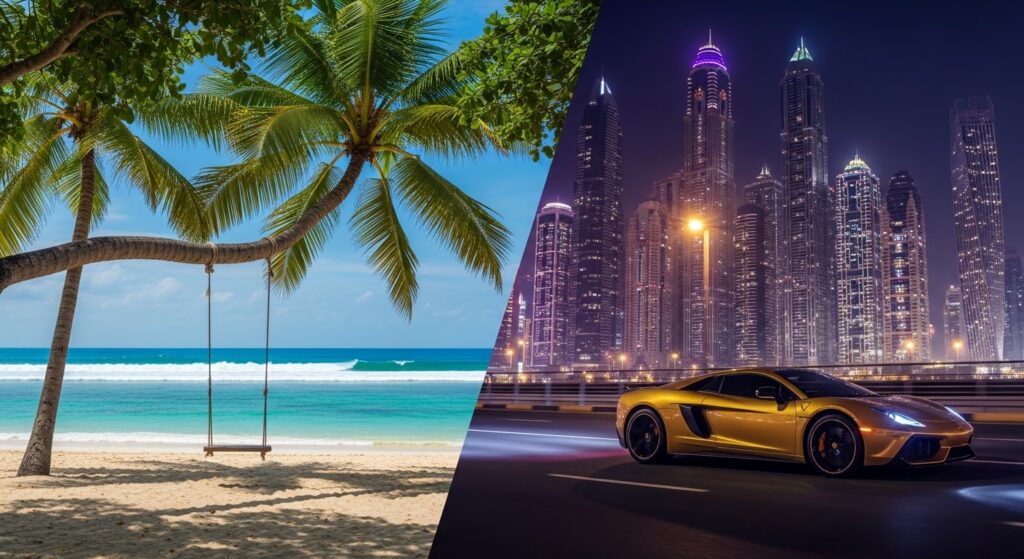
The city’s most famous landscapes are products of extraordinary engineering. The Palm Jumeirah, enormous skyscrapers, artificial islands, spectacular waterfront developments and vast luxury districts demonstrate what happens when technology and capital attempt to redesign the desert.
- Dubai’s luxury is based on precision.
- Bali’s luxury is often based on connection.
- And this difference is becoming increasingly important in 2026.
- The rise of organic travel
After years of increasingly polished, Instagram-perfect tourism, many travellers are looking for something different.
They want places that feel authentic, imperfect and human.
They want local food instead of international chains. They want small cafés instead of enormous commercial complexes. They want experiences that cannot easily be replicated in another city.
This is where Bali has a natural advantage.
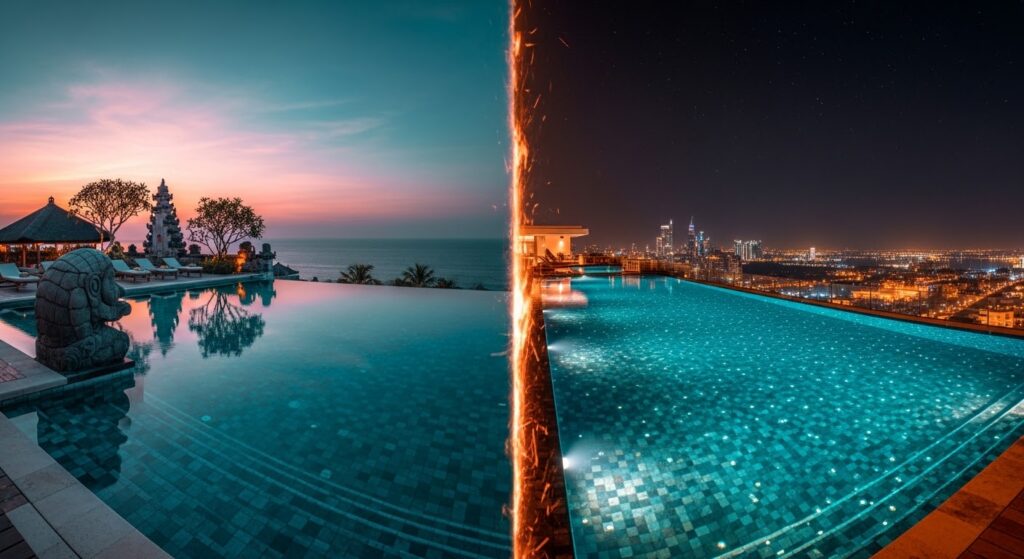
A Balinese temple ceremony, a local warung, a surf lesson or an early-morning walk through a rice field can feel deeply connected to the place.
Dubai, meanwhile, offers a different form of authenticity: the experience of ambition itself.
The skyline, luxury cars, mega-projects and futuristic architecture tell the story of a city that transformed itself at extraordinary speed.
One destination says:
“Slow down and reconnect.”
The other says:
“Look how far humanity can go.”
The Pulse of the Escape
The difference becomes even clearer when you look at how a typical day unfolds.
In Bali, mornings can begin slowly.
The sun rises over the ocean. Surfers head toward the water. Yoga studios begin their sessions. Cafés fill gradually. Travellers move between beaches, temples, rice terraces and wellness retreats.
- The day doesn’t necessarily demand constant consumption.
- Sometimes the biggest experience is simply sitting somewhere beautiful.
- Dubai operates on an entirely different rhythm.
Breakfast can be followed by a business meeting, a luxury shopping expedition, a beach club, an architectural attraction and dinner at a high-end restaurant.
After sunset, the city becomes even more energetic.
Restaurants, lounges, rooftop venues and entertainment districts keep the city moving deep into the night.
Dubai is built around efficiency and abundance.
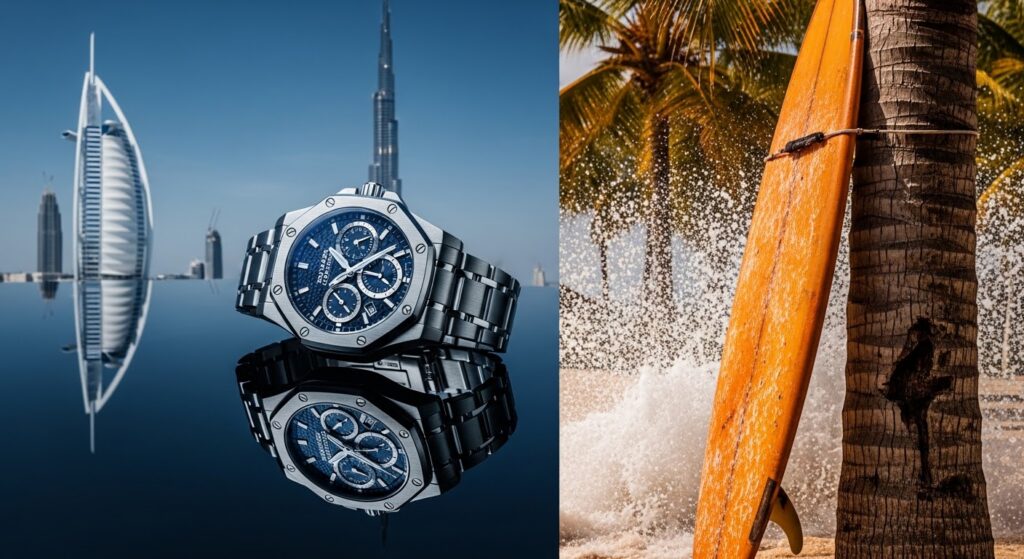
Bali is better suited to slowness and decompression.
This difference represents one of the biggest travel trends of 2026: the growing popularity of slow living.
People are increasingly asking whether a holiday should leave them with more energy—or simply more photographs.
A Bali retreat can be designed around doing less.
Dubai can make doing more feel incredibly exciting.
Neither philosophy is inherently better.
The right choice depends on what your life already looks like.
If your everyday life is chaotic, Bali may feel like medicine.
If your everyday life feels repetitive, Dubai may feel like an adrenaline injection.
Souks and Sanctuaries
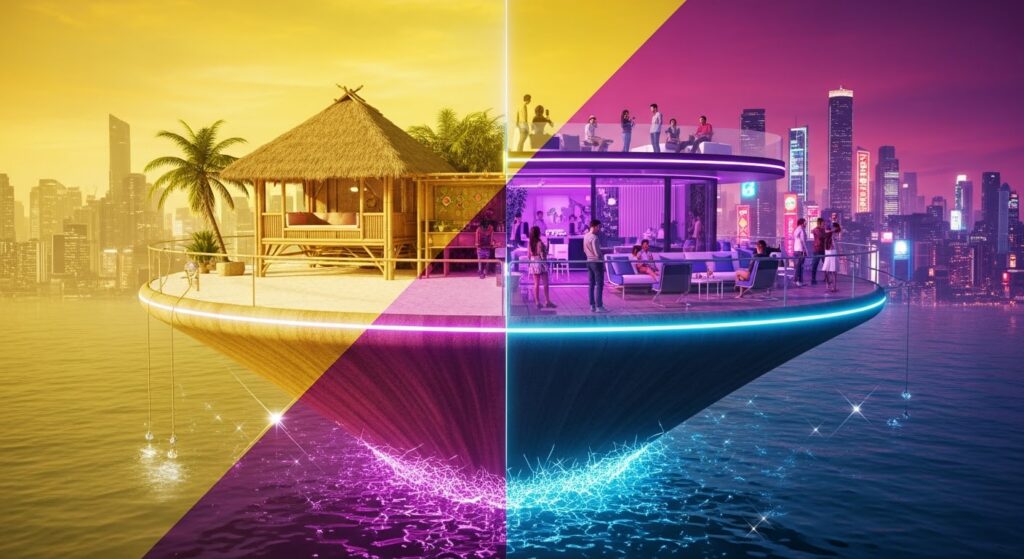
Shopping reveals another major difference between the two destinations.
Bali’s shopping experience is often intimate.
You find handmade textiles, jewellery, woodcraft, ceramics, artwork, natural products and locally designed fashion in small stores and artisan markets.
The attraction isn’t necessarily the price.
It’s the story.
You can see the imperfections in handmade products. You can meet the person who created something. You can understand where the material came from.
The object becomes a memory of the journey.
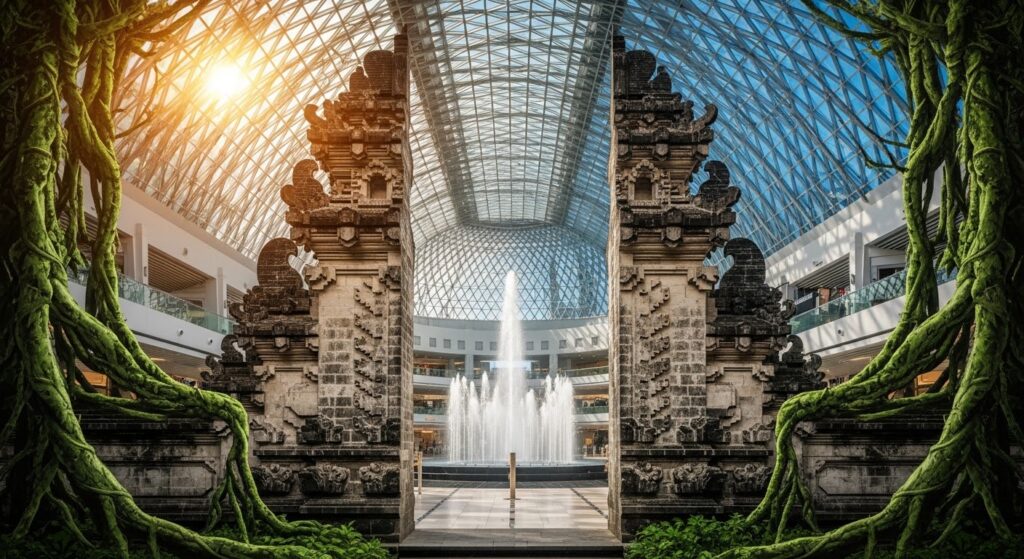
Dubai approaches shopping as an experience in itself.
Its enormous malls combine luxury brands, restaurants, entertainment, architecture and technology under one roof.
The modern Dubai shopping experience increasingly sits at the intersection of physical and digital—“phygital” retail.
Mobile integration, AI-assisted recommendations, digital experiences and highly personalized retail environments are changing the way visitors interact with major commercial spaces.
The mall is no longer simply somewhere to buy something.
It becomes a destination.
And this is where Dubai has a spectacular advantage.
You can spend an entire day inside a single complex and experience shopping, dining, entertainment and architecture without worrying about weather or transportation between attractions.
But Bali offers something Dubai cannot easily manufacture:
tactile intimacy.
- The handmade object has fingerprints, texture and history.
- Dubai’s luxury often communicates status and sophistication.
- Bali’s craftsmanship communicates culture and individuality.
When the Sun Goes Down
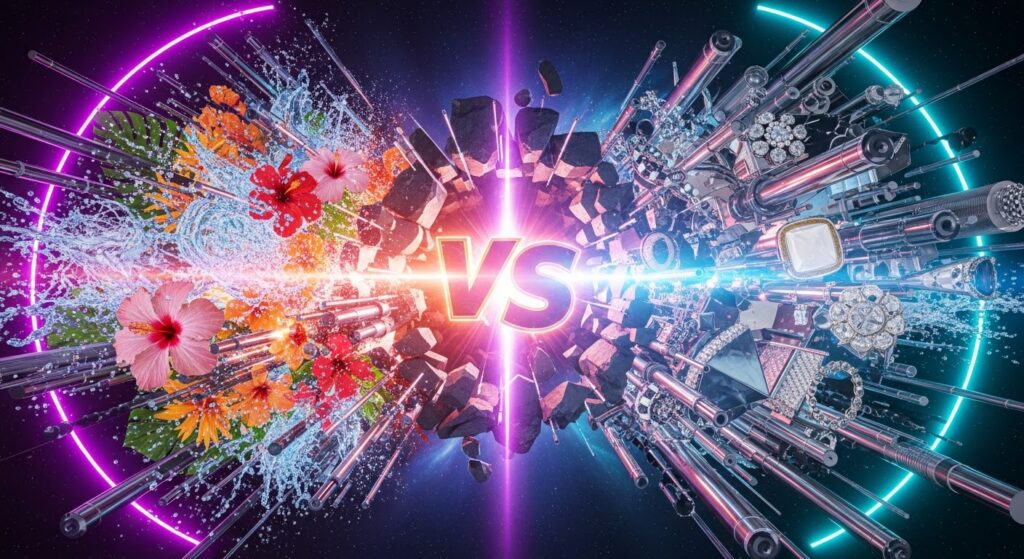
The biggest contrast may appear after sunset.
Bali’s nights can be peaceful.
A beach dinner, sunset over the Indian Ocean, traditional performance or quiet drink at a small bar can provide a relatively relaxed end to the day.
But certain parts of Bali also have vibrant nightlife, particularly around areas such as Seminyak, Canggu and Kuta.
Dubai takes nightlife to another level.
Rooftop restaurants illuminate the skyline. Luxury hotels transform into entertainment destinations. Clubs, lounges and restaurants compete for attention.
The city becomes a visual spectacle.
Skyscrapers glow against the darkness while traffic continues to move through the streets.
Dubai’s night is not simply the end of the day.
It is another version of the day.
And that makes the two destinations almost impossible to compare using conventional rankings.
Bali asks:
How relaxed can you become?
Dubai asks:
How much can you experience?
The Value of the Ultimate Getaway
Cost complicates the comparison.
Neither destination should automatically be classified as “cheap” or “expensive.”
Your final budget depends heavily on travel dates, accommodation level, flights, food choices, transportation and activities.
Bali can be surprisingly affordable for travellers willing to use local restaurants, smaller hotels and local transport.
At the same time, luxury Bali can become extremely expensive.
Private villas, premium resorts, wellness retreats, private drivers and high-end restaurants can transform a supposedly affordable destination into a luxury holiday.
Dubai follows the same pattern but with a generally higher premium attached to many luxury experiences.
Accommodation, dining, entertainment and shopping can quickly push the budget upward.
The important concept in 2026 is therefore not simply cost per day.
It is value per experience.
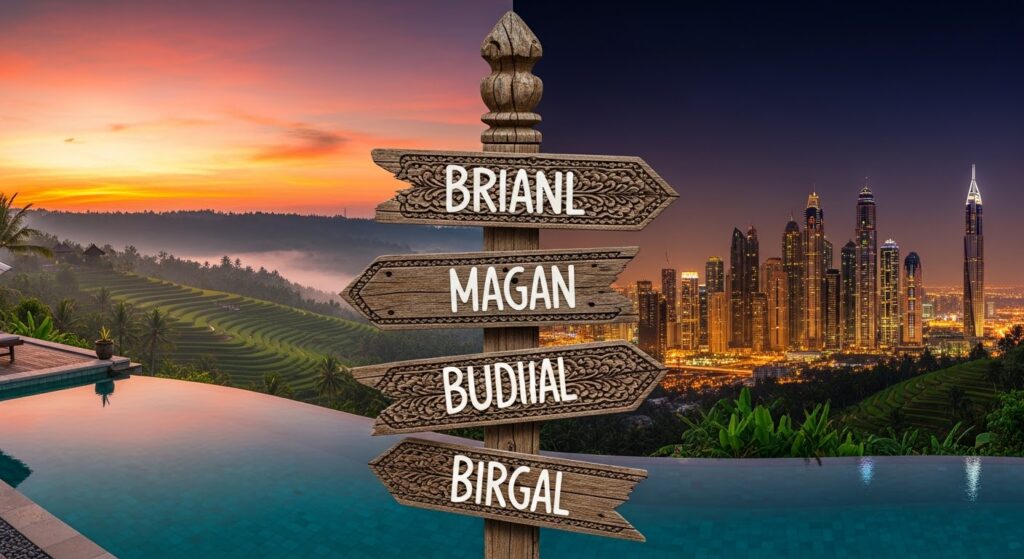
A ₹1 lakh Bali trip and a ₹1 lakh Dubai trip can feel completely different because they purchase different types of experiences.
Spiritual ROI vs Status ROI
Perhaps the most interesting way to compare these destinations is through an unconventional concept:
Return on Investment from a holiday.
Bali offers what we might call spiritual ROI.
You may return with better memories of nature, wellness, culture, solitude and personal reflection.
Dubai provides something closer to status ROI.
The value comes from experiencing extraordinary architecture, luxury hospitality, premium shopping, exclusive venues and the atmosphere of one of the world’s most ambitious cities.
One makes you feel closer to yourself.
The other can make you feel closer to the world’s most spectacular version of modern luxury.
Of course, these are broad generalizations.
You can have an incredibly spiritual experience in Dubai.
And you can have an extravagant party holiday in Bali.
The destinations simply make different experiences easier to find.
So, Who Wins—Bali or Dubai?
There is no universal winner.
Instead, imagine two travellers.
The first has spent months working in a crowded city. Their phone never stops ringing. Their schedule is packed. They want ocean, greenery, silence and time to think.
Bali wins.

The second wants skyscrapers, luxury hotels, designer shopping, nightlife, restaurants, futuristic architecture and an extraordinary urban experience.
Dubai wins.
Choose Bali if you want:
- Nature and beaches
- Wellness and slow living
- Surf culture
- Rice terraces and rural landscapes
- Spiritual and cultural experiences
- Artisan craftsmanship
- Relaxed mornings and sunsets
- A more organic travel experience
Choose Dubai if you want:
- Futuristic architecture
- Luxury shopping
- High-energy nightlife
- Premium hospitality
- Luxury experiences
- Technology-driven experiences
- High-end dining
- A polished, spectacular city experience
The Final Verdict
- Bali is an escape from the modern world.
- Dubai is an escape into the modern world.
- That may be the simplest way to understand the rivalry.
- Bali’s greatest luxury is space, nature and time.
- Dubai’s greatest luxury is choice, convenience and spectacle.
And perhaps that’s why the Bali-versus-Dubai debate is becoming so interesting in 2026.
The modern traveller is no longer necessarily searching for the best destination.
They are searching for the destination that matches the life they want to experience for a few days.
So before booking your ticket, ask yourself one question:
- Do I want my holiday to slow my life down—or turn it up?
- If the answer is slow it down, Bali may be your winner.
- If the answer is turn it up, Dubai might be waiting for you.
Bali or Dubai—there is no wrong answer. There are simply two very different definitions of the ultimate escape.