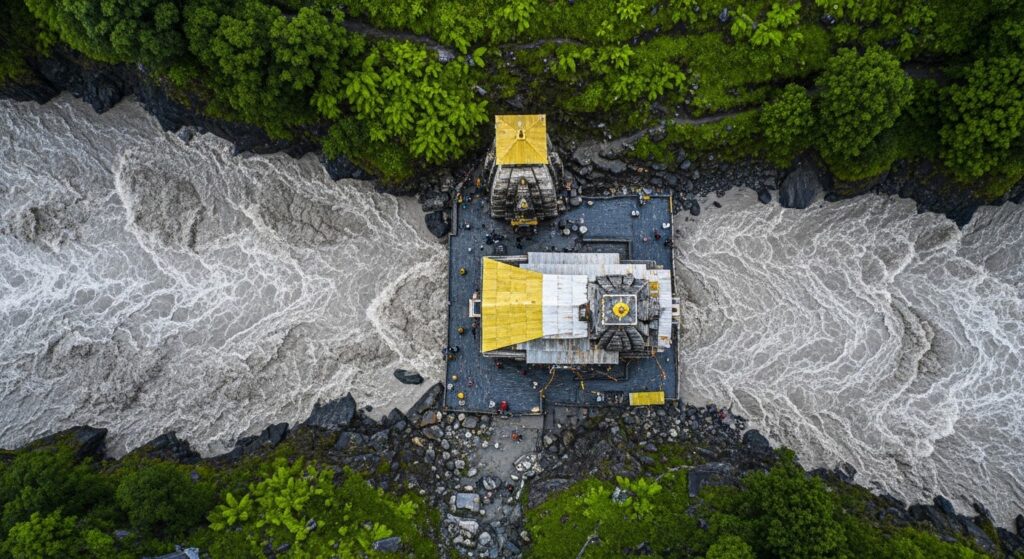
In June 2013, the Kedarnath region experienced one of the most devastating Himalayan disasters in recent Indian history. Torrential rainfall, flooding and massive debris flows destroyed buildings, roads and bridges across the valley.
Yet the ancient **Kedarnath Temple remained standing**.
Its survival has often been described as a miracle. For engineers and historians, however, it also raises a fascinating question:
**What can the temple’s architecture tell us about the resilience of traditional Himalayan construction?**
The answer is more complex than the popular story suggests. The temple was not simply a “12th-century earthquake-proof building,” nor can its survival be attributed entirely to a single boulder. But its massive stone construction, substantial plinth, location and geometry clearly played important roles.
To understand why, we have to look beyond the legend and into the architecture.
The 2013 Disaster: When the Landscape Changed

The Kedarnath disaster was not simply a conventional river flood.
Extreme rainfall triggered a series of destructive processes involving overflowing water bodies, slope failures, landslides, debris and enormous quantities of rock and sediment moving through the valley.
Buildings around the temple complex were swept away or severely damaged.
Concrete structures, hotels, shops and bridges that had appeared permanent suddenly became vulnerable to forces far beyond those for which they had been designed.
The temple, meanwhile, emerged from the catastrophe with remarkably limited structural damage compared with the surrounding built environment.
That contrast created one of the most enduring images of the disaster:
**an ancient stone temple standing amid a devastated landscape.**
But the survival story needs to be examined carefully.
First, How Old Is the Temple?

Kedarnath is traditionally associated with the Pandavas and is one of the most important Shiva temples in Hindu tradition.
Historically, the exact construction date of the present temple is difficult to establish with certainty.
It is often popularly described as an **8th-century temple associated with Adi Shankaracharya**, while some architectural and historical interpretations place the surviving structure within a broader medieval period.
Therefore, calling it definitively an “8th-century engineering project” oversimplifies a complicated historical question.
What is far less controversial is the architectural character of the building itself: it is an imposing Himalayan stone structure constructed from enormous blocks and designed for an exceptionally harsh environment.
And that is where the engineering story becomes fascinating.
The Unshakable Stone Foundation

Look closely at Kedarnath Temple and one feature immediately stands out.
**Massive stone dominates the structure.**
The walls are built from large, carefully shaped stone blocks rather than lightweight modern materials.
This gives the building enormous mass.
Mass is not automatically the same thing as strength, but in a structure exposed to severe weather, temperature fluctuations and seismic activity, a massive stone construction can provide substantial stability when combined with appropriate geometry and foundations.
The temple also sits on a substantial raised stone platform.
That elevated base is particularly important when considering the 2013 disaster.
A building designed to sit above its immediate surroundings has a very different relationship with moving water and debris from a lightweight structure constructed directly on a vulnerable surface.
Ashlar Masonry: Precision Without Modern Concrete
The temple’s masonry is often described as **ashlar-style construction**—large blocks shaped and fitted carefully against one another.
Traditional stone construction relies heavily on geometry.
Instead of asking concrete to perform all the work, the architect uses:
- the weight of the stones,
- their shape,
- friction between surfaces,
- carefully aligned joints,
- the geometry of the walls,
- and the strength of the foundation.
This approach has an important characteristic.
A large stone block does not behave exactly like a thin concrete wall.
The mass of the material gives the structure considerable inertia, while properly fitted blocks distribute loads through the masonry.
That does not make the building invulnerable.
It means that the structure was fundamentally conceived as a **massive stone system**, rather than a collection of lightweight components attached to a reinforced-concrete frame.
The Temple Wasn't Designed to "Defeat" a Flood

One popular claim about Kedarnath is that its builders intentionally designed the temple to split floodwater.
There is not enough reliable historical evidence to establish that this was the specific intention of the original architects.
The temple predates modern understanding of Himalayan hydrology by many centuries.
What we can say is that its **large stone mass, elevated plinth and location** contributed to its resilience.
The distinction matters.
Ancient engineers may have understood water, slopes, drainage and local environmental conditions through practical experience without possessing the terminology of modern hydrodynamics.
Traditional architecture often represents generations of empirical learning.
The result can be remarkably effective even when the original builders did not describe it using modern engineering equations.
The Bhim Shila: Miracle, Geology and Physics
Then comes the most famous part of the story.
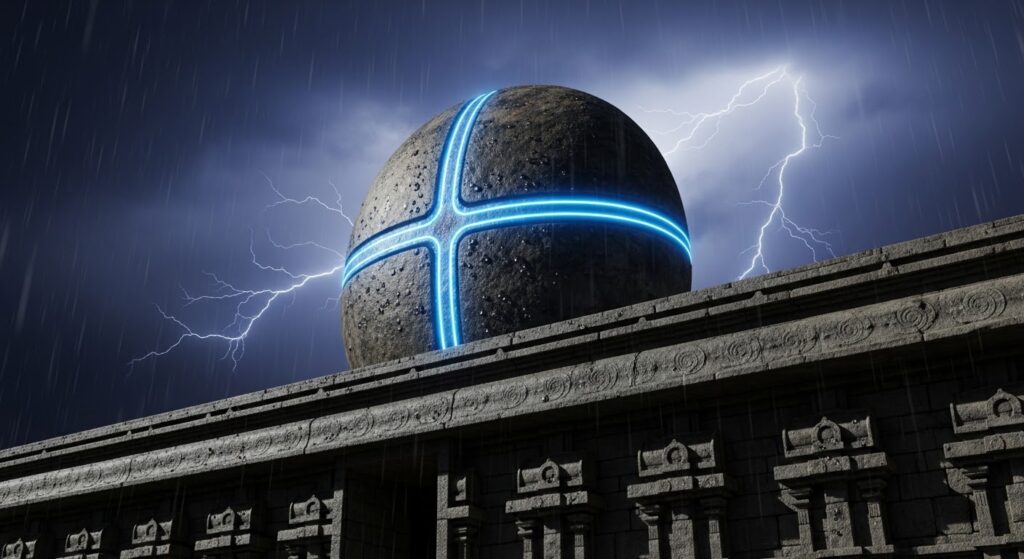
Behind the temple lies a huge boulder popularly known as **Bhim Shila**.
During the 2013 disaster, this enormous rock came to rest behind the temple.
As the debris flow moved through the area, the boulder is widely credited with helping divert part of the destructive flow around the temple.
- The visual evidence is compelling.
- The temple survived.
- The boulder sits directly behind it.
- The surrounding area suffered enormous destruction.
- It is easy to understand why the stone became known as a divine protector.
But another interpretation is possible.
A massive boulder moving with a debris flow can alter the direction and distribution of water and sediment around it. Once it comes to rest, it can also influence the local flow pattern.
In other words, **there is a plausible physical mechanism behind the protective effect without requiring the boulder to have been deliberately positioned by ancient engineers.**
There is no credible evidence that the temple builders placed Bhim Shila there as an engineered shield.
Its role in 2013 is better understood as a remarkable interaction between natural geology and human architecture.
A Natural Shield in the Right Place

Imagine the force of a debris-laden flow approaching a massive stone structure.
The flow carries not only water but also sediment, rocks and other material.
A large obstacle can disrupt that movement.
Instead of allowing the entire flow to strike one surface uniformly, the obstacle can divide and redirect portions of the moving material.
This is broadly consistent with what appears to have happened around Kedarnath Temple.
But it would be misleading to claim that scientists have proven a precise “dead zone” or calculated that the boulder was mathematically destined to stop at exactly that location.
Those claims go beyond the available evidence.
The real story is already extraordinary:
**a natural geological event appears to have interacted with the temple in a way that helped limit the disaster’s impact on the structure.**
Why Modern Buildings Failed Differently
The comparison between the temple and modern buildings also needs nuance.
It would be wrong to conclude that ancient stone construction is automatically superior to reinforced concrete.
Modern engineering, when properly designed and constructed for site-specific hazards, can produce extremely resilient structures.
The problem in the Kedarnath disaster was not simply “concrete versus stone.”
Building location, foundation conditions, river channels, drainage, slope stability, construction quality and exposure to debris flows all matter.
A modern hotel constructed in a hazardous flood or debris-flow corridor can be vulnerable regardless of whether its structural material is concrete, steel or stone.
This is one of the biggest lessons of Kedarnath.
**The location of a building can be just as important as the material used to build it.**
The Himalayan Lesson of Heavy Construction
There is another reason the temple’s survival fascinates engineers.
The structure is extraordinarily heavy.
Large stone blocks create a building with considerable mass and substantial load paths.
In seismic engineering, however, mass is not universally beneficial. More mass can also mean greater seismic forces.
So the lesson isn’t that “heavier is always safer.”
The real lesson is that **structural form, material, foundation, geometry and environmental conditions must work together.**
The temple survived one catastrophic event.
That does not mean it is immune to earthquakes, floods or future extreme events.
In fact, the Himalayas remain one of India’s most geologically active regions.
Stone, Temperature and Mountain Weather
Kedarnath presents another extraordinary engineering challenge: climate.
At an elevation of more than 3,500 metres, the structure experiences freezing temperatures, snowfall, intense seasonal weather and large temperature variations.
- Water entering cracks and joints can freeze and expand.
- Repeated freeze-thaw cycles can slowly damage stone.
- Snow and ice can create additional loads.
- Wind, moisture and seismic activity add further stress.
For a building to survive centuries in such an environment requires more than strong material.
It requires **maintenance, appropriate geometry and continuous adaptation**.
The temple’s continued survival therefore represents not just an ancient construction achievement but also generations of conservation.
What 2013 Really Taught Us

Perhaps the most important lesson from Kedarnath is not that ancient engineers possessed secret technology that modern engineers do not understand.
- The lesson is simpler—and potentially more useful.
- Buildings must respect their landscape.
- The mountains are not empty construction sites.
- A river channel is not simply unused land.
- A steep slope is not equivalent to a flat urban plot.
A valley shaped by glaciers, landslides and extreme rainfall cannot be treated like a conventional city development zone.
- Traditional Himalayan architecture evolved within these constraints.
- Modern development sometimes attempted to overcome them.
- The 2013 disaster demonstrated the consequences of ignoring them.
The Future of Resilient Himalayan Construction
As climate change increases concern about extreme rainfall and as Himalayan infrastructure continues to expand, the question is no longer simply how to build stronger buildings.
It is:
- **Where should we build them?**
- How far should development remain from active channels?
- How should bridges be designed for debris flows?
- How can drainage systems handle extreme rainfall?
- Which slopes should remain undeveloped?
How should traditional knowledge be incorporated into modern engineering?
These are much more important questions than whether stone is inherently better than concrete.
The future may lie in combining the best of both worlds.
Modern structural analysis can be combined with traditional understanding of local materials, terrain, climate and settlement patterns.
The Architecture of Resilience
Standing in front of Kedarnath Temple today, it is tempting to see only a religious monument.
But look closer and another story emerges.
- The huge stone blocks tell a story of material knowledge.
- The massive plinth tells a story of stability.
- The temple’s position tells a story about landscape.
The survival of the structure in 2013 tells a story about the interaction between architecture and geology.
And Bhim Shila adds another remarkable chapter—a natural boulder whose movement during the disaster appears to have helped protect the temple.
None of this requires us to turn engineering into mythology.
The truth is powerful enough.
The Ancient Lesson for a Modern World

Kedarnath’s greatest engineering lesson may be surprisingly modern:
**Resilience is not about defeating nature. It is about understanding nature.**
The architects who built this massive stone temple could not predict satellite rainfall forecasts, glacial hazards or climate models.
But their architecture emerged from centuries of living in a demanding mountain environment.
The 2013 disaster showed that this traditional approach had remarkable strengths.
At the same time, it reminds us that no structure is invincible.
The challenge for the 21st century is therefore not to romanticize the past or dismiss modern engineering.
It is to learn from both.
Kedarnath Temple survived because of a combination of **massive stone construction, substantial foundations, its particular location and geometry, and extraordinary geological circumstances during the 2013 disaster**.
And perhaps that is the most fascinating part of the story.
The temple was not simply a monument that survived a flood.
It became a living case study in how **architecture, geology and human resilience can intersect in one of the world’s most unforgiving landscapes.