7 N 8 DAYS | 3 STAR STD | 3 STAR DLX | 4 STAR |
2 PERSON | 46750 | 48750 | 78000 |
4 PERSON | 36750 | 38750 | 67000 |
6 PERSON | 33750 | 35416 | 58000 |
8 PERSON | 31500 | 34125 | 54000 |
10 PERSON | 27500 | 33550 | 53300 |
12 PERSON | 26000 | 28500 | 52750 |
DAY WISE ITINERARY: 06 NIGHTS/07 DAYS
02 N THIMPHU + 02 N PUNAKHA + 02 N PARO)
Day 1: Pick up at Paro international airport and transfer to Thimphu
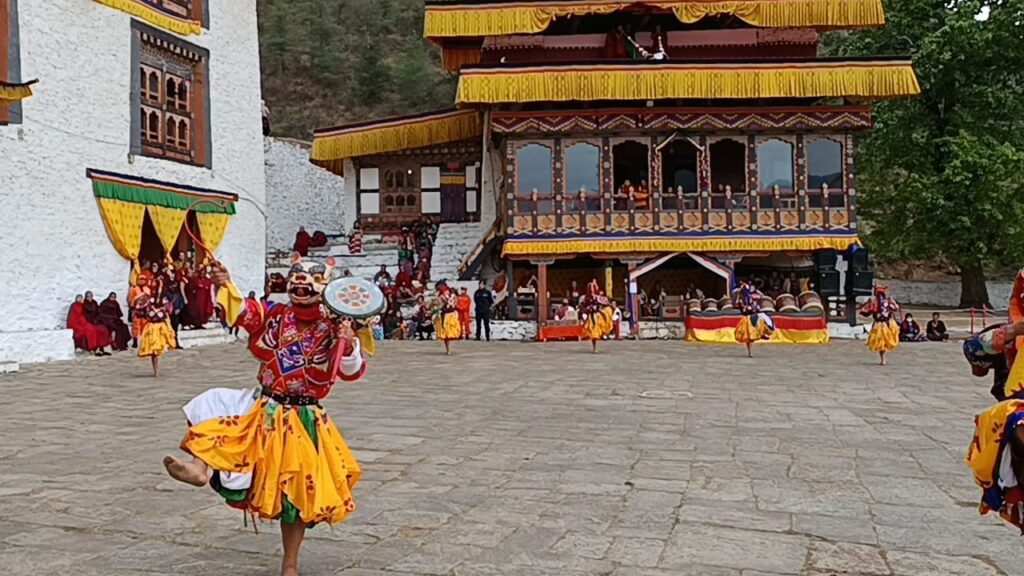
Meet & greet on arrival at Paro Airport and driveq towards the Thimphu After reaching Thimphu check in to the Hotel
& Evening for Leisure.
Overnight in Thimphu.
Day 2: THIMPHU LOCAL SIGHTSEEING
After breakfast, start for local Thimphu sightseeing
The National Memorial Chorten or Thimphu Chorten is a site for evening prayer. The chorten or stupa was built in the memory of the third king, continuously circumambulated by people, murmuring mantras and spinning their prayer wheels. Construction of this landmark was the idea of Bhutan’s third king, His Majesty Jigme Dorji Wangchuk (“the father of modern Bhutan ”) who wished to erect a monument to world peace and prosperity. Completed in 1974 after his untimely death, it serves both as a memorial to the Late King and as a monument to peace.
Folk Heritage Museum – Folk Heritage Museumq is a great place for those who want to learn about the traditional lifestyle of the Bhutanese people. Established in 2001, it offers an insight into the everyday life of the villagers as well as their culture. The museum itself is housed inside a three storied house built sometime in the 19th century.
Buddha Dodenma– On the top of Kuensel Phodrang hill sits the statue of Sakyamuni Buddha. The 51.5-meter long bronze statue would surely attract you and the uninterrupted view of the valley would leave you spellbound. The site is also known as Buddha View Point.
Changangkha Lhakhang – At Thimphu, you will go across several monasteries and temples. Changangkha Lhakhang is among the most important religious structures in Thimphu. The structure dates back to the 15th century and is one of the oldest in the region. The structure is dedicated to Avalokiteshvara, the sign of compassion. You will also enjoy the grand view of Thimphu valley from here.
Takin Preservation Centre – You will find the National animal of Bhutan “Takin” in this open zoo. Takin is one of the most endangered species of the World and it is available only in Bhutan. The National Library has got a fabulous collection of Buddhist manuscripts that are priceless. It also houses the World’s largest published booqk which is about 130 pounds and 5X7 feet.
Zorig Chusum – Institute for Zorig Chusum (commonly known as the Painting School) where students undergo a 6-year training course in Bhutan’s 13 traditional arts and crafts The Royal Textile Museum – Thimphu also introduces visitors to the culture and heritage of Bhutan. The Royal Textile Museum at Norzin Lam is a site where you will get introduced to Bhutanese textiles, some of which date back to the 1600s
Simply Bhutan: Simply Bhutan is a unique and exciting project whose primary aim is to conserve the culture and tradition of the Bhutanese people while creating job opportunities for the young people who are job seekers. The infrastructure in this museum primarily portrays the ancient Bhutanese architecture which is decreasing at a high rate. A visit to Bhutan will bring you closer to an architectural design of its kind. The structure of the museum itself is built reusing old timber, door and window frames and numerous other materials from demolished houses. Simply Bhutan has so much to offer its visitors. First, you get the opportunity to experienc e the real Bhutanese feeling. Unlike numerous museums in Bhutan and all over the world where you aren’t allowed to touch the arteqqfacts or take photographs, things are done differently here. The guides give all visitors an excellent prehistoric experience a nd also let you immerse and experience the real Bhutanese culture and traditions. Some of the most
interactive experience in this museum includes the following:
- Wearing the Gho and Kira. All tourists are given a set of beautiful traditional dresses that you can even try while at the museum. You are even allowed to wear the beautiful Bhutanese traditional dress. They also offer the dress to children and allow you to take photographs of them for future reference.
- You will also get an opportunity to see how the traditional Bhutanese houses were constructed. You can also try a hand at the archery and the dart game that is locally known as Khuru.
Chang Yul Park Thimphu – Newly opened Park in Thimphu, a seven-acre urban green space along the Wangchhu River, developed as a royal initiative by His Majesty The King. Offering visitors a serene environment for relaxation and nature walks. Popular among locals and tourists alike, it provides beautiful views of the surrounding landscapes and is a perfect spot for picnics, casual strolls, or simply eqnjoying Bhutan’s natural beauty. Its proximity to Thimphu’s city centre makes it an accessible escape for those looking to unwind amidst nature. The park also boasts a community hub with a cafeteria, performance plaza, and underground restrooms, serving as a central gathering place for events and social interaction. Key zones of the park include an adventure play area for children, an outdoor gym, walking paths, jogging tracks, and elevated bridges that offer panoramic river views.
Tashiccho Dzong: In the evening after sunset visit to Tashiccho Dzong and experience the unforgettable night view of the monastery enlighten with colourful lights. The monastery is a stronghold of Bhutanese art, tradition, culture and architecture. Tashiccho Dzong is located at the northern side of the city. The Dzong has temples, government offices and shrines to offer its visiter to show.
Overnight in Thimphu.
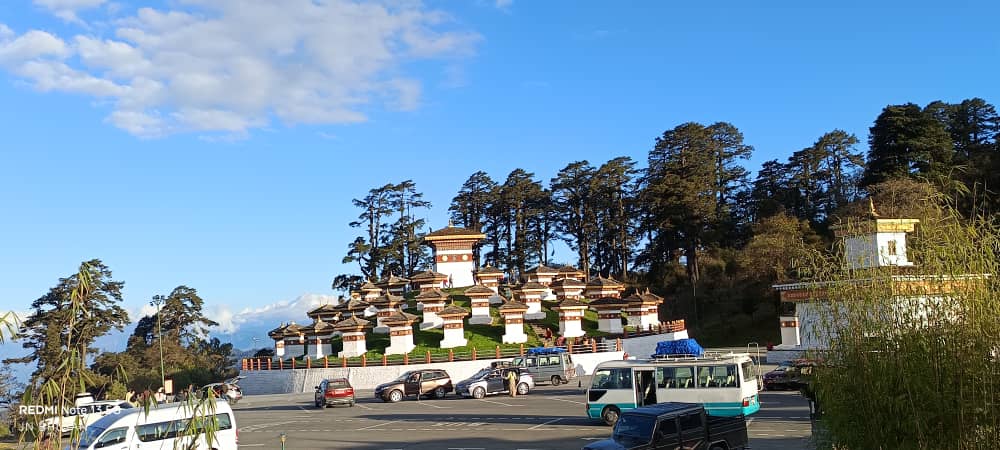
Day 3: THIMPHU to Punakha via Dochula Pass
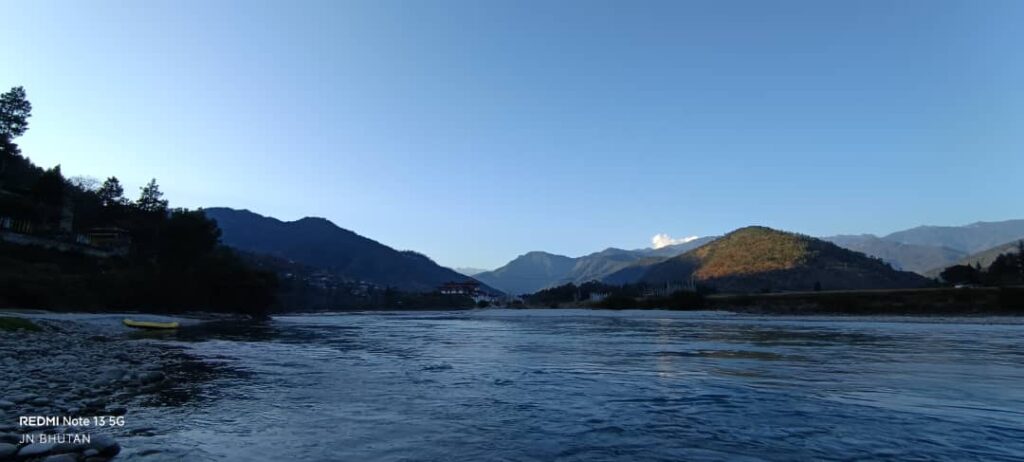
As the Sun shines up high in the Land of Happiness, open your eyes to a beautiful morning in the lap of serene nature, and sip into your cup of hot tea while admiring the green valley from your bed before moving towards Punakha post brqeakfast.
As your Hot Ngaja (a Sweet Bhutanese milk tea) arrives sip into it while enjoying the beautiful valley from the room. Post breakfast heads towards Punakha, the former capital of Bhutan. Punakha is much backward from the chaotic city life at an elevation of 1200 m, which makes this place quite warm in winter and hot during summer. The valley is famous for Red and white rice farming along the Pho and Mo Chu river’s stretch.
En-route visit.
River Rafting: After breakfast, an exciting River rafting (on Direct Payment Basis) tour awaits you. Following a short drive at the river and, after a full safety briefing, you take to your raft for a soft rafting experience down in the Po Chu (Male River). This rafting tour is expected to last for 1 to 2 hours. The clear rivers of Bhutan are one of the Kingdom’s best assets. The Pho Chu (Male River) in Punakha valley, with its approx. 16 Km course with about 15 rapids of class 2- 4 is the most popular for rafting in Bhutan followed by Mo chu (Female river ) in Punakha valley with 10 Km course comprising around ten rapids.
Punakha Dzong: Also known as “the palace of great happiness”, Punakha Dzong is located at the
confluence of the Pho Chhu (father) anqd Mo Chhu (mother) rivers in the Punakha–Wangdue valley.
This Dzong is the most picturesque of all Bhutan ancient fortresses and it joins the mainland by an arched wooden bridge that contains many precious relics from the days when successive kings reigned the Kingdom from this Punakha valley.
Suspension Bridge – This hidden treasure in the Punakha Valley connects the rest of the valley to the old administrative center of Punakha Dzongkhag. The whole deck is covered with prayer flags and provides a perfect spot for bird watching and photography.
IF Time Permit:
Chimi Lhakhang (FERTILITY TEMPLE)– Stationed at the top of a hillock, the Chimi Lhakhang is a site dedicated to Lama Drukpa Kuenley. Known as the ‘Divine Madman,’ Lama Drukpa Kuenley is said to use songs, humor, and outrageous behavior to preach his teachings. Chimi Lhakhang temple is believed to be the temple of fertility, and the Bhutanese hold a strong belief that childless couples are blessed by Lama Drukpa Kuenley if they visit the temple and pray for a child. The road to the temple follows a picturesque rural trail through the paddy field that takes visitors to the temple from the road, and after crossing the paddy field, you will find a tiny stream from where Chimi Lhakhang is just a short climb away.qq
In the evening you can stroll around KajaThrom (market) in Khuruthang town which is the newest space for people to visit and it was inaugurated on 30th April 2023. The Punakha KajaThrom is the largest and most picturesque. One can witness a beautiful local market which showcases the best of what locals have to offer to visitors. You can enjoy the gardens, live music, food & drinks, and meet local Bhutanese farmers. This can be one of the best places to hang out after sightseeing.
Overnight stay in Punakha.
Day 4: PUNAKHA TO PARO TRANSFER (4 - 5 hrs) AND VISIT PARO LOCAL SIGHTSEEING
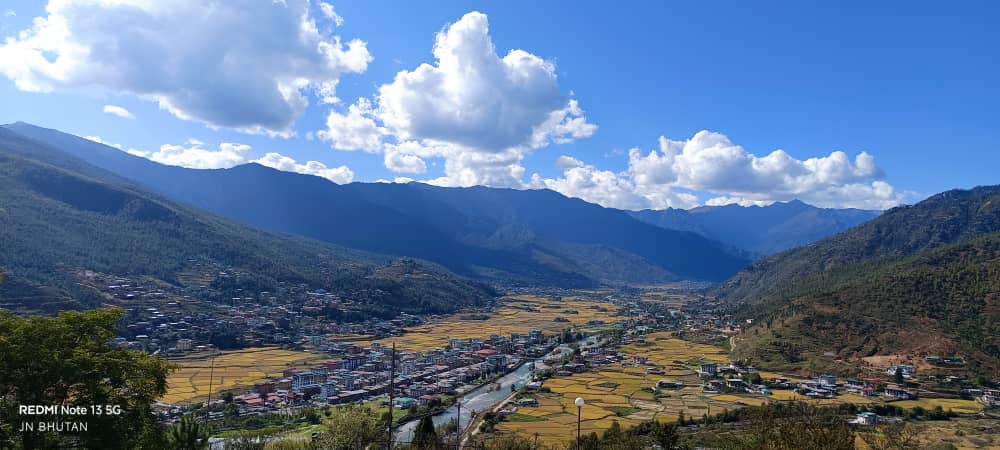
Start for Paro sightseeing, visit the picturesque town in Bhutan. En-route visit,
National Museum of Bhutan: Situated right above RinpungDzong in Paro, the National Museum of Bhutan is a house that showcases Bhutan’s culture. Built-in 1968, the museum stands inside the ancient Ta-dzong building. The museum houses the collection of finest specimens of Bhutanese culture and art and its highlights arqe paintings and some bronze statues, which are simply masterpieces. The items are demonstrated in large galleries and you can get to know a lot about Bhutan’s art and culture from these objects.
RinpungDzong (Paro Dzong) – Built-in 1646 by ShabdrungNgawangNamgyal, the first spiritual and temporal ruler of Bhutan, the Dzong houses the monastic body of Paro, the office of the Dzongda (district administrative head) and Thrimpon (judge) of Paro district. The approach to the Dzong is through a traditional covered bridge called NemiZam.
Nya MeyZam Bridge – “The Bridge with No Fish “ is the bridge that connects Paro Town to Dzong. It is one of the finest specimens in Bhutan and locals believe if one sees a fish in the river, it is an ill omen. The earlier bridge which could be folded during the war was washed away by a flood in 1969.
Paro Airport View Point – This is the finest valley viewpoint to look after Paro Valley and Paro Airport. This viewpoint overlooks the Paro River along with all the Dzongs and Monastery.
Overnight in Paro.
Day 5: PARO TO CHELE-LA-PASS DAY TRIP / VISIT TAKTSANG MONASTERY (Tiger Nest)
From the beautiful valley, let’s move towards the Chela-Lqqa-Pass (3,998m). So, post breakfast let & proceeds towards the gateway to mini heaven aka the spectacular Chela – La- Pass, which is barely a few hours from the Paro town and is well known for being the highest motorable pass in Bhutan, that offers a panoramic view of Bhutan’s second-highest sacred peak, Mt. Jomolhari(7314m) and other snow-clad ranges on a clear day. The journey through the winding roads is very charming as the green valleys, chirping birds, snowy mountains, and the fantastic view on both sides are sure to keep everyone glued, and the breath-taking scenery keeps you going.
OR
As the sun rays touch the beautiful Paro valley, wake up in the middle of Mother Nature and relish the beautiful view of the river and mountains in a single frame. Enjoy the gala spread but make sure to add some protein to it, as climbing to the top of the Taktsang Monastery and back will require a good boost.
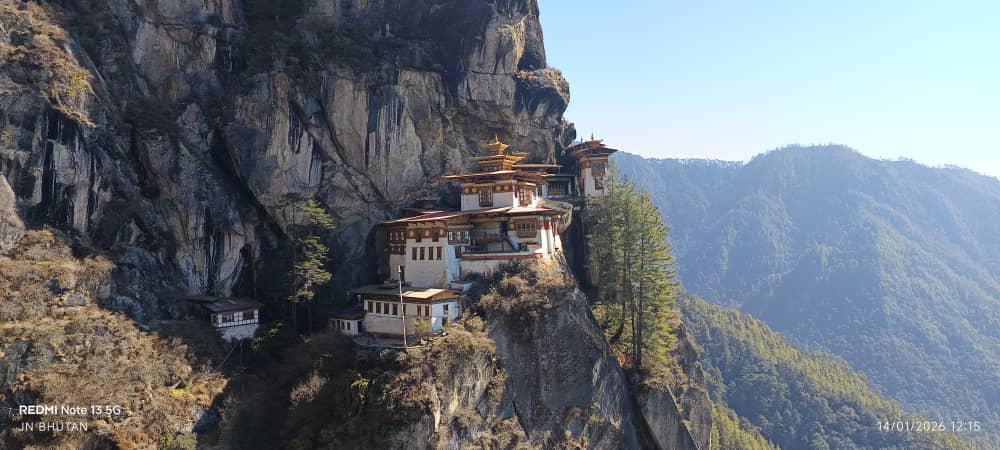
Taktsang Monastery: After covering 1200 meters on a fierce cliff, you will reach this sacred site known as the Tiger Nest. Once you climb to the top, take a deep breath of the fresh air and soothe the eyes and soul with the stunning view ofqq the scenic surroundings and the valley lying underneath—the Taktsang Monastery, established by Sain Guru Rinpoche in 747 CE. Construction of the complex was completed in 1694. After 3 hours of some adventurous trek, discover the Tiger Nest monastery, and if you wish, opt for a horse ride from the parking lot to reach the top. While trekking, witness the glorious view of the Paro town, with its lush green valleys, sparkling river, clear blue sky, and moving clouds, in-short, enjoy nature at its best. Traditional Hot Stone Bath (Direct Payment Basis): It is very nice to experience Bhutanese hot
stone baths. It is the perfect way to relax and wind down after a long day of sightseeing, and it is considered for numerous health benefits. It admitted that the local herbs all combine to produce medicinal benefits for joint pains, hypertension, stomach disorders and arthritis.
Overnight in Paro.
Day :6 Post breakfast, bid farewell to the Last Buddhist Kingdom and start towards Paro Airport with long-
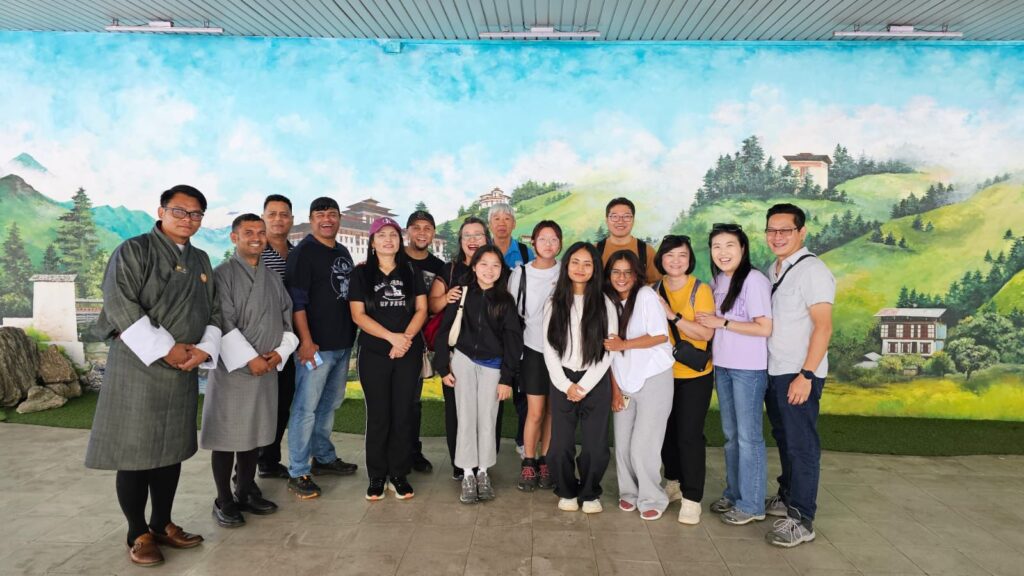
lasting sweet Bhutan Holiday memories……..
Inclusion
Breakfast Dinner and Bed, Guide, Car For All sightseeing and transfer from one place to another, Government Sustainable Development Fee all permit process and formalities .
Exclusion
Air or train fair ,Lunch, Monument fee for Museum, Dzongs And Temple, personal expenses like River Rafting, Hot Stone Bath, Spa and Tips for guide driver and hoteliers.
Note
- Carry passport or original voter id
- For child who is below 18 years if he or she don’t have passport carry Original birth Certificate.
- Carry personal medicine
- Walking shoes
- Long sleeve clothes
- Umbrella or rain coat in summer may june july august and September.
- Warm clothes in winter November December January and February.
- Carry Hard Currency for personal expenses and Shopping.